




Night Flow Analysis: How to Find Hidden Leaks in UK Water Networks (2026)
Night flow analysis is the most reliable method for quantifying hidden leakage across water networks and commercial estates. By measuring the minimum flow entering a district metered area (DMA) or building zone between 02:00 and 04:00, when legitimate demand is near zero, operators isolate the volume lost to leaks and prioritise repairs before losses compound. With Ofwat demanding a 17% leakage reduction across England and Wales by 2030, and escape-of-water claims costing UK insurers £1.8 million every day, continuous overnight flow monitoring with IoT sensors is now an operational necessity.
Key takeaways
- Night flow analysis measures water entering a zone between 02:00 and 04:00 to separate legitimate demand from hidden leakage.
- Ofwat requires a 17% leakage reduction (457.3 Ml/d) across England and Wales by 2030 under AMP8 targets.
- Escape-of-water claims account for over 25% of all UK domestic property insurance claims, according to the Association of British Insurers.
- The AQUAIOT Clamp-on Ultrasonic Flow Meter enables non-invasive, continuous overnight flow monitoring on live pipework from DN8 to DN100.
- Combining flow-based analysis with the Multifunction Water Leak Sensor and cloud dashboards catches leaks in minutes rather than months.
Contents
- What is night flow analysis and why does it matter for leak detection?
- How does minimum night flow measurement work in a DMA?
- Why are UK water companies under pressure to cut leakage by 2030?
- How can commercial estates use overnight flow monitoring to find hidden leaks?
- What equipment do you need for continuous flow monitoring?
- How do you choose the right monitoring system?
- The full AQUAIOT leak detection capability stack
- Frequently asked questions
What is night flow analysis and why does it matter for leak detection?
Night flow analysis is a leakage quantification method that measures the total flow entering a defined water zone during the period of minimum demand, typically between 02:00 and 04:00, and subtracts estimated legitimate night use to reveal the volume lost to leaks. The technique works because genuine consumption drops to near zero in most commercial, institutional, and residential zones overnight, making any persistent flow a strong indicator of hidden leakage in the pipework downstream of the meter.
The method originated in district metered area (DMA) management, where utilities partition networks into hydraulically bounded zones of 500 to 3,000 connections, each monitored by boundary flow meters. By comparing the minimum night flow (MNF) across DMAs, leakage managers rank zones by severity and deploy field teams where they recover the most water. The same principle scales down to building estates, campuses, and multi-site portfolios.
The urgency is greater than at any point in the past decade.
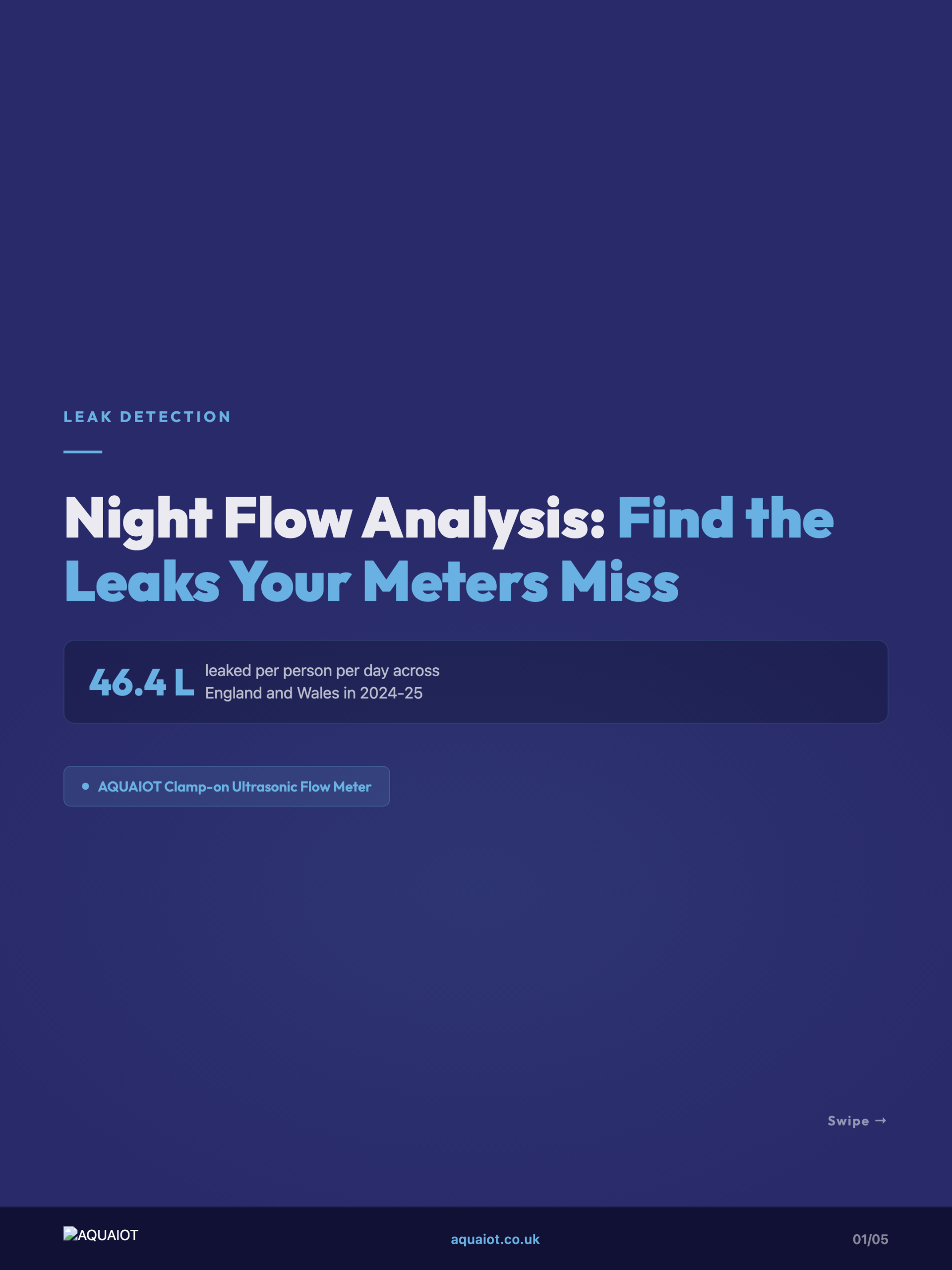
England and Wales leaked 46.4 litres of water per person per day in 2024-25, according to Ofwat’s leakage dataset.
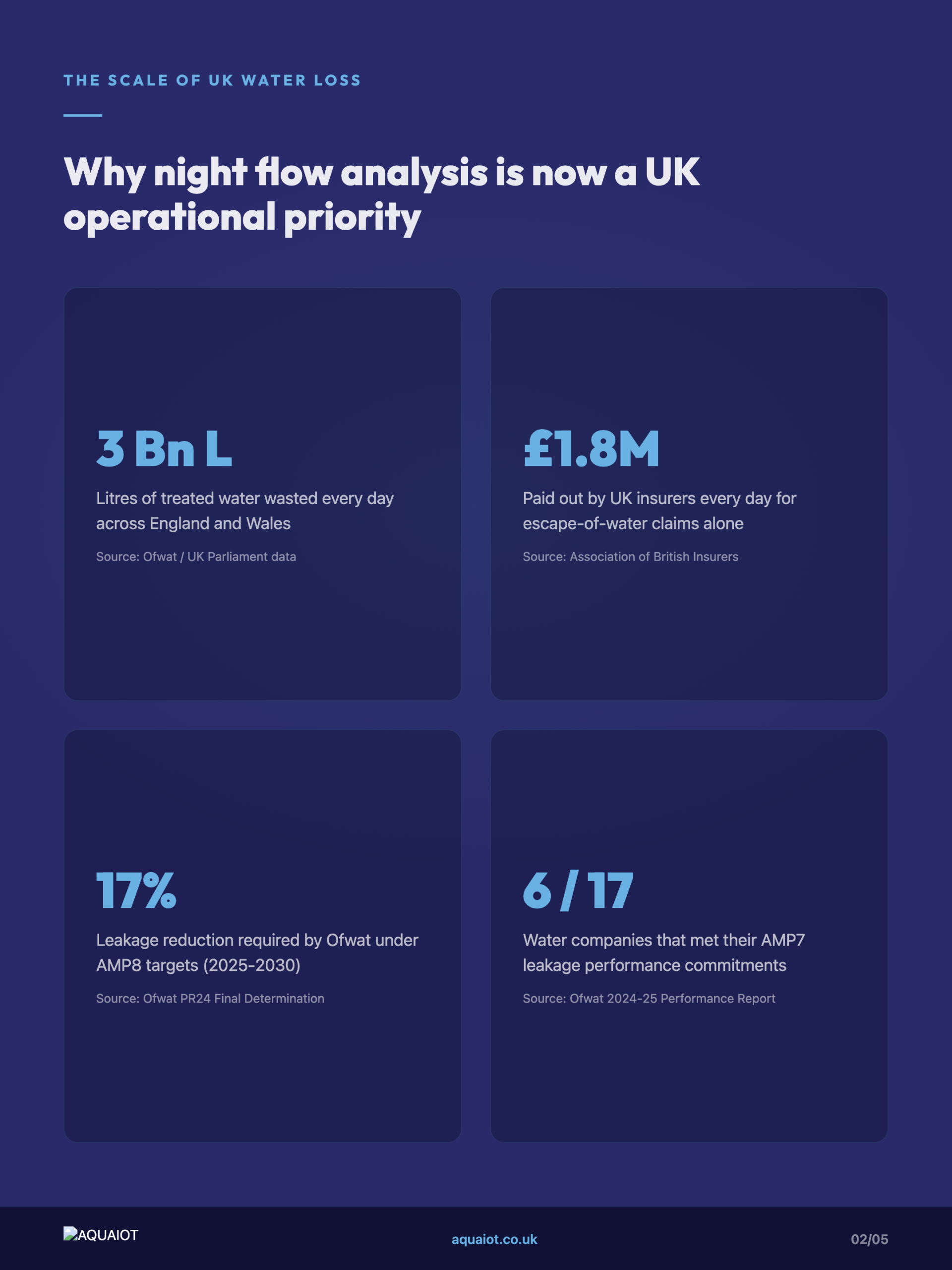
That translates to roughly 3 billion litres wasted every day across the country, equivalent to the 2,869 megalitres per day Ofwat reports for 2024-25. For organisations managing large estates, those losses translate directly into inflated water bills, undetected property damage, and compliance exposure.
How does minimum night flow measurement work in a DMA?
Minimum night flow measurement works by recording the lowest sustained inflow to a hydraulically isolated zone during the overnight low-demand window, then decomposing that flow into legitimate night use and background leakage. It relies on boundary meters logging at high resolution (every 15 minutes or better), closed valves ensuring all water passes through a metered point, and a calculation framework that estimates what proportion of the overnight flow is genuine consumption.
In a traditional DMA, the utility closes boundary valves so that one or two inlet meters capture all supply. Between 02:00 and 04:00, the reading drops to its minimum. Operators subtract estimated legitimate night use, derived from per-property allowances and known night-shift processes, to isolate the leakage component. A rising MNF trend over days or weeks signals new or worsening leaks. A sudden spike suggests a burst.
Modern IoT-enabled night flow analysis automates this cycle. AQUAIOT’s Clamp-on Ultrasonic Flow Meter, which fits onto live pipework from DN8 to DN100 without cutting or shutdowns, streams continuous data to the cloud. The AQUAIOT dashboard applies anomaly detection to flag overnight deviations the moment they exceed a configurable threshold, eliminating the delay between data collection and response. Where a manual DMA survey might run quarterly, continuous monitoring catches deviations within hours.
Why are UK water companies under pressure to cut leakage by 2030?
UK water companies face the most demanding leakage reduction programme in the industry’s history because Ofwat’s PR24 price review set a binding target of
457.3 Ml/d of further leakage reduction between 2024-25 and 2029-30, a 17% cut over five years
. That volume equals the daily household consumption of Birmingham, Liverpool, Sheffield, and Manchester combined, according to Ofwat’s own analysis.
The pressure is compounded by past under-delivery. During AMP7 (2020-2025), the sector committed to a 16% leakage reduction but delivered only 9%.
Only six of seventeen water companies met their individual performance commitments, according to Ofwat’s 2024-25 performance report.
Companies missing AMP8 targets face financial penalties through Ofwat’s outcome delivery incentive (ODI) mechanism, making leakage detection a balance-sheet issue.
To support the step change, Ofwat approved over £700 million in cost allowances for pressure management, leak repairs, and mains replacement, plus £1.7 billion for 10.4 million smart meters by 2030. Minimum night flow measurement sits at the core of this strategy: smart meters generate the granular consumption data needed to refine legitimate night use estimates, and continuous monitoring at DMA boundaries converts that data into actionable leakage intelligence. The longer-term target is a 50% reduction from the 2017-18 baseline by 2050.
How can commercial estates use overnight flow monitoring to find hidden leaks?
Commercial estates apply overnight flow monitoring by installing non-invasive meters on incoming mains and key branches, then reviewing profiles to identify zones where water moves when buildings should draw nothing. A building showing persistent flow between 02:00 and 05:00 almost certainly has a leak, whether a weeping valve, degraded fitting, slow cistern overflow, or underground service pipe fracture.
The financial case is clear.
UK insurers pay £1.8 million every day for escape-of-water claims, and escape of water accounts for over 25% of all domestic property insurance claims, according to the Association of British Insurers.
Commercial claims follow the same pattern. A single undetected leak in a plant room or underground main can run for months before surfacing as visible damage, by which point the water bill overpayment alone may reach thousands of pounds before factoring in remediation and increased premiums.
The AQUAIOT Clamp-on Ultrasonic Flow Meter clamps onto live pipework without cutting, draining, or disrupting operations, making it practical to retrofit across occupied buildings and service risers. The meter streams data to the AQUAIOT cloud dashboard, where overnight baselines are established automatically and deviations trigger alerts via email, SMS, or app notification. For multi-building portfolios, comparing each building’s overnight signature enables zone-by-zone prioritisation, the same approach utilities use across DMAs applied at building level. Read more in our guide to water leak detection for commercial buildings.
What equipment do you need for continuous flow monitoring?
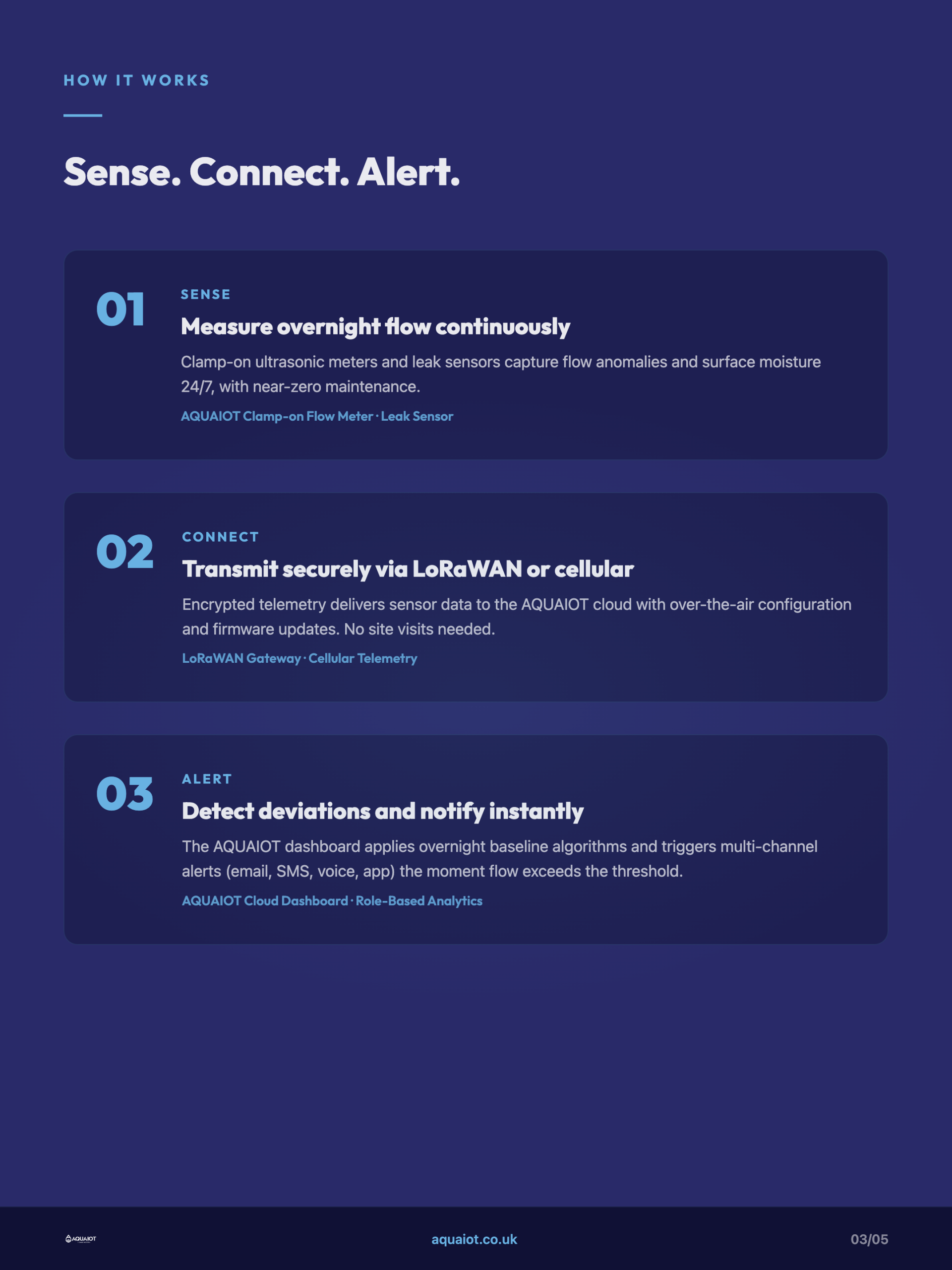
Continuous overnight monitoring requires three layers: flow sensing hardware on the pipework, a connectivity layer transmitting data to the cloud, and an analytics platform applying baseline logic and triggering alerts when flow deviates from normal patterns.
Flow sensing. The most practical retrofit option is a clamp-on ultrasonic flow meter measuring velocity through the pipe wall without modification. AQUAIOT’s Clamp-on Ultrasonic Flow Meter covers DN8 to DN100 and installs in minutes. For surface and contact-point leaks inside buildings, the Multifunction Water Leak Sensor complements flow monitoring with a leak sensing membrane that triggers on water contact, using LoRaWAN Class A radio with up to 10 years of battery life.
Connectivity. Data reaches the cloud via secure cellular or LoRaWAN telemetry with encrypted payloads and over-the-air firmware updates. For estates with BMS, RS485/Modbus and API integration feed data directly into SCADA, AIMS, or CAFM platforms.
Analytics and alerting. The AQUAIOT cloud dashboard consolidates data from all monitored points, applies overnight baseline algorithms, and generates multi-channel alerts when the minimum night flow exceeds a threshold. Role-based dashboards serve site managers through to portfolio directors. Exportable records and audit trails support compliance reporting.
How do you choose the right monitoring system?
Choosing the right system depends on matching hardware, connectivity, and analytics to your site requirements. Follow these five steps.
- Map your monitoring zones. Identify incoming mains, distribution branches, and risers where meters will provide the clearest overnight baseline. Each point should represent a hydraulically meaningful boundary, similar to the DMA principle. Prioritise high-risk zones first.
- Assess pipe sizes and access. Check diameters across target zones. Clamp-on meters such as the AQUAIOT Clamp-on Ultrasonic Flow Meter cover DN8 to DN100. Confirm installation points are accessible without scaffolding or confined-space entry.
- Evaluate connectivity. Determine whether cellular or LoRaWAN suits each site. A single LoRaWAN gateway can serve dozens of sensors across a multi-building estate. Ensure the system supports encrypted payloads and remote updates.
- Confirm integration requirements. The platform must support automatic baseline calculation, configurable thresholds, and multi-channel alerts. Confirm RS485/Modbus or API integration if you use SCADA, BMS, or CAFM. Exportable audit trails matter for insurance and regulatory reporting.
- Request a site survey and pilot. AQUAIOT offers end-to-end engineering support from survey through installation, dashboard configuration, and training. Start with a pilot zone, validate overnight baseline accuracy, then scale across the estate.
The full AQUAIOT leak detection capability stack
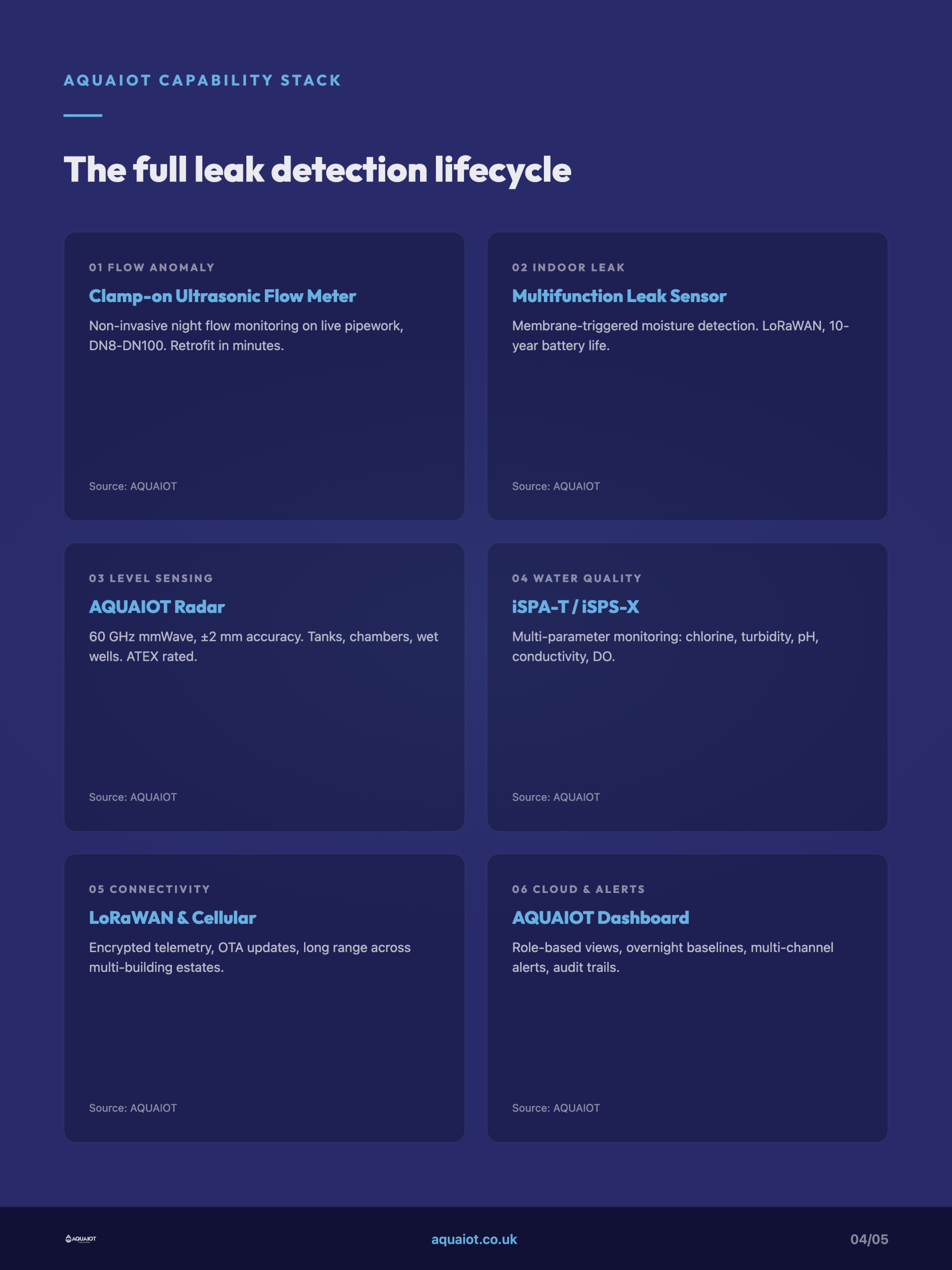
Overnight flow monitoring is one layer in a comprehensive water loss strategy. AQUAIOT provides the full stack from flow sensing through surface detection, level monitoring, water quality verification, and cloud alerting.
01 Flow anomaly detection
The AQUAIOT Clamp-on Ultrasonic Flow Meter delivers continuous, non-invasive monitoring across DN8 to DN100. It supports MNF-based leakage quantification, zone-by-zone profiling, and real-time burst detection on live pipework. Retrofit-friendly across occupied estates.
02 Indoor and surface leak sensing
The Multifunction Water Leak Sensor uses a leak sensing membrane that triggers on water contact, covering moisture detection, freeze protection, and flood alerting. LoRaWAN Class A radio delivers long range and high penetration with up to 10 years of battery life.
03 Tank, chamber, and asset level monitoring
The AQUAIOT Radar uses 60 GHz mmWave sensing accurate to plus or minus 2 mm for non-contact level monitoring in tanks, chambers, and wet wells. Falling levels without scheduled draw-off indicate leakage. ATEX variants available.
04 Water quality verification
Leaks can introduce contaminants. The iSPA-T and iSPS-X provide continuous multi-parameter monitoring (chlorine, turbidity, pH, conductivity, dissolved oxygen) to confirm supply safety after a leak event or repair.
05 Cloud dashboards, alerts, and integration
All sensors feed into a unified cloud platform with role-based dashboards, trendlines, and multi-channel alerts. Integration via RS485/Modbus and APIs connects to SCADA, AIMS, CAFM, and BMS. Exportable records provide audit-ready compliance trails. Learn more about AQUAIOT’s full leak detection service.
From our sister company: Indiott compares gateways for LoRaWAN meters and sensors with UK prices.
Frequently asked questions
What time window does night flow analysis use?
Night flow analysis typically measures flow between 02:00 and 04:00, when legitimate demand drops to its lowest point. This two-hour window minimises the influence of genuine consumption and isolates background leakage. Some operators extend to 01:00-05:00 for greater confidence, but the 02:00-04:00 core remains the industry standard for DMA leakage quantification in the UK.
Can overnight flow monitoring work on a single building?
Overnight flow monitoring works on any hydraulically bounded zone with a metered inlet, including a single building. Installing a clamp-on ultrasonic flow meter on the incoming main establishes a baseline, and alerts fire whenever the minimum night flow exceeds the expected level. This is the same principle utilities apply to DMAs, scaled to building level.
How does overnight flow monitoring differ from acoustic leak detection?
Overnight flow monitoring quantifies the total volume of leakage across a zone, while acoustic detection pinpoints the location of individual leaks using sound. The two are complementary: flow-based analysis identifies which zones lose the most water and prioritises where to deploy acoustic teams, making the combined approach more cost-effective than either method alone.
What leakage reduction targets apply under AMP8?
Under AMP8 (2025-2030), Ofwat set a target of 457.3 Ml/d of further leakage reduction, a 17% cut from 2024-25 levels. Companies missing targets face financial penalties through the outcome delivery incentive mechanism. The longer-term commitment is a 50% reduction from the 2017-18 baseline by 2050.
Does the AQUAIOT Clamp-on Flow Meter require pipe cutting?
The AQUAIOT Clamp-on Ultrasonic Flow Meter requires no pipe cutting, shutdowns, or drainage. It clamps onto the outside of live pipework covering DN8 to DN100, measuring flow velocity through the pipe wall using ultrasonic transit-time technology. This makes it practical for retrofit installation across occupied buildings and service risers.
Last updated: 25 May 2026
By GP, Digital and IoT lead at AQUAIOT