



Emergency Showers and Eyewash Stations: How Often HSE Says to Flush Them for Legionella
TL;DR: Emergency showers and eyewash stations are used rarely, so the water in their pipework stands for weeks. HSE lists them as other risk systems for Legionella, and HSG274 Part 3 says to flush through and purge to drain, drawing off three to five times the volume of water in the stagnant zone, as the risk assessment indicates but at least every six months. Work out the stagnant volume for each unit, flush to drain without using the equipment as intended, record the date, volume and temperature, and keep the supply cool. A missed flush is the usual failure.
Last updated: 22 October 2026
On this page
Key takeaways
- HSE names emergency showers and eye wash sprays among the systems, other than cooling towers and hot and cold water systems, that can be a source of Legionella growth.
- Appendix 6 of HSG274 gives the flushing rule: flush through and purge to drain, ensuring three to five times the volume of water in the stagnant zone is drawn off, as indicated by the risk assessment but at least every six months.
- These units are used rarely, so water stands in the pipe between the active supply and the outlet. HSE says Legionella needs water between 20 and 45 degrees, a way of making breathable droplets, stored or recirculated water and a food source such as scale, sludge or biofilm.
- HSG274 says many of these systems operate at or above ambient temperature, or are prone to thermal gain, and that all can generate aerosols.
- The dutyholder must carry out a risk assessment, maintain records of maintenance and monitoring results, and review the assessment regularly in case anything changes.
- Flushing for Legionella does not replace the function checks that the manufacturer and the equipment standard set for an emergency shower. It adds a water hygiene check to them.
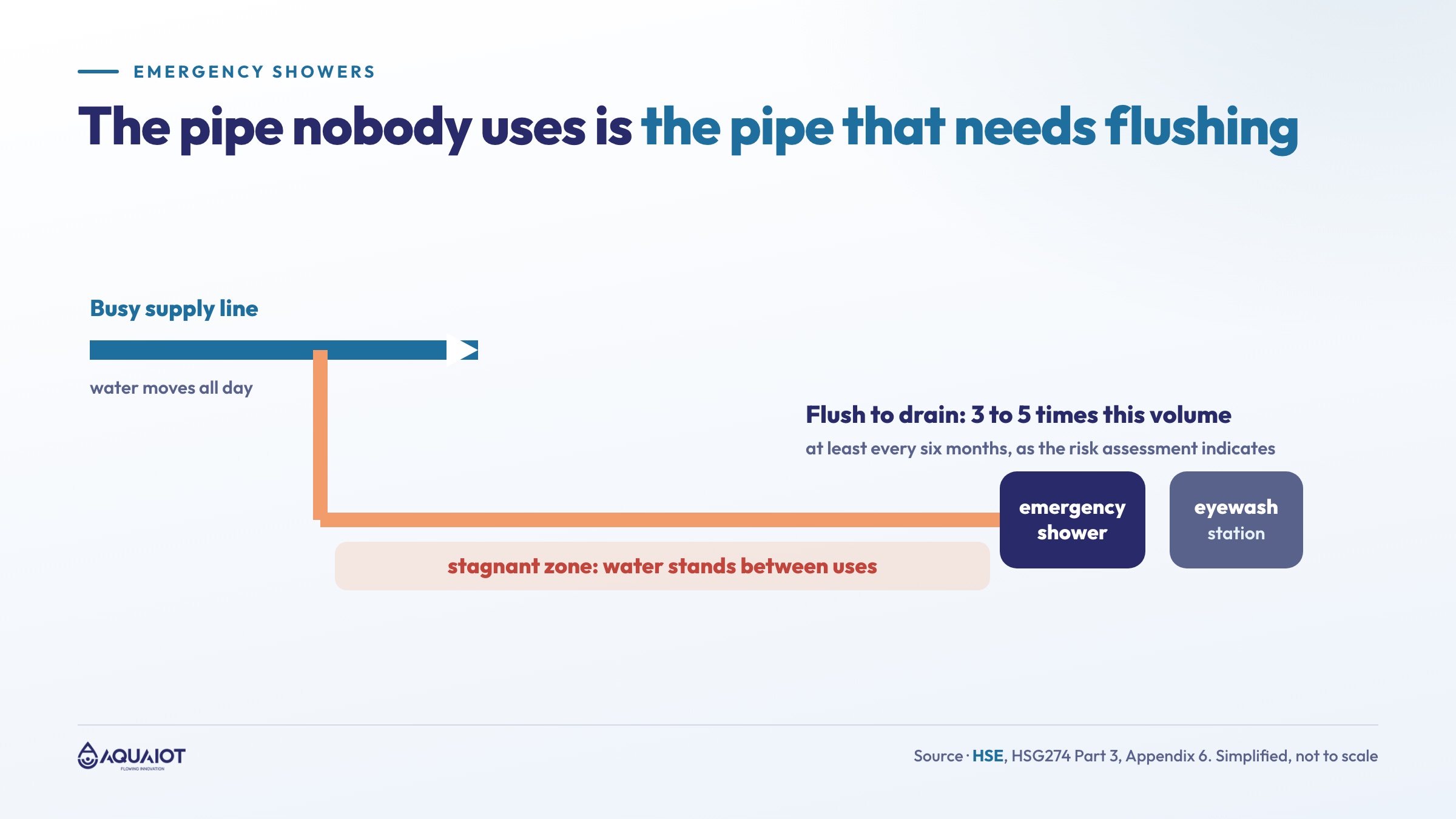
A chemical store has an emergency shower and an eyewash station at the door. They have been tested for function and nobody has needed them. The pipe that feeds them leaves a busy supply line and runs forty metres to the store, past a ceiling void that gets warm in summer. The water in it is as old as the last test.
Emergency showers and eyewash stations are safety equipment, and they are also a water system. This guide explains why HSE treats them as a Legionella risk, what HSG274 Part 3 says about flushing, how to work out the volume to flush, what to record, and how temperature data and flush records together show that the routine is being done. It is not legal advice. Your risk assessment decides your own frequency, and the manufacturer’s instructions and the equipment standard still apply.
Why are emergency showers a Legionella risk?
Emergency showers are a risk because they are used rarely and they make a spray. Water sits in the pipe for weeks, can warm towards the room, and then comes out as droplets over a person’s face and body when the unit is used. That combination matches the conditions HSE gives for a foreseeable Legionella risk.
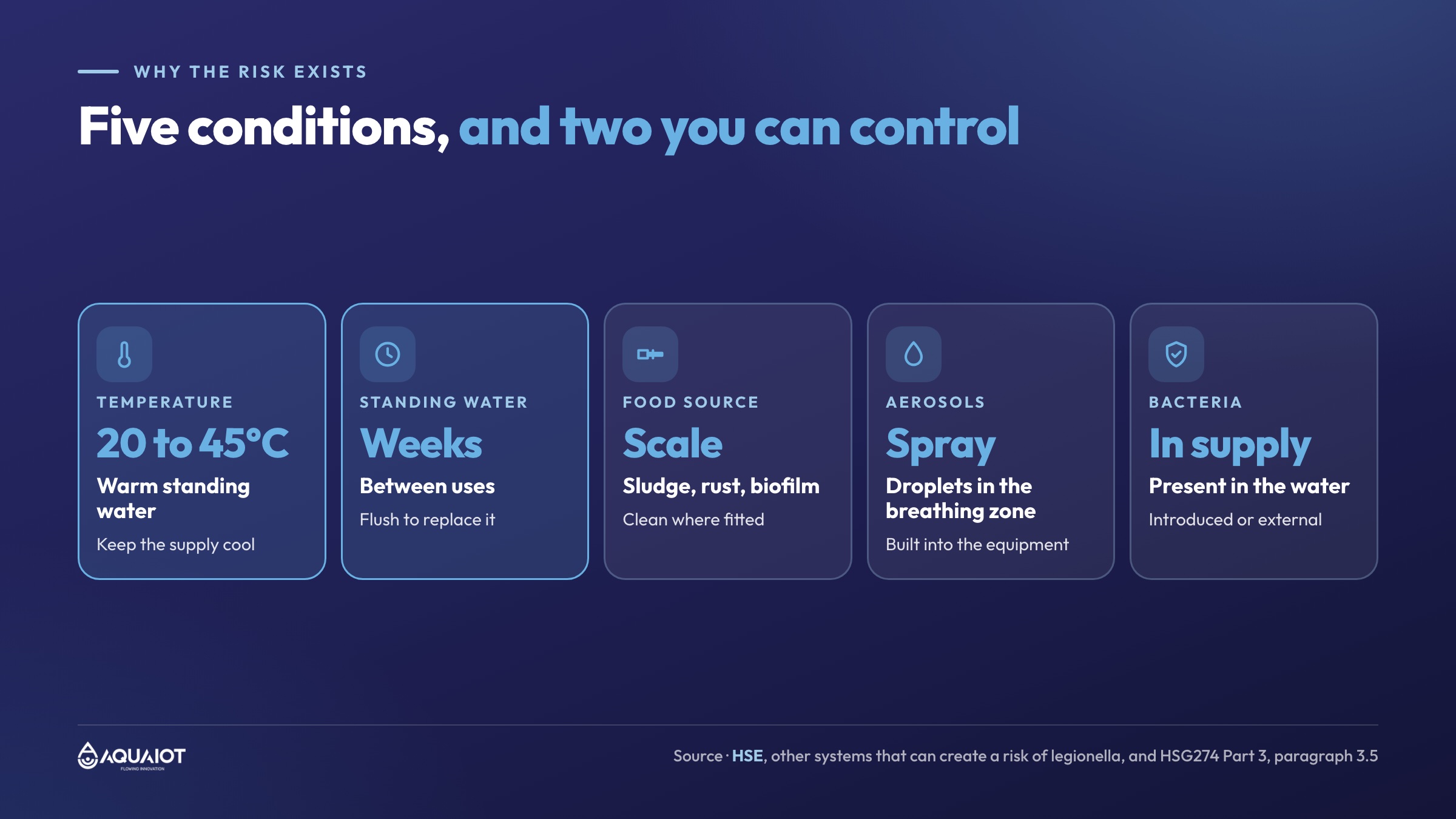
HSE’s page on other systems that can create a risk of Legionella lists emergency showers, eye wash sprays, humidifiers, air washers, indoor ornamental fountains and aqueous tunnel washers. It sets out the factors that make any water system a reasonably foreseeable risk: Legionella present in the system water, water temperature that may be between 20 and 45 degrees, a means of creating or spreading breathable droplets, stored or recirculated water, and a likely source of food for the organism, such as sludge, rust, scale, organic matter or biofilm.
HSG274 Part 3 adds a point that suits these units. Many of these systems operate at or above ambient temperature, or are prone to thermal gain during operation, and all have the capacity to generate water droplets, which are aerosols, during operation. An emergency shower is built to flood a person with water at once, which is the opposite of a gentle flow.
The risk is not that the equipment is faulty. It is that safety equipment is, by design, almost never used, so the usual driver of water quality, flow, does not happen unless someone makes it happen.
What does HSE say about flushing emergency showers?
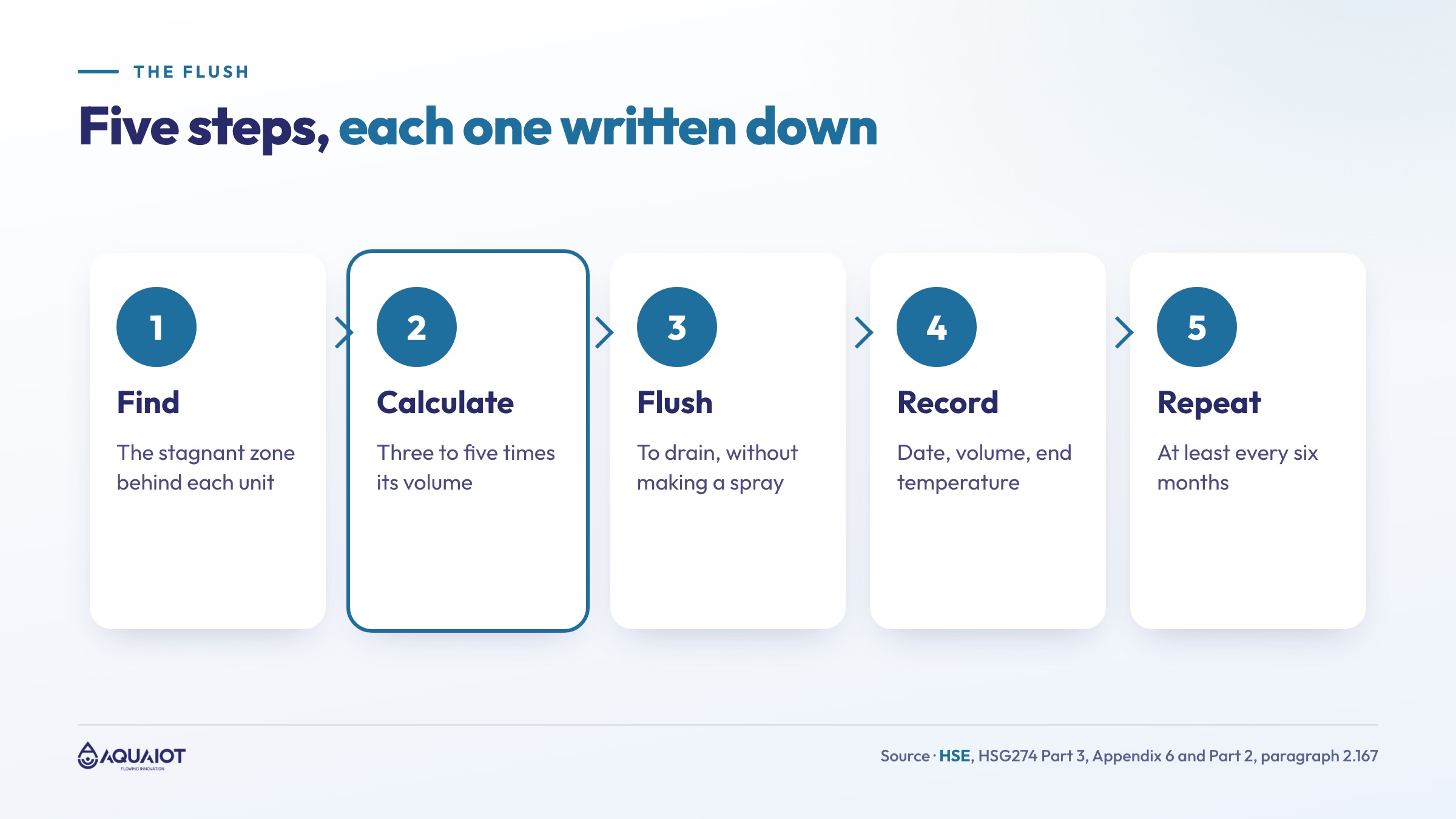
HSG274 Part 3, Appendix 6, gives one line for emergency showers, eyebaths and face wash fountains: flush through and purge to drain, ensuring three to five times the volume of water in the stagnant zone is drawn off. The frequency is as indicated by the risk assessment, but at least every six months.
Two phrases deserve attention. Purge to drain means the water goes to a drain, not over a person and not into a bucket that is then used. And the stagnant zone is the length of pipework between the point where water is regularly moving, such as a busy supply line, and the outlet of the unit. Drawing off three to five times that volume replaces the standing water with fresh supply.
The same table includes a further task for units that have a water storage tank. It asks for the tank to be inspected monthly, and for shower heads, nozzles, roses, strainers and tanks where fitted to be cleaned and disinfected quarterly, or more frequently as indicated by the risk assessment. Check the exact table in the guidance for your type of system.
Six months is a floor, not a target. Where the unit is hard to flush, serves a high risk population or sits on a warm run of pipe, the risk assessment may call for monthly or weekly flushing. HSE’s wider guidance on infrequently used outlets in hot and cold water systems uses weekly flushing for anything unused for seven days or more, and twice weekly for susceptible patients where the risk assessment says so.
Design helps too. HSG274 Part 2 says low use outlets should be installed upstream of frequently used outlets to maintain frequent flow, and gives the example of an emergency shower installed upstream of a frequently used toilet. If a refurbishment lets you choose where the shower branches off, put it on a line that already flows.
How much water do emergency showers need flushed?
Work out the volume of the pipe in the stagnant zone, then multiply by three to five. The volume depends on the pipe length and internal diameter. Measure or take the length from the drawings, find the internal diameter from the pipe specification, and add any tanks, filters or flexible hoses in the run.
Here is a worked example with assumed figures, which you should replace with your own. Take a copper pipe with an internal diameter of about 13 millimetres. Its cross-section is about 133 square millimetres, so each metre holds about 0.13 litres. A 20 metre run holds about 2.7 litres. Three to five times that volume is roughly 8 to 13 litres to be drawn off to drain.
| Stagnant run | Internal volume at about 0.13 litres a metre | Flush three times | Flush five times |
|---|---|---|---|
| 10 m | About 1.3 litres | About 4 litres | About 7 litres |
| 20 m | About 2.7 litres | About 8 litres | About 13 litres |
| 40 m | About 5.3 litres | About 16 litres | About 27 litres |
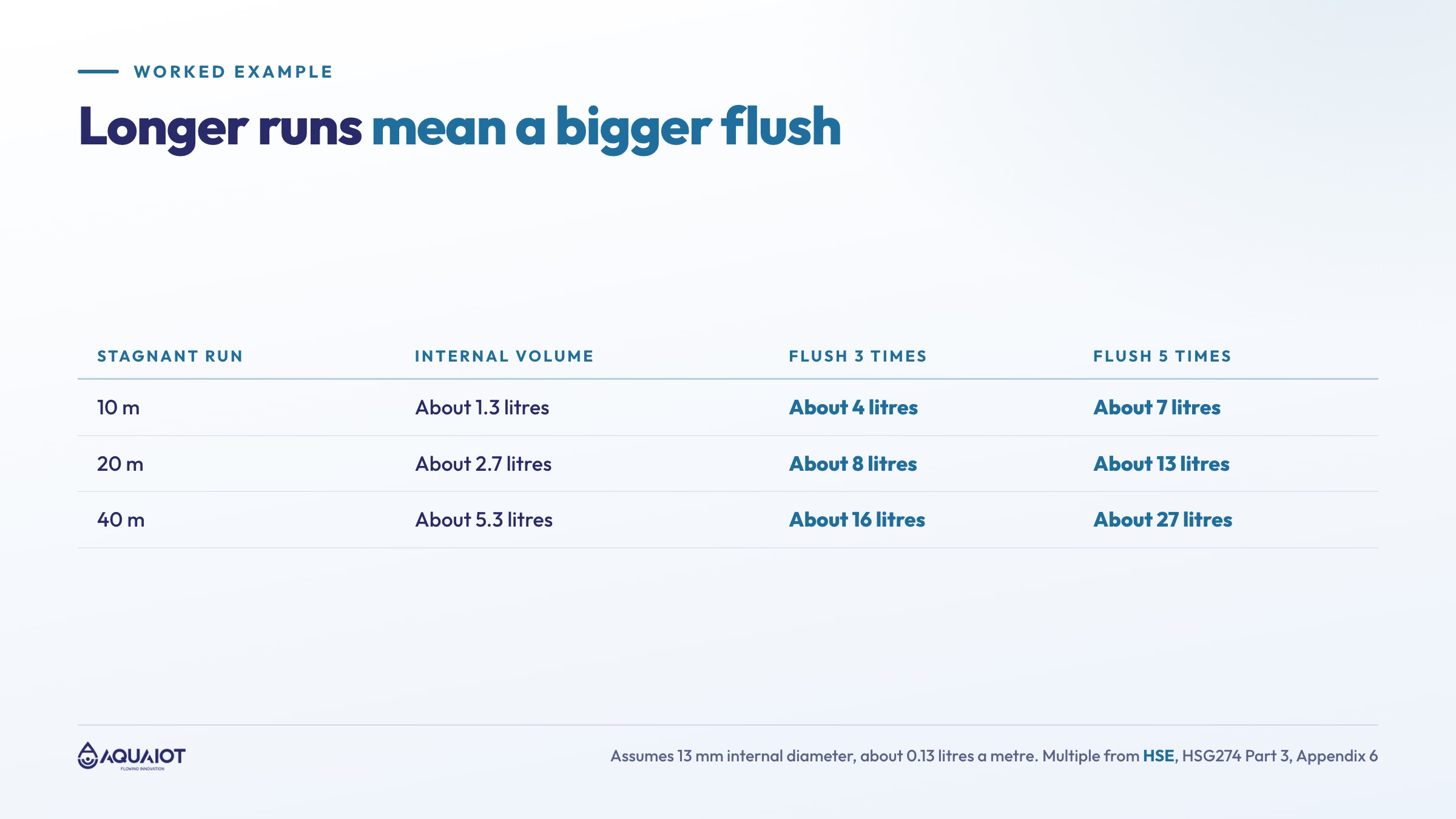
The figures are only a guide, because fittings, valves and any flexible hose add volume, and a larger bore multiplies it. Where the run is long, flush for longer, and use the temperature as a second check. HSE’s general instruction for outlets is to flush until the temperature at the outlet stabilises and is comparable to the supply water, so measure the temperature as well as the volume.
Collect the flush water safely. Direct it to a drain so that it does not splash, and avoid making a spray at head height while you work. HSG274 Part 2 makes the same point about lapses in flushing, where stagnant and potentially contaminated water in a shower or tap and its dead leg should be purged to drain without discharge of aerosols before use.
What conditions let Legionella grow in emergency showers?
HSE gives five conditions, and emergency showers can meet most of them at once. Legionella present in the supply, temperatures between 20 and 45 degrees, stored or standing water, a food source in scale or biofilm, and a way of making droplets. Remove any one reliably and the risk falls.
Temperature is the easiest to watch. A cold supply that stands in a warm void drifts upward. HSE’s guidance for the wider water system is to keep cold water below 20 degrees, and a branch to an emergency shower can warm above that between flushes, particularly in summer or where it runs near heating pipes. A temperature sensor on the supply close to the unit shows how fast that happens.
Nutrients come from scale, sludge and biofilm. The longer water stands, the more the pipe wall and any fittings build a film. Regular flushing and, where fitted, cleaning of shower heads and nozzles interrupt that build-up.
Aerosols are the one factor you cannot remove, because producing a spray is the point of the equipment. That is why the other factors carry the weight.
What records should you keep?
Keep a flush log and the temperature data. HSG274 Part 3 says there is a duty to maintain records of all maintenance carried out, together with monitoring results, and that the risk assessment should be reviewed regularly in case anything changes in the water system or its use.
A useful flush record has the unit identifier and location, the date and time, who flushed it, the volume drawn off or the time run, the temperature at the end of the flush, and any observations such as discoloured water or a damaged nozzle. A single sheet per site, filed with the risk assessment, is enough.
Review the risk assessment when something changes. A new run of pipe, a relocated unit, a closed department or a change in who uses the area all alter the risk. A unit that was flushed weekly because the area was busy may now be used by nobody, which makes the flushing more important.
For the wider duty, our guides to Legionella temperature monitoring and the HSG274 monitoring requirements explain what monitoring and records the guidance expects across a building.
How does monitoring help with emergency showers?
Monitoring helps by showing two things between visits: that the supply to the unit stays cool, and that the flush really happened. A wireless sensor on the supply pipe records temperature continuously, and a missed scheduled flush shows up as a gap in the record and an alert.
AQUAIOT’s automated Legionella monitoring places wireless temperature sensors at tanks, calorifiers, loops and sentinel outlets, logs every reading to the cloud over cellular or LoRaWAN telemetry, and alerts by SMS, email or app when cold water exceeds 20 degrees or hot water falls below 50 degrees at the point of use. It also shows when a scheduled flush has been missed. For an emergency shower the useful point is the supply pipe a short way before the unit, because that is where standing water warms and where a flush shows up as a change in temperature.
Our page on Legionella flushing monitoring explains how flush logging works, and our guide to dead leg monitoring covers other branches that stand unused. The same logic applies to showers in changing rooms, and our guide to shower heads and Legionella covers their quarterly cleaning.
Monitoring does not replace the flush. A sensor cannot draw off the stagnant water. It shows that the controls are being delivered and that the water around them is in range.
What mistakes do sites make with emergency showers?
The common mistakes with emergency showers are testing the function but not flushing to drain, flushing by volume with no temperature check, never working out the stagnant volume, forgetting eyewash stations on the same run, leaving the flush to one person with no cover and keeping no record. Each is easy to fix.
- Function test only. Running the unit for a few seconds proves it works and may not clear the pipe behind it.
- No stagnant volume. Without the volume, nobody knows whether three to five times has been reached.
- Volume without temperature. HSE says to flush until the outlet temperature stabilises and is comparable to the supply.
- Eyewash stations forgotten. HSG274 groups emergency showers, eyebaths and face wash fountains together.
- One person, no cover. A flush that depends on one holiday-prone person lapses.
- No record. A flush that is not logged cannot be shown to anyone.
Frequently asked questions
How often should emergency showers be flushed for Legionella?
HSG274 Part 3 says as indicated by the risk assessment, but at least every six months. Flush through and purge to drain, drawing off three to five times the volume of water in the stagnant zone. Your risk assessment may set a shorter interval.
What is the stagnant zone?
It is the pipework between the point where water flows regularly and the outlet of the emergency shower or eyewash station. Water in it stands between uses, so flushing aims to replace it. Calculate its volume from the pipe length and internal diameter, and add any tank, filter or hose.
Do eyewash stations need flushing too?
Yes. HSG274 Part 3 groups emergency showers, eyebaths and face wash fountains in the same row of its table, with the same flushing instruction and frequency.
Is flushing enough to control Legionella in an emergency shower?
It is the main control for standing water, but the risk assessment may add others, such as keeping the supply cool, cleaning shower heads and nozzles quarterly where fitted, and inspecting any storage tank monthly. HSG274 also asks for records and regular review of the assessment.
Does the Legionella flush replace function checks?
No. Manufacturers and equipment standards set their own function checks for emergency showers. The Legionella flush is an additional water hygiene task, and the two can be done together.
Can temperature monitoring show a missed flush?
Yes. A sensor on the supply pipe records temperature continuously, so a unit that has not been flushed shows a branch drifting toward room temperature, and a scheduled flush that does not happen can raise an alert.
Where to start
List every emergency shower, eyewash station and face wash fountain on site, with its location, the length and size of the pipe behind it, the date of the last flush and who owns the task. Work out the stagnant volume for each, and mark the ones on warm or long runs. If you want the supplies to those units watched continuously, contact AQUAIOT with the number of units and buildings, and we will suggest where temperature sensors should go.
For the guidance quoted here, read HSE’s Legionnaires disease technical guidance, HSG274 Part 3 and its page on other systems that can create a risk of legionella.