



Shower Heads and Legionella: How Often HSE Says to Clean and Descale Them
TL;DR: Shower heads matter for Legionella because they turn water into a spray people can breathe in. HSE’s HSG274 Part 2 says to dismantle, clean and descale removable parts, heads, inserts and hoses quarterly, or more often where fouling or risk factors such as high risk patients call for it. Showers not used for seven days or more belong on the flushing regime, and a showerhead that has stood unused should be purged to drain without making a spray before anyone uses it. Record each clean and each flush, and keep the hot and cold feeds in range.
Last updated: 22 October 2026
On this page
Key takeaways
- Showers and spray taps are routine items in HSE’s maintenance table. HSG274 Part 2 says to dismantle, clean and descale removable parts, heads, inserts and hoses where fitted, quarterly or as indicated by the rate of fouling or other risk factors, such as areas with high risk patients.
- Shower heads matter because they make a fine spray. Legionnaires’ disease comes from breathing in droplets that contain the bacteria, so an outlet that sprays is the way the bacteria reach the lungs.
- Scale gives the bacteria somewhere to live. HSE says deposits increase the surface area and therefore the potential for microbial colonisation, and can protect bacteria from biocides.
- Showers not used for seven days or more should be on the flushing regime. HSE says to flush until the temperature at the outlet stabilises and purge to drain, and to remove infrequently used showers where possible.
- After a lapse in flushing, the stagnant water inside the shower and its dead leg should be purged to drain without discharging aerosols before the shower is used.
- Low storage volume electric showers are not exempt. HSG274 says their spray nozzles should be inspected, cleaned and descaled as part of the showerhead and hose cleaning regime.
A leisure centre closes its changing rooms for a week over the school holidays. When the doors reopen, the showers run clear and warm, and the first swimmers of the morning stand under them. The shower heads were last taken apart in the spring.
This guide explains what HSE’s Legionnaires’ disease technical guidance, HSG274 Part 2, says about shower heads, hoses and spray taps: how often to dismantle, clean and descale them, how to treat showers that are rarely used, and what records and temperature data show that the routine is working. It is not legal advice. Your own Legionella risk assessment decides the frequencies, and a competent person should write it.
Why do shower heads matter for Legionella?
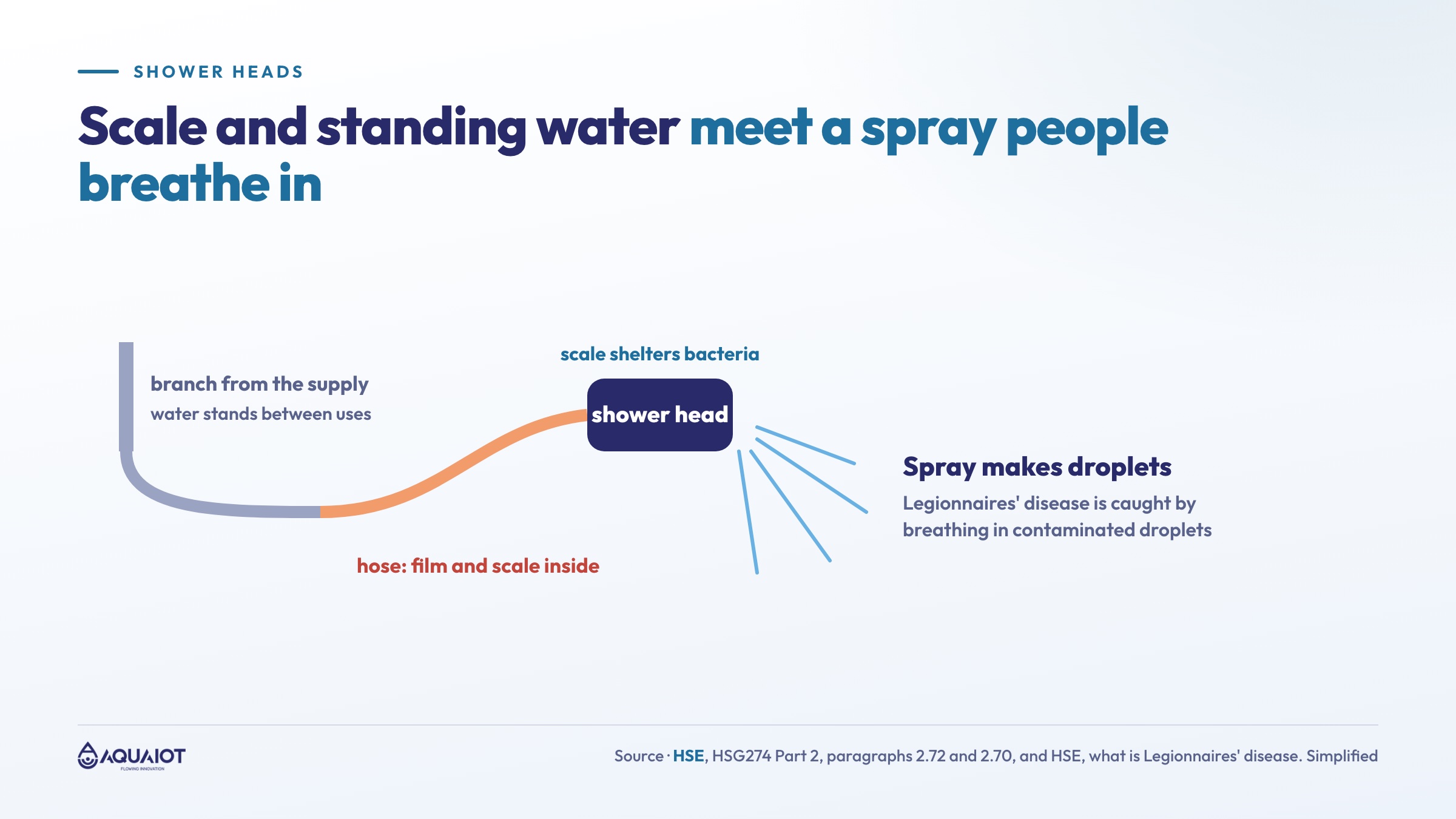
Shower heads matter because Legionnaires’ disease is caught by breathing in water droplets that contain Legionella bacteria, and a shower is built to create fine droplets. A contaminated head, hose or branch puts the bacteria into the air at head height, which is why HSE treats showers as a priority outlet.
HSE’s guidance links the risk to conditions in the system. It identifies peripheral parts of the system, such as remote outlets and dead legs, as higher risk, and it names showers in healthcare premises, supplied through tertiary loops, as areas for additional temperature monitoring. Its example of a low-risk system is one in a small building without people especially at risk, with enough daily water use to turn over the whole system, and where the only outlets are toilets and hand washbasins, with no showers.
That last detail shows how HSE thinks about showers: no showers is one of the conditions for its low-risk example. Keep them and the system needs a routine for cleaning, flushing and temperature control.
Scale is the second reason. In hard water areas, deposits increase the surface area and therefore the potential for microbial colonisation, which HSE calls biofilm formation, and can provide protection from the effects of biocides. A head full of limescale is more than an untidy fitting. It is a place where bacteria can sit protected.
How often should shower heads be cleaned?
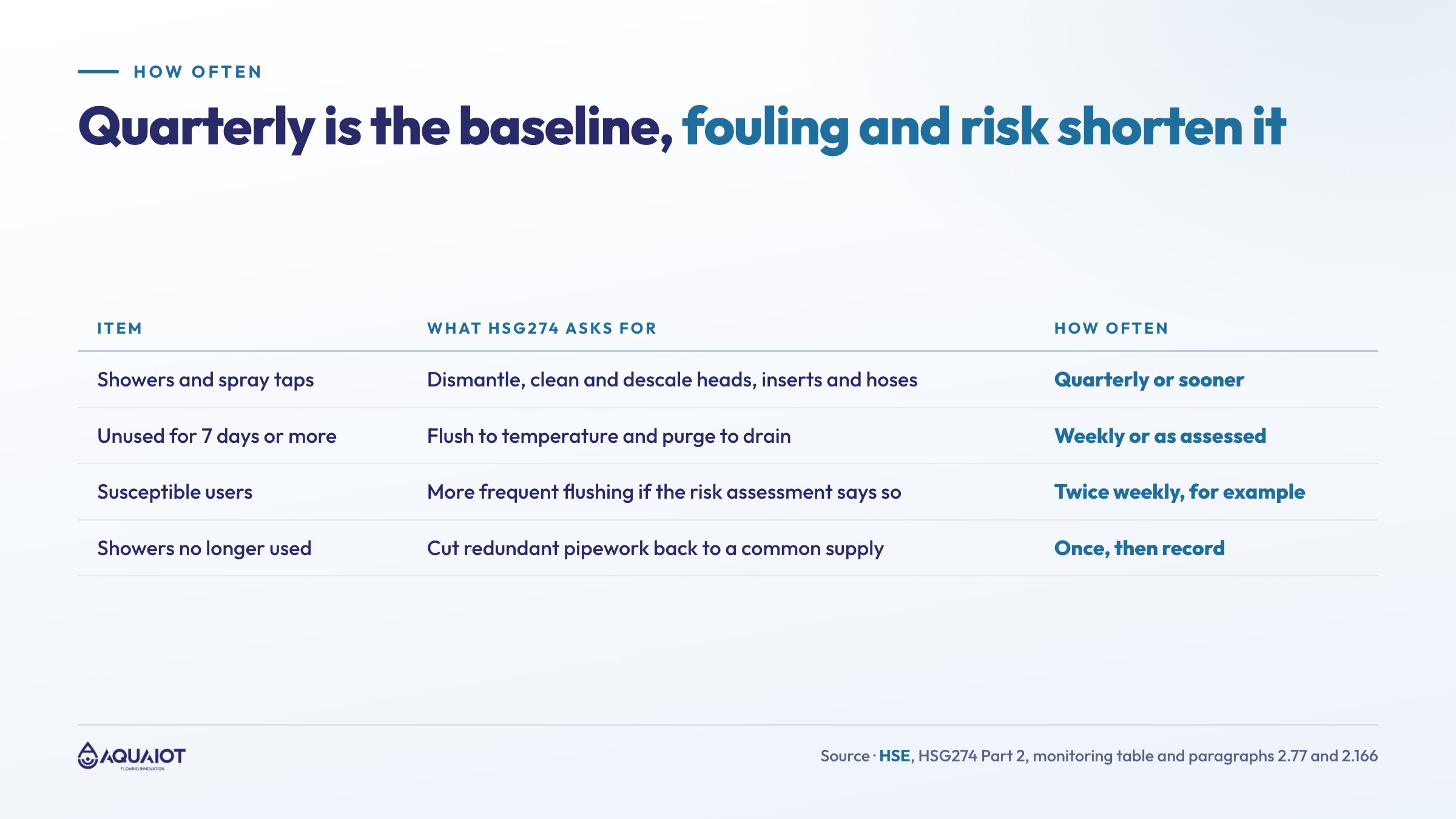
HSG274 Part 2 gives a quarterly baseline for shower heads: dismantle, clean and descale removable parts, heads, inserts and hoses where fitted, quarterly or as indicated by the rate of fouling or other risk factors, for example areas with high risk patients. The risk assessment sets the real frequency for your site.
The wording is deliberate. Quarterly is the default, and the phrase as indicated by the rate of fouling means you should look at what comes out of the head. If you find heavy scale or slime at three months, clean more often. If the water is soft and the heads are clean, the risk assessment may justify keeping to quarterly.
HSE’s table lists the action in one row for showers and spray taps. The action is to dismantle, clean and descale the removable parts, heads, inserts and hoses. The frequency is quarterly, with the reasons to go faster: the rate of fouling or other risk factors, such as areas with high risk patients.
| Item | Action in HSG274 Part 2 | Frequency |
|---|---|---|
| Showers and spray taps | Dismantle, clean and descale removable parts, heads, inserts and hoses where fitted | Quarterly, or as the rate of fouling or other risk factors indicate |
| Infrequently used showers and taps | Consider removing, and cut redundant pipework back to a common supply | Weekly flushing, or as the risk assessment indicates |
| Equipment unused for seven days or more | Include on the flushing regime | Weekly, until removed |
| Low storage volume heaters and electric showers | Inspect, clean and descale spray nozzles as part of the showerhead and hose regime | With the showerhead regime |
How do you clean shower heads properly?
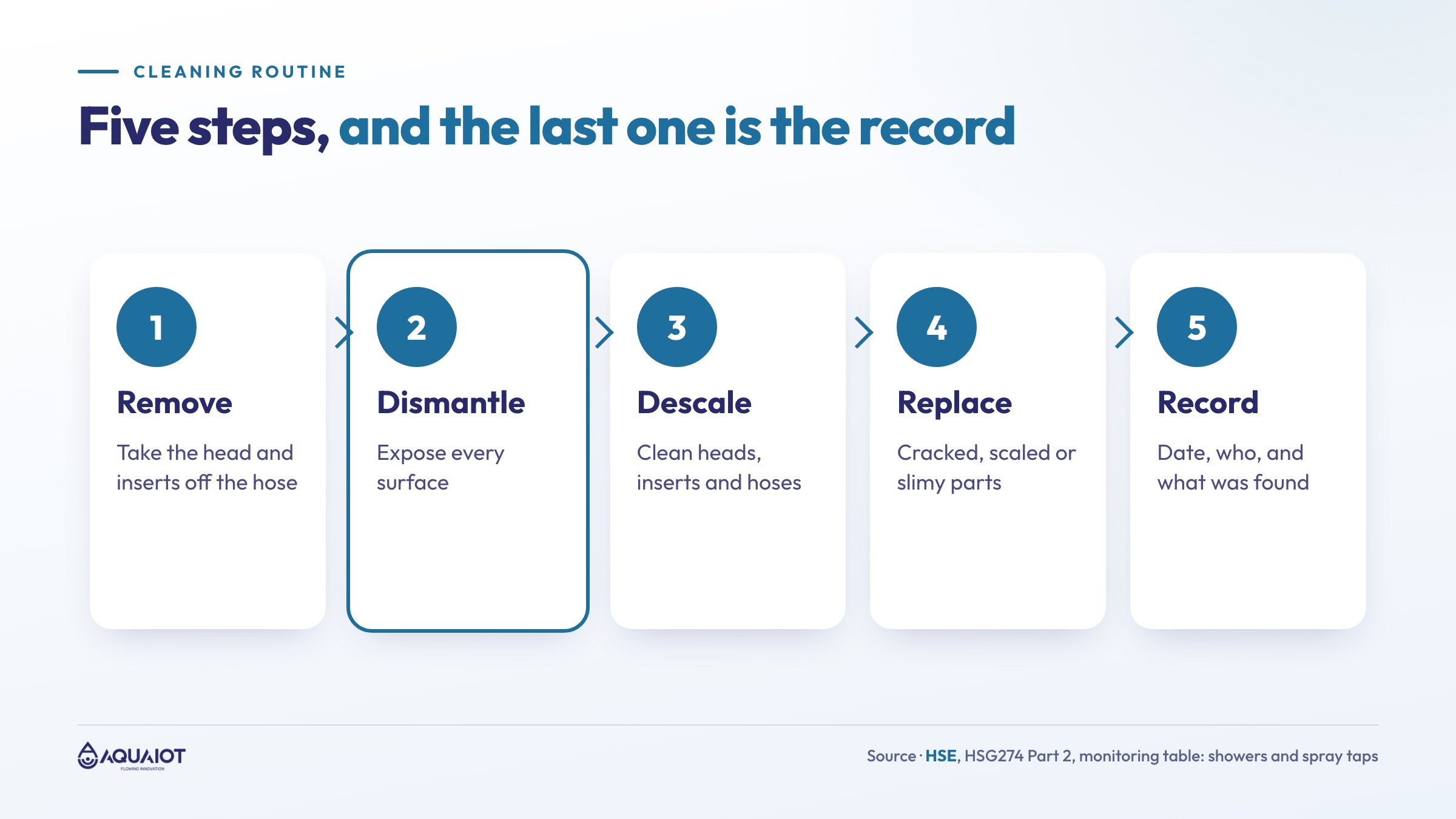
Take the shower heads apart, descale them, clean them and put them back, then record the date. HSE’s instruction is to dismantle, clean and descale removable parts, heads, inserts and hoses where fitted. Descaling removes the surface that shelters bacteria, and cleaning removes the film.
The steps follow from the guidance.
- Take the shower head and any removable insert or filter off the hose.
- Dismantle the head and inserts so every surface is exposed.
- Descale and clean each part, and inspect the hose, which is also part of the regime.
- Replace anything cracked, heavily scaled or slimy.
- Reassemble, run the shower until the water temperature stabilises, and record the date and who did it.
Use methods and products that suit the fittings, and follow the manufacturer’s instructions. Where the risk assessment calls for disinfection as well as cleaning, make sure the chemicals are suitable and rinsed away, and that people are not in the room while you work, because cleaning itself can make spray.
Electric showers need the same attention. HSG274 says low storage volume heaters, which include electric showers, often have spray nozzle outlets, and these should be inspected, cleaned and descaled as part of the showerhead and hose cleaning regime. HSE adds that if these units are not regularly used, or are set to supply warm water, the risk from Legionella is likely to increase dramatically, and more so where the units are supplied from a cold water storage tank.
What about shower heads that are rarely used?
Showers that are not used regularly are the bigger risk, because the water inside them stands still. HSE says infrequently used equipment, meaning equipment not used for a period equal to or greater than seven days, should be included on the flushing regime, and that infrequently used showers should be considered for removal.
The guidance sets out what flushing means. Flush the outlet until the temperature at the outlet stabilises and is comparable to the supply water, and purge to drain. Regularly use the outlets to minimise the risk from microbial growth in the peripheral parts of the system, and sustain and log the procedure once started. For high risk populations such as healthcare and care homes, more frequent flushing may be needed, and HSE gives twice weekly as an example where the risk assessment indicates it for susceptible patients.
If the shower has been removed from use, HSE says to cut the redundant supply pipework back as far as possible to a common supply, such as the recirculating pipework or the pipework supplying a more frequently used upstream fitting, preferably by removing the feeding T. A shower that is gone but still connected is a dead leg with a very short fuse. Our page on dead leg monitoring explains why.
The guidance also covers lapses. Where there has been a lapse in the flushing regime, the stagnant and potentially contaminated water within the shower or tap and associated dead leg should be purged to drain without discharge of aerosols before the appliance is used. In practice that means flushing in a way that does not spray, for example by removing the head or directing the flow to drain, before anyone steps in.
Who is responsible for shower heads in rented homes and shared buildings?
The duty holder is the person in control of the premises, and for a let property HSE’s guidance says landlords should consider control measures including advising tenants to regularly clean and disinfect shower heads. The landlord should also inform tenants of the risk and tell them to report hot water that is not heating properly.
HSG274 lists the landlord measures. They include flushing out the system before letting the property, avoiding debris getting into the system, setting control parameters such as storing water at 60 degrees, removing redundant pipework and advising tenants to clean and disinfect showerheads regularly. It also says tenants should be advised to tell the landlord if the hot water is not heating properly.
For a shared building such as a leisure centre, gym, hotel or care home, the duty holder keeps the cleaning schedule and the records. A written schedule that names who cleans which showers, and when, is easier to defend than good intentions. Our page for care homes shows how the same routine applies where residents are more susceptible.
How do you show the routine is working?
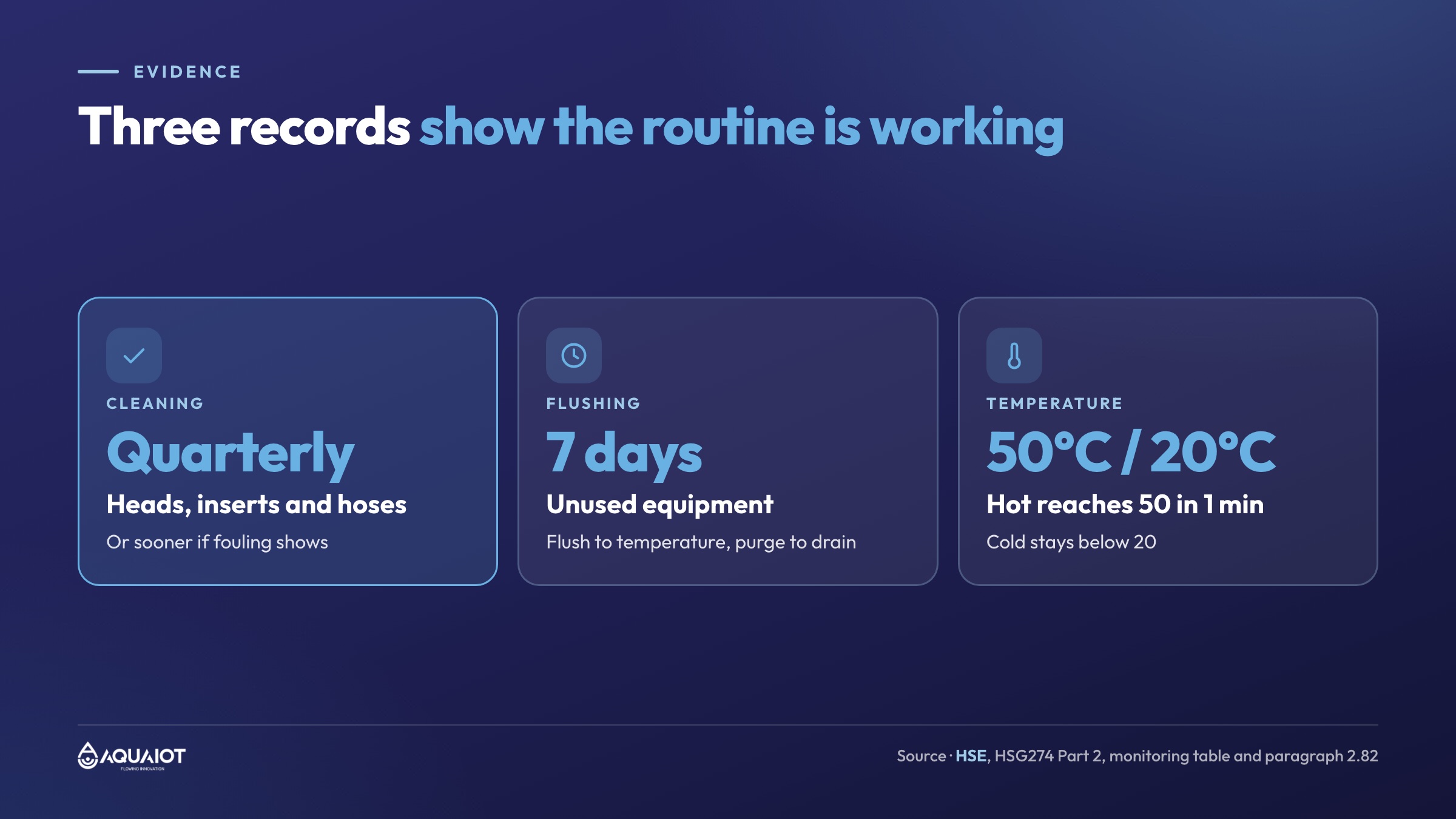
Keep three records for your shower heads: the cleaning dates, the flushing log and the temperatures. HSE’s guidance asks for records of precautions, and the combination shows that heads are clean, unused showers are flushed, and the water behind them is in a safe range.
Temperature is the part that is easy to miss. HSG274 says hot water should be stored at a minimum of 60 degrees and reach 50 degrees within one minute at the outlets, or 55 degrees in healthcare premises, and that cold water should be kept below 20 degrees. A shower fed by a hot supply that has fallen to 40 degrees is in the growth range however clean the head is.
AQUAIOT’s automated Legionella monitoring places wireless temperature sensors at tanks, calorifiers, loops and sentinel outlets, logs every reading to the cloud over cellular or LoRaWAN telemetry, and alerts by SMS, email or app when cold water exceeds 20 degrees or hot water falls below 50 degrees at the point of use. It also shows when a scheduled flush has been missed. It does not clean a shower head, but it shows that the temperature controls and the flushing are holding between your visits.
For showers, useful sensor points are the hot and cold feeds close to a bank of showers, the furthest shower on a long branch, and the return of the loop that serves them. Our guides to sentinel outlets, Legionella flushing monitoring and TMV checks explain related controls, since many showers are served by a thermostatic mixing valve.
What mistakes do sites make with shower heads?
The common mistakes with shower heads are cleaning heads but not hoses, cleaning without descaling, forgetting electric showers, leaving unused showers connected, flushing with the head spraying and keeping no record. Each is easy to fix with a written routine.
- Hoses forgotten. HSE’s wording includes hoses where fitted, not only the head.
- Cleaning without descaling. Scale shelters bacteria and gives them surface to grow on.
- Electric showers left out. HSG274 includes their spray nozzles in the regime.
- Unused showers still connected. Anything unused for seven days or more belongs on the flushing regime, or should be removed and the pipe cut back.
- Spraying on restart. Purge stagnant water to drain without making aerosols.
- No record. A clean that is not logged cannot be shown.
Frequently asked questions
How often should shower heads be cleaned for Legionella?
HSG274 Part 2 says to dismantle, clean and descale removable parts, heads, inserts and hoses quarterly, or as indicated by the rate of fouling or other risk factors, such as high risk patients. Your risk assessment sets the frequency for your site.
Do shower hoses need cleaning too?
Yes. HSE’s wording covers removable parts, heads, inserts and hoses where fitted. Hoses hold water between uses and can fill with scale and film, so they belong in the same quarterly routine.
How often should an unused shower be flushed?
HSE says equipment not used for seven days or more should be on the flushing regime, and the table gives weekly, or as the risk assessment indicates. For susceptible patients, twice weekly may be needed. Flush until the temperature stabilises and purge to drain, and log it.
Are electric showers a Legionella risk?
They can be. HSG274 says low storage volume heaters, including electric showers, often have spray nozzles that should be inspected, cleaned and descaled in the showerhead regime, and that the risk rises dramatically if they are rarely used or set to supply warm water.
What should I do with a shower that is no longer used?
HSE says to consider removing infrequently used showers and cutting the redundant supply pipework back as far as possible to a common supply, preferably by removing the feeding T, so that no dead leg is left behind.
Does temperature monitoring replace cleaning shower heads?
No. Monitoring shows whether hot and cold supplies stay in range and whether flushes happen, but it cannot descale a head. Cleaning and flushing control the risk, and monitoring shows that the controls are being delivered.
Where to start
Walk the building and list every shower and spray tap, with its type, how often it is used, the date its heads and hoses were last cleaned and whether it is on the flushing regime. Mark the ones used less than weekly. If you want the supplies behind your showers watched continuously, contact AQUAIOT with the number of buildings and shower blocks, and we will suggest where temperature sensors should go.
For the guidance quoted here, read HSE’s Legionnaires disease technical guidance, HSG274 Part 2 and its page on what Legionnaires disease is.