



Legionella Over School Holidays: The Half-Term Checklist for Closed and Quiet Buildings
TL;DR: Water that sits unused in a closed building warms up, stagnates and lets Legionella grow, which is why the HSE treats any outlet not used for seven days or more as infrequently used and puts it on a flushing regime, typically weekly for several minutes, logged and sustained. A half-term or holiday closure easily passes seven days. HSE guidance for buildings taken out of use says to keep systems filled, manage microbial growth during the closure, and recommission as new, with flushing, cleaning and disinfection, before reopening.
Last updated: 23 October 2026
On this page
Key takeaways
- For Legionella school holidays planning, note that a building left empty over a half-term or holiday can pass the seven days that HSG274 Part 2 uses to define infrequently used equipment, which should then be included on a flushing regime.
- HSE guidance says that when outlets are not in regular use, weekly flushing for several minutes can significantly reduce the risk of Legionella growth, but once started it has to be sustained and logged, because lapses can cause a critical increase at the outlet.
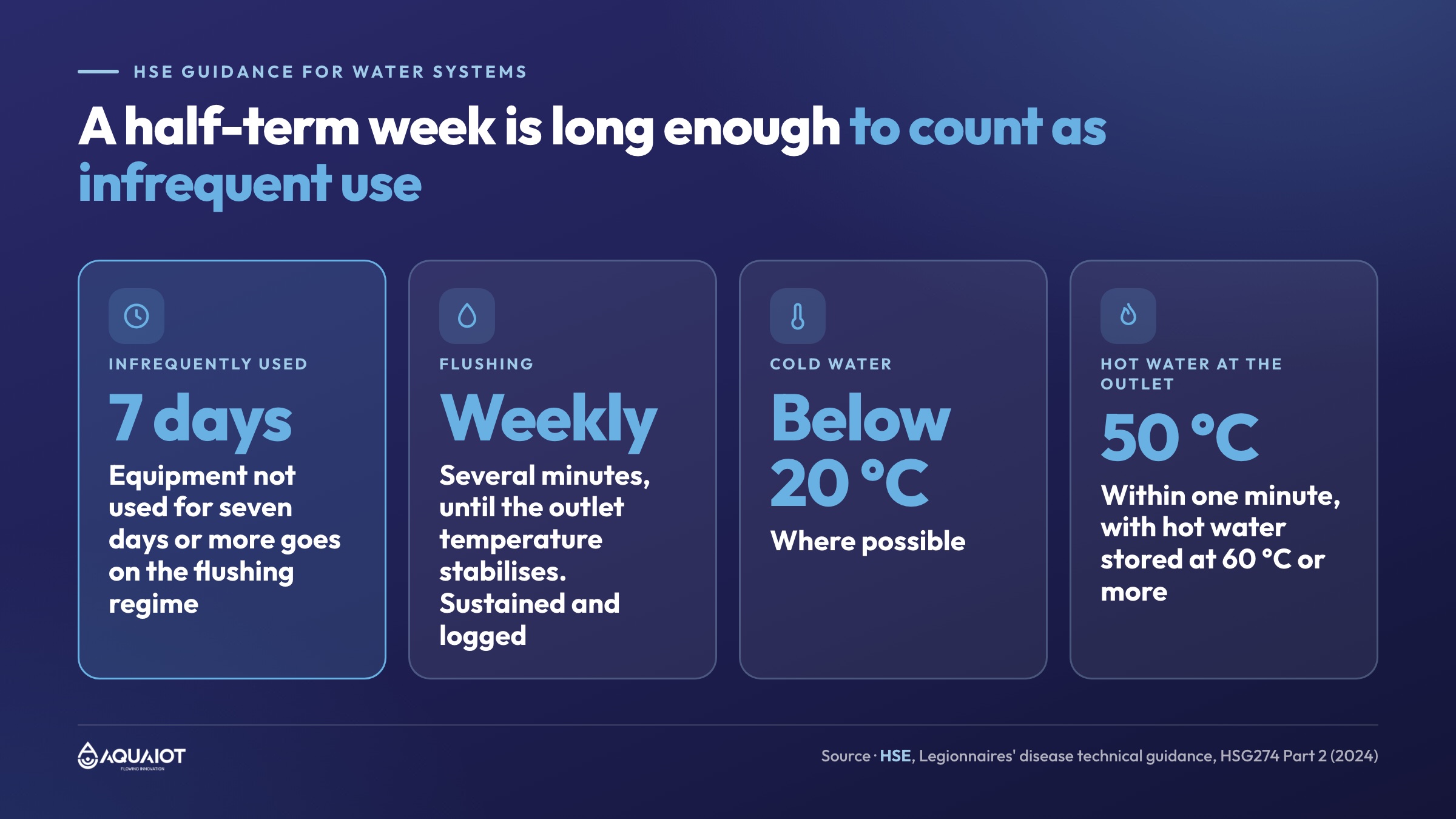
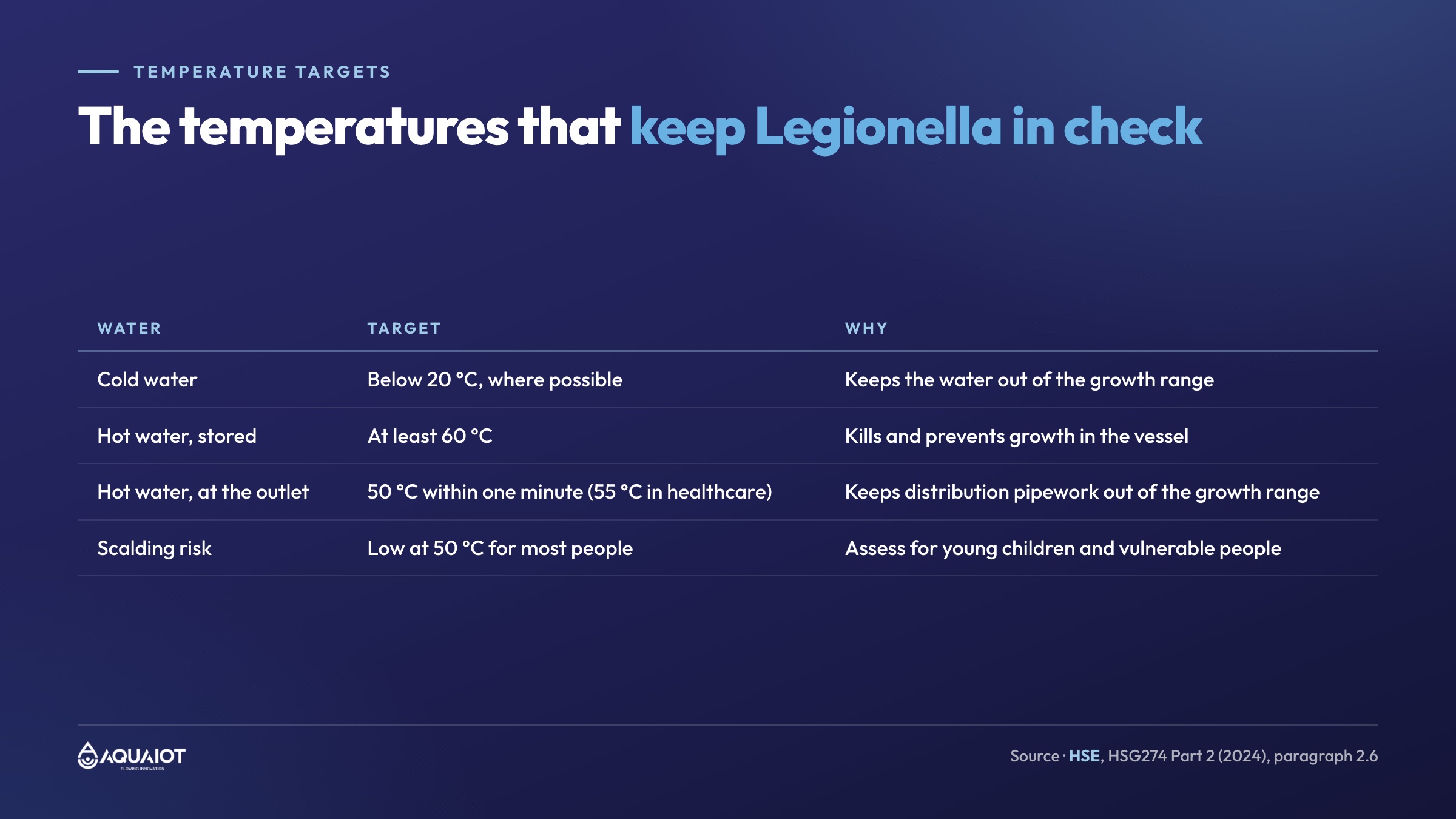
- Cold water systems should be kept, where possible, below 20 degrees Celsius, and hot water should be stored at least at 60 degrees and reach 50 degrees at outlets within one minute, or 55 degrees in healthcare premises.
- Systems taken out of use are normally left filled, not drained, and recommissioned as though new, thoroughly flushed, cleaned and disinfected, before returning to use.
- Infrequently used showers and taps that are not needed should be considered for removal, with the supply pipework cut back to a common supply.
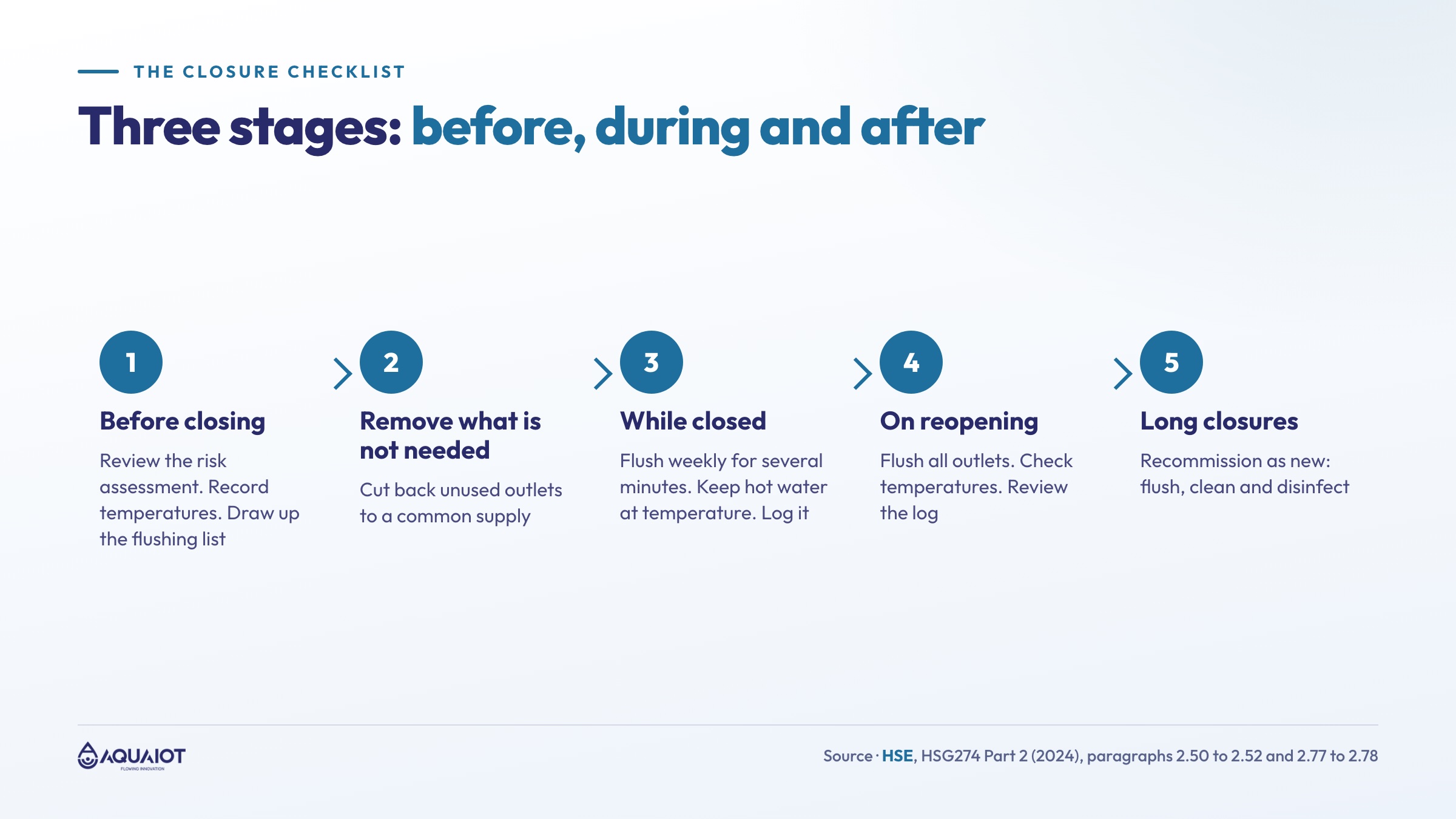
- A closure checklist has three stages: before you close, flush and monitor while you are away, and recommission when you reopen.
On the last Friday before half-term, the site team locks up, switches off the lights and goes home. Nobody turns off the water, but nobody uses it either. Nine days later the building reopens, and the first people to run a tap or take a shower are children and staff who have no idea the pipes have been standing still all that time.
This guide covers Legionella school holidays planning: why it matters, what HSE guidance says, and what to do before you close, while you are away and when you reopen. It applies to schools, colleges and nurseries, and equally to offices, sports halls, community buildings and any premises that goes quiet for a week or more. It draws on the Health and Safety Executive’s technical guidance for hot and cold water systems.
Legionella school holidays: why does a closed building raise the risk?
A closed building raises the risk because water that does not move warms up, loses its disinfectant and lets biofilm grow, and Legionella bacteria thrive in that film at the wrong temperatures. HSE guidance lists dead legs, capped pipes, infrequently used outlets and areas of poor circulation as places where optimum temperatures for microbial growth and stagnation occur.
The risk does not come from the water sitting in the pipes alone. It comes from the first use after a long break, when a shower or tap releases a spray that people can breathe in. Legionnaires’ disease is caught by breathing in small droplets of contaminated water, so showers, spray taps and anything that makes a mist are the points of concern.
Schools have more of these points than most buildings, because they have changing rooms, science and art rooms, kitchens, caretaker’s sinks, and often outbuildings and sports halls that are used for only part of the week.
When does an outlet count as infrequently used?
HSE guidance treats infrequently used equipment, meaning equipment not used for a period equal to or greater than seven days, as something that should be included on the flushing regime. The table of control measures in HSG274 Part 2 sets the flushing frequency for infrequently used outlets as weekly, or as indicated by the risk assessment.
The HSE technical guidance, HSG274 Part 2, published in 2024 as part of the wider HSE Legionnaires’ disease guidance, adds that the outlets should be flushed until the temperature at the outlet stabilises and is comparable to the supply water, and then purged to drain. For high-risk populations, such as healthcare and care homes, more frequent flushing may be required as indicated by the risk assessment.
A half-term week, with school closed from the Friday evening until the Monday of the following week, is nine or ten days. Every outlet in the closed building has crossed the seven-day line. Many schools run an excellent weekly flushing routine during term, because the outlets are used, and then stop thinking about it because the building is empty.
What does HSG274 say about half-term flushing?
HSG274 Part 2 says that when outlets are not in regular use, weekly flushing of those devices for several minutes can significantly reduce the risk of Legionella growing in the system, which is why half-term flushing belongs in the plan. It also says that once this procedure is started it has to be sustained and logged, because lapses can result in a critical increase in Legionella at the outlet.
That sentence is the one to build your procedure around. Three points follow from it:
- Weekly, for several minutes. A quick splash does not clear the water in the branch pipe. Run each outlet until the temperature stabilises.
- Sustained. A flushing regime that starts in September and lapses in the holidays is worse than none, because it creates a false sense of security.
- Logged. If it is not recorded, it did not happen, as far as an inspection or an investigation is concerned.
Flushing should be done in a way that limits spray, for example by running taps gently at first and keeping shower heads low in the tray.
What does HSE say about buildings taken out of use?
HSE guidance on buildings temporarily taken out of use, sometimes called mothballing, says the building, part of it or a water system should be managed so that microbial growth, including Legionella, is appropriately controlled. In general, systems are left filled with water and not drained down, because moisture and pockets of water can let biofilm develop, and the water also protects against corrosion and failed joints.
The same section says all mothballing procedures are a compromise between control of microbial growth, use of water for flushing while avoiding waste, and degradation of the system by any disinfectant. It also says systems should be recommissioned as though they were new, meaning thoroughly flushed, cleaned and disinfected, before they are returned to use.
For a half-term closure of a few days, you would not mothball the whole building. But the principle is the same for a longer shutdown such as a summer break, a refurbishment or a part of a building that is simply left unused: keep it controlled while it is closed, and bring it back properly.
Legionella school holidays: what should you do before you close?
Prepare the building before the last person leaves, because the best time to fix a problem is when the system is still running.
- Review the Legionella risk assessment. Check that it covers the closure and that the person responsible knows the plan.
- Record temperatures. Take readings at sentinel outlets, representing the overall system, and at the calorifier, so you have a baseline.
- Keep the temperatures up. Hot water is stored at least 60 degrees. Do not switch off the boiler or calorifier to save energy unless the plan allows it.
- Draw up the flushing list. Every outlet, shower and tap, with a named person, a day and a log sheet. Include outbuildings and sports halls.
- Remove what is not needed. HSG274 says to consider removing infrequently used showers and taps, cutting redundant pipework back as close as possible to a common supply.
- Check the access. Make sure the person doing the flushing can get in, has keys and knows how to avoid spray.
- Tell the site team and contractors, so nobody turns off a supply or a heater during the break.
Legionella school holidays: what should you do while the building is closed?
Flush every infrequently used outlet weekly, for several minutes, until the temperature stabilises, and log each one. Keep the hot water system running at its normal temperatures. Check that the cold water is not warming in tanks or in the pipework, and make a note of anything unusual.
Practical tips for the person doing the round:
- Work in a fixed order, starting with the outlets furthest from the supply, and tick each one off.
- Run the cold first, then the hot, until each is at a steady temperature, using a probe thermometer if the temperature is not obvious.
- Reduce spray. Run taps gently, and aim shower heads into the drain.
- Look for faults. A dripping tap, a leak or a tank with a missing lid should be reported and fixed.
- Keep the log. Date, time, outlet, temperature, name.
If you cannot guarantee a weekly visit, consider a monitoring system, because a sensor does not take a day off.
What should you do when you reopen?
Before anyone uses the building, check temperatures at the sentinel outlets and flush every outlet, so water that has stood in the pipes is cleared. For a longer closure, the guidance says the system should be recommissioned as though new, with thorough flushing, cleaning and disinfection. Review the log and any readings, and act on anything outside the expected range.
A short reopening routine:
- Review the flushing log for gaps, and the temperature readings for anything out of range.
- Flush all outlets before first use, hot and cold, and showers last.
- Check temperatures again at sentinel outlets and the calorifier.
- Investigate any reading that is cold water above 20 degrees or hot water below the target, and decide whether further action, such as disinfection or sampling, is needed on the risk assessment.
- Record it all and file it with the risk assessment.
Which outlets do schools and offices forget?
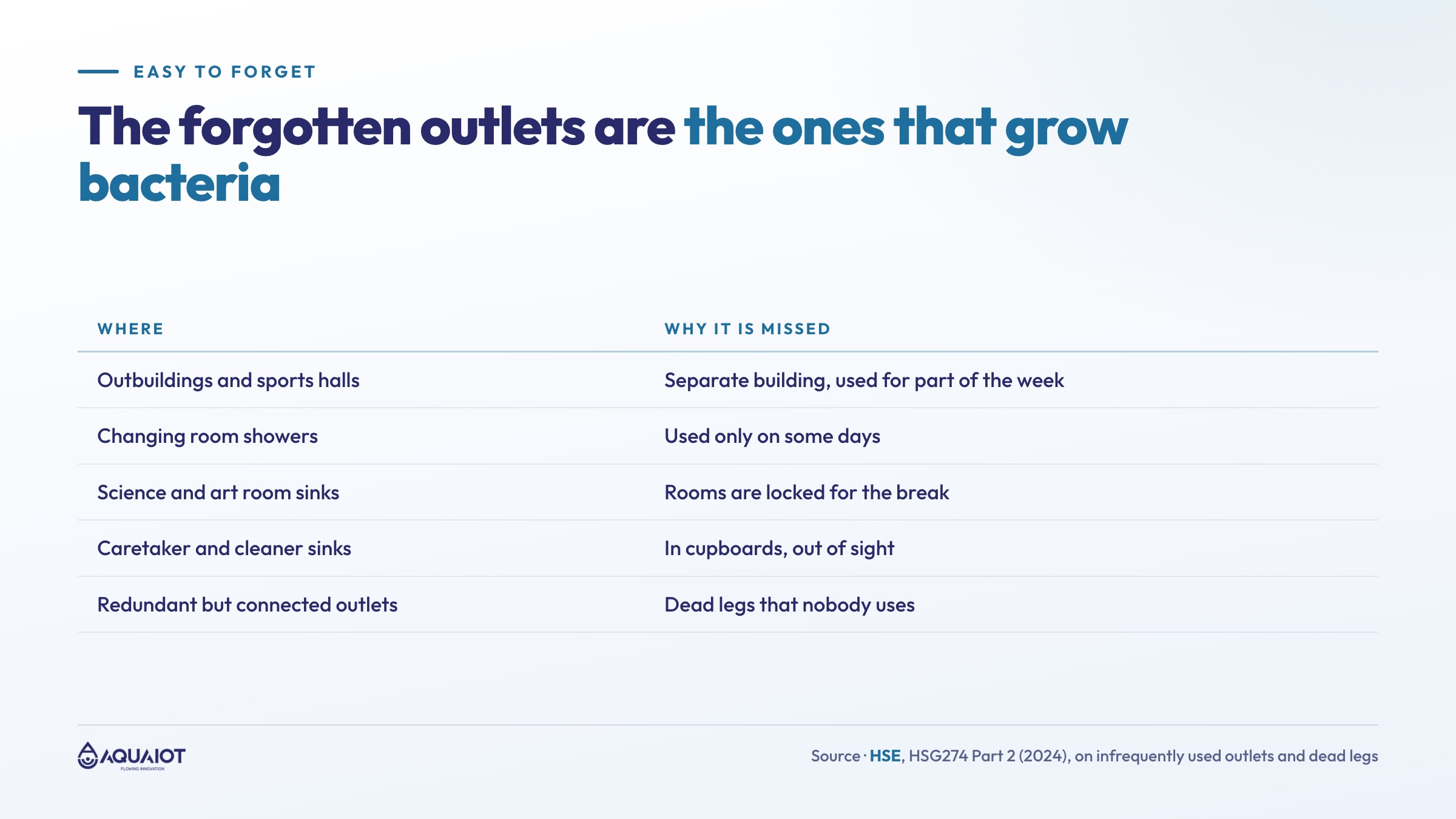
The outlets that cause trouble are the ones nobody thinks of as part of the water system. They get missed because they are in a corner, in a cupboard or in another building.
- Outbuildings and sports halls with their own showers and sinks.
- Changing room showers that are only used for part of the week.
- Science and art room sinks, and demonstration taps.
- Caretaker’s and cleaner’s sinks, and any cleaner’s cupboard with a tap.
- Kitchen sinks and hand wash basins in rooms that are shut for the break.
- Hose reels and external taps, where they supply a spray.
- Infrequently used disabled and staff toilets with showers.
- Redundant outlets that are still connected, which are dead legs.
How can monitoring help during a closure?
Monitoring gives you evidence from the days when nobody is on site. Temperature sensors at sentinel outlets and on the hot and cold pipework report continuously, so a cold-water rise above 20 degrees or a hot-water fall below target generates an alert during the break, and the record shows that flushing took place and what the temperatures were.
That helps in three ways. It catches a failed boiler or a warming tank on day two, not at the reopening. It proves the weekly flush happened, as a sensor on the outlet shows the temperature changing when the tap runs. And it replaces a handwritten log with a time-stamped one. Our guides explain the pieces: Legionella temperature monitoring, flushing monitoring, sentinel outlet monitoring, dead leg monitoring and the digital Legionella logbook.
For how this maps to the guidance, see our pages on HSG274 Part 2 monitoring, what a sentinel outlet is, what ACoP L8 requires, and our overview for schools.
Who is responsible for Legionella control in a school or office?
The dutyholder is. HSE describes dutyholders as employers, those in control of premises, and those with health and safety responsibilities for others, and says their duties include identifying and assessing the source of risk, preparing a scheme to prevent or control the risk, implementing, managing and monitoring precautions, keeping records and appointing a manager responsible for others.
In a school that is usually the employer, such as the local authority, the academy trust or the governing body, with a named responsible person on site. Contractors can carry out the work, but the duty stays with the dutyholder, so check that the closure plan is written, that someone owns it and that the records are kept.
What mistakes cause problems over holidays?
- Assuming an empty building is a safe building. Stagnation is the risk, and empty means stagnant.
- Stopping the flushing in the break, which is when it matters most.
- Switching off the hot water to save energy without a plan, and letting it fall below the temperatures that control growth.
- Forgetting the outbuildings. The sports hall and the caretaker’s store are the usual gaps.
- Not logging. An unrecorded flush cannot be shown to anyone.
- Opening on the Monday without a check, so the first user is the first test.
Frequently asked questions
Do I need to flush taps and showers during half-term?
Yes, where they will not be used for seven days or more. HSE guidance puts infrequently used equipment, not used for seven days or more, on a flushing regime, with weekly flushing for several minutes, logged, unless your risk assessment says otherwise.
How long should I flush each outlet?
HSE guidance says to flush until the temperature at the outlet stabilises and is comparable to the supply water, and says weekly flushing for several minutes can significantly reduce the risk. Your risk assessment sets the actual time.
Should I turn off the hot water during the school holidays?
Not without a plan. HSE guidance says hot water should be stored at least at 60 degrees Celsius and reach 50 degrees at outlets within a minute, so switching a heater off can let temperatures fall into the growth range.
Should I drain the system for a long closure?
Generally not. HSE says systems are normally left filled with water for mothballing, because draining can leave pockets of water and humidity where biofilm develops, and the system should be recommissioned as new before use.
What temperature should cold water be?
HSE says cold water systems should be maintained, where possible, below 20 degrees Celsius.
Who is responsible for Legionella control in a school?
The dutyholder, meaning the employer or the person in control of the premises, such as the local authority, academy trust or governing body. They must assess the risk, put precautions in place, monitor them and keep records.
Where to start
List every outlet, name who flushes it and when, and put the log on the door before you close. If you want proof of what happened between closing and reopening, contact AQUAIOT with the number of buildings and outlets, and we will suggest where temperature sensors should go and who should receive the alerts.