



Other Risk Systems for Legionella: Vehicle Washers, Fountains, Misting and the Rest of HSE’s List
TL;DR: Other risk systems for Legionella are the water systems that are not cooling towers or hot and cold water services but can still make breathable droplets. HSG274 Part 3 lists humidifiers, misting devices, air washers, water softeners, emergency showers, sprinkler and hose reel systems, spa pools, vehicle washers, fountains, irrigation, dust suppression and industrial effluent treatment among them. The duty is the same: assess the risk, control it with cleaning and monitoring, keep records and review the assessment. Appendix 6 gives starting checks for each, such as quarterly sampling of vehicle wash systems.
Last updated: 22 October 2026
On this page
Key takeaways
- HSG274 Part 3 covers other risk systems, meaning water systems other than evaporative cooling systems and hot and cold water systems that may produce aerosols and so pose a foreseeable risk of exposure to Legionella. HSE says the list is not exhaustive.
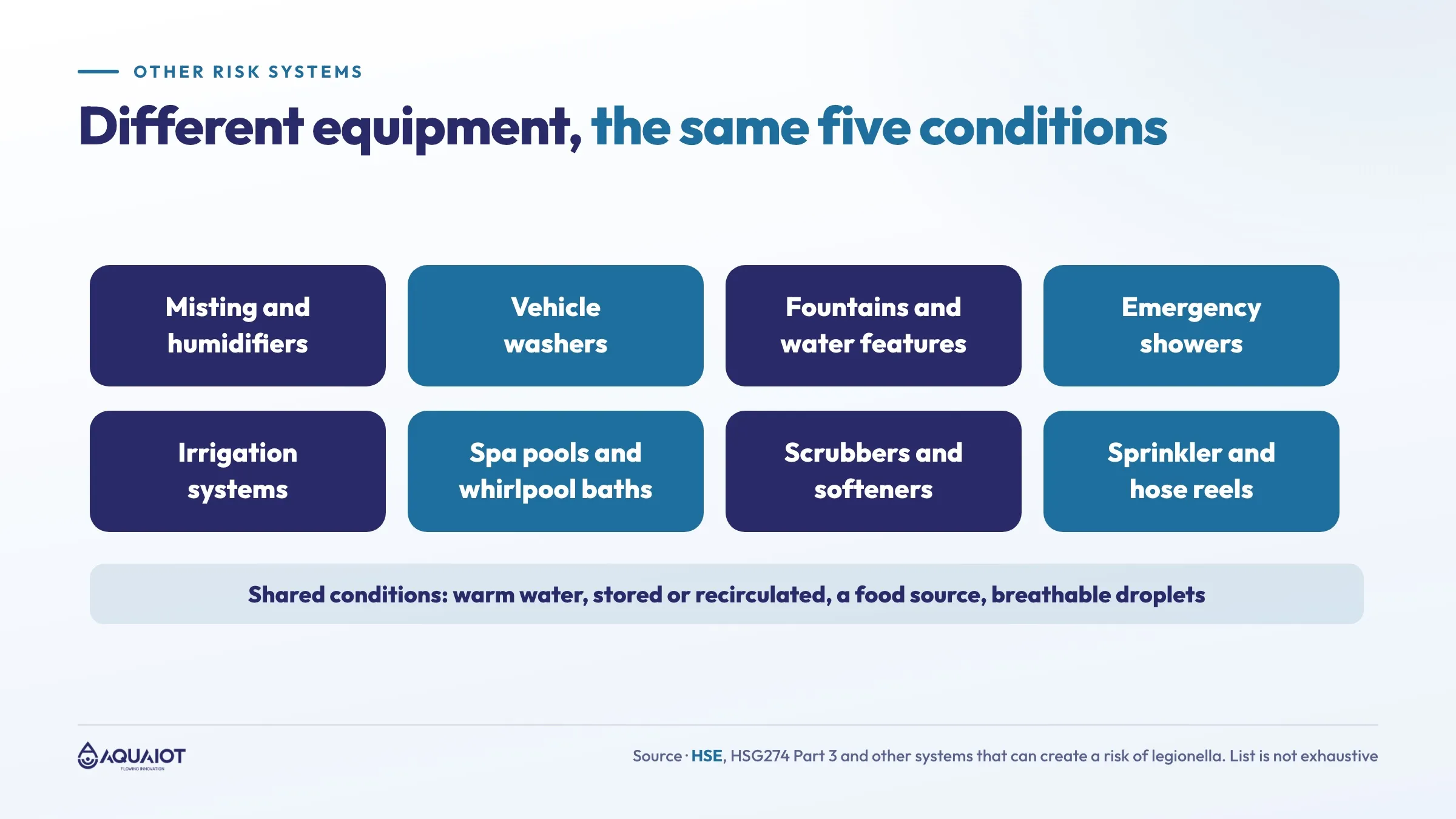
- The list includes ultrasonic humidifiers and foggers, misting devices, air washers and scrubbers, water softeners, emergency showers and eyebaths, sprinkler and hose reel systems, spa pools, whirlpool baths, horticultural misting, vehicle washers, powered dental equipment, fountains and water features, irrigation systems, dust suppression systems and industrial effluent treatment plants.
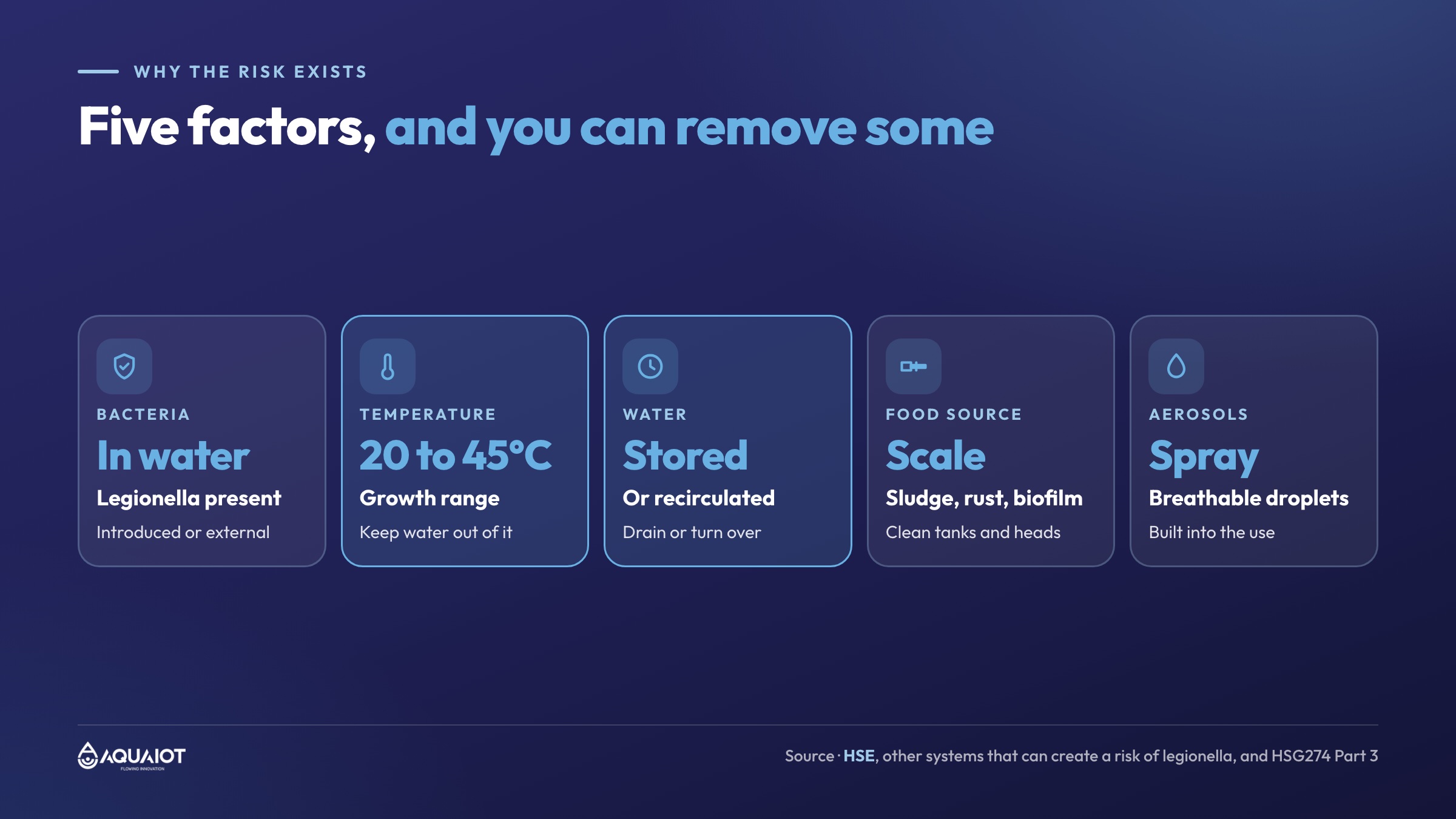
- A system is a foreseeable risk if it combines Legionella in the water, temperatures that may be between 20 and 45 degrees, stored or recirculated water, a food source and a way of making breathable droplets, with susceptible people exposed.
- The duties are the same as for any risk system: carry out a risk assessment, control the risk, monitor where appropriate, keep records of maintenance and monitoring, and review the assessment regularly.
- Appendix 6 of HSG274 gives starting checks for each system. For vehicle wash systems it asks for a biocide programme monitored like a cooling tower and Legionella sampling to establish control, then quarterly or as the risk assessment indicates.
- Where it is practical, consider replacing the system with a dry one. If not, put a written scheme in place.
A bus depot installs a new automatic wash for its fleet. A garden centre switches on the misting line over its seedlings. A shopping centre refills the fountain in its atrium after a long closure. None of them has a cooling tower or a hot water calorifier on the list of systems it checks for Legionella. All three can make a fine spray from water that has been standing or recirculating at the wrong temperature.
This guide explains what HSE’s technical guidance calls other risk systems, why they matter, what the five risk factors are, what HSG274 Part 3 asks dutyholders to do, and what Appendix 6 says about specific systems, with a closer look at vehicle washers, fountains and misting. It also shows where temperature and water quality monitoring helps. It is not legal advice, so use your own risk assessment and the full HSE text.
What are other risk systems?
Other risk systems are water systems, apart from evaporative cooling systems and hot and cold water services, that can create aerosols and so a foreseeable risk of exposure to Legionella. HSG274 Part 3 gives the definition and a list of examples that HSE says is not exhaustive.
HSE’s page on other systems that can create a risk of Legionella sets the scene. In addition to the systems most likely to cause Legionella, which are evaporative cooling systems, hot and cold water systems and spa pools, it says there are several other systems that could be a source of growth. Its examples include humidifiers, air washers, emergency showers, eye wash sprays, indoor ornamental fountains and aqueous tunnel washers.
Part 3 of the technical guidance expands the list considerably. It names ultrasonic humidifiers and foggers, misting devices used for humidifying vegetables, meat and other food products, spray humidifiers, air washers and scrubbers, water softeners, emergency showers, eyebaths and face wash fountains, and sprinkler and hose reel systems.
It goes on to spa pools, whirlpool baths, horticultural misting systems, vehicle washers including automatic washers for cars, buses, lorries and railway rolling stock, powered dental equipment, fountains and decorative water features, non-disposable nebulisers, industrial effluent treatment plants, irrigation systems, fire, dust and odour suppression systems, paint spray preparation equipment and tunnel pasteurisers.
HSG274 explains why they matter. Many of these systems operate at or above ambient temperature, or are prone to thermal gain during operation. Some are seasonal, such as irrigation systems that operate outdoors and so may use water at temperatures within the range in which Legionella grows. All have the capacity to generate droplets during operation, and some, like powered dental equipment and respiratory nebulisers, may deliver them directly into a person’s breathing zone.
What makes a water system a foreseeable Legionella risk?
A system is a reasonably foreseeable risk if it combines several factors. HSG274 Part 3 lists Legionella in the system water, conditions suitable for multiplication such as water between 20 and 45 degrees, water that is stored or recirculated, a food source for the organism, a means of creating breathable droplets and susceptible people who may be exposed.
HSE’s page gives the same factors in a shorter list. Legionella present in the water, water temperature that may be between 20 and 45 degrees, a means of creating or spreading breathable droplets, stored or recirculated water, and a likely food source such as sludge, rust, scale, organic matter or biofilms.
The food source in Part 3 is described broadly, including contaminants from the surroundings or process, including rust, sludge, scale, organic matter and biofilms. A vehicle wash tank that collects road film and sludge, an irrigation tank with leaf matter and a fountain basin with algae all supply nutrients.
Susceptible people matter too. A fountain in a hospital atrium has a different risk profile from one in a car park. The risk assessment should consider the source of the water, the potential for microorganisms to grow, the potential for aerosol release, and the likelihood and susceptibility of people being exposed.
If the findings show the risk is insignificant and properly managed, HSE says no further action may be required, but the assessment should still be reviewed regularly in case anything changes in the water system or its use.
What does HSE ask dutyholders to do?
HSE asks for a risk assessment, a written scheme where there is a risk, monitoring of the control measures with records, regular review, and competent people. Where the risk is significant it also asks you to consider replacing the system with a dry one.
HSG274 Part 3 sets out the steps. As with all foreseeable risk systems, there is a duty to carry out a risk assessment to decide whether further actions are needed and to maintain records of all maintenance carried out, together with monitoring results. If the assessment shows risks, consider whether the system can be replaced with a dry system. Where that is not practicable, draw up and put in place a written scheme of measures to prevent or control the risk.
Monitor the control measures and keep records, record the significant findings of the risk assessment with an indication of when to review it, review it regularly, review the written scheme if the level of risk changes, and make sure everyone involved, including contractors, is competent and has clear roles and reporting lines.
Control usually combines measures. HSE says these systems will often need regular maintenance to keep them clean, regular disinfection and ongoing monitoring where appropriate. Most of them need a mains supply, so the Water Supply (Water Fittings) Regulations 1999 and the Water Supply (Water Quality) Regulations 2001 also apply.
The guidance recognises that the dutyholder may need help. Unless there is enough knowledge and expertise within your company, specialist help may be needed to carry out the risk assessment, to devise and implement an effective written scheme and to monitor its effectiveness.
What does Appendix 6 say about specific systems?
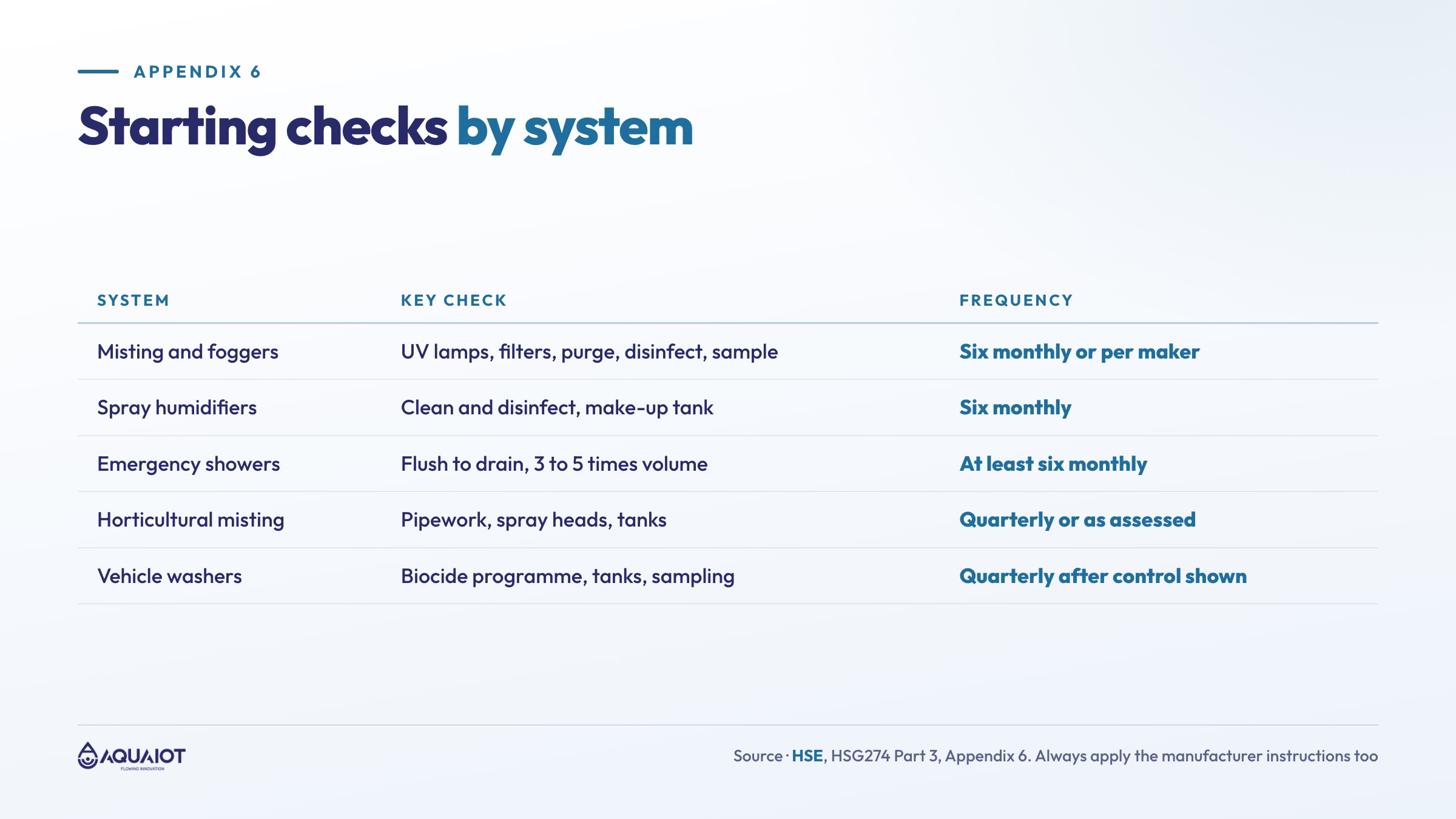
Appendix 6 of HSG274 Part 3 gives a checklist of recommended inspection frequencies for other risk systems, in addition to the manufacturer’s instructions. It covers foggers, scrubbers, softeners, emergency showers, sprinkler and hose reel systems, spa pools, whirlpool baths, misting, dental equipment, vehicle washers, fountains and industrial process water.
| System | What HSE asks for | Frequency |
|---|---|---|
| Ultrasonic foggers and water misting systems | Check UV lamps and clean filters, confirm automatic purge, clean and disinfect wetted parts, sample for Legionella | Six monthly or per manufacturer, and as the risk assessment indicates |
| Spray humidifiers | Clean and disinfect them and their make-up tanks, descaling as necessary | Six monthly |
| Air washers and wet scrubbers | Clean and disinfect them and their tanks, apply and record water treatment | As indicated by the risk assessment |
| Water softeners | Clean and disinfect resin and brine tank as the manufacturer allows | As recommended by the manufacturer |
| Emergency showers and eyebaths | Flush to drain, drawing off three to five times the volume of the stagnant zone | At least every six months |
| Horticultural misting | Clean and disinfect pipework, spray heads and make-up tanks | Quarterly or as the risk assessment indicates |
| Vehicle wash systems | Clean filtration, collection and interceptor tanks, run a biocide programme, sample for Legionella | Sampling to establish control, then quarterly or as assessed |
| Fountains and water features | Clean and disinfect ponds, spray heads and make-up tanks, descaling as necessary | As indicated by the risk assessment and condition |
Spa pools get separate treatment. HSG274 says they are the most significant of these systems in terms of risk and points to the HSE and PHE guidance on managing spa pools. Whirlpool baths, which have high velocity jets but no recirculation, are not considered high risk if the water is discharged immediately after each use and the source water is safe.
What about vehicle washers?
Vehicle wash systems recirculate water, hold it in tanks and spray it, which makes them a clear fit for the risk factors. HSE covers automatic washers for cars, buses, lorries and railway rolling stock, and asks for a monitored biocide programme, regular cleaning and sampling for Legionella.
Appendix 6 lists four actions for vehicle wash systems. Check and clean filtration systems, collection tanks and interceptor tanks and check the treatment system, as indicated by the risk assessment. Put in place a biocide programme that is monitored and controlled similar to the standards required in cooling towers. Clean and disinfect the system and make sure sludge tanks are emptied. And sample for Legionella, initially to establish that control has been achieved and thereafter quarterly or as indicated by the risk assessment.
The comparison to cooling towers is helpful. Where the biocide is chlorine based, the residual needs to be checked, recorded and kept in range, not assumed. AQUAIOT’s SPA-Chlorine free and total chlorine analyzer measures free and total chlorine on a continuous basis, and our water quality monitoring service covers the wider set of parameters.
Temperature matters because recirculated process water gains heat from pumps and the sun. A tank temperature sensor shows when the water has moved into the 20 to 45 degree range, which is the point at which the biocide programme and the cleaning matter most. For transport depots, where a single wash may serve a whole fleet, that early warning is cheap.
What about fountains, misting and irrigation?
Fountains, misting and irrigation systems spray water into the open air. Their checks are the same in principle: keep the water clean, keep the tanks and spray heads free of scale and film, and watch the temperature. HSE’s table asks for cleaning and disinfection of ponds, spray heads and make-up tanks as the risk assessment indicates.
Fountains and decorative water features sit in the list of other risk systems and Appendix 6 asks for the ponds, spray heads and make-up tanks to be cleaned and disinfected, with descaling as necessary, as indicated by the risk assessment and depending on condition. HSE’s website specifically names indoor ornamental fountains. The reasoning is simple: an indoor fountain recirculates water at room temperature and makes droplets close to people.
Horticultural misting systems need quarterly cleaning of pipework, spray heads and make-up tanks, or as the risk assessment indicates. Food misting and ultrasonic foggers have their own entries, with UV lamp and filter checks every six months or per the manufacturer.
Irrigation systems can bring the seasonal point into focus. HSG274 notes that outdoor systems may use water at temperatures within the Legionella growth range in warm weather, and that the risk can be seasonal. Our guide to irrigation water monitoring covers the monitoring side of irrigation supplies.
For all of these, a sensor in the make-up tank or the basin shows temperature trends across the season. The reading will not replace cleaning, but it tells you when the water has warmed into the risk range and when to bring forward a clean.
How does monitoring help with other risk systems?
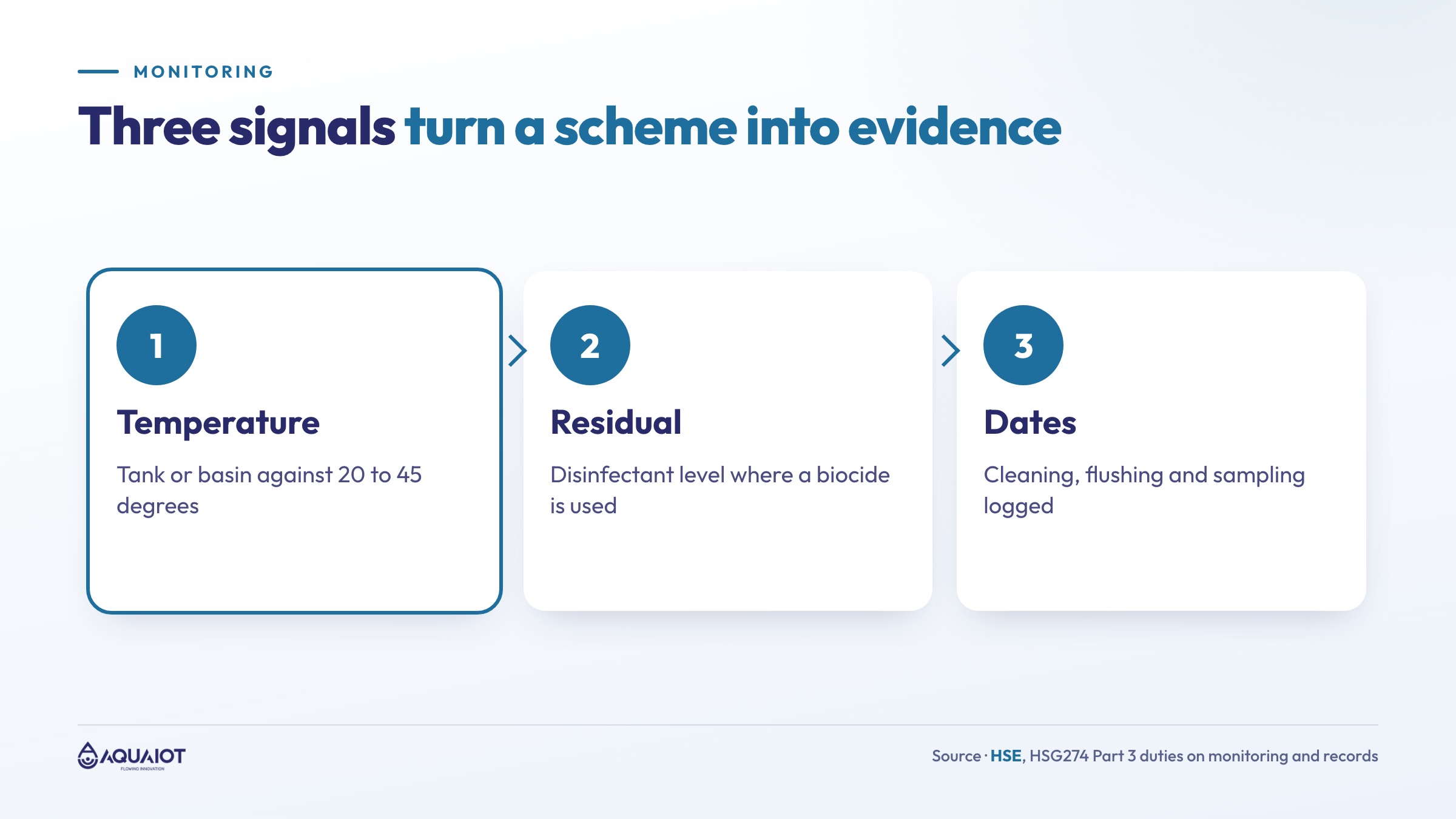
Monitoring shows whether the controls you rely on are holding between visits. For these systems the useful signals are tank or basin temperature, disinfectant residual where a biocide is used, and the dates of cleaning and flushing. Together they turn a written scheme into evidence.
AQUAIOT’s automated Legionella monitoring places wireless temperature sensors at tanks, calorifiers, loops and sentinel outlets, logs every reading to the cloud over cellular or LoRaWAN telemetry, and alerts by SMS, email or app when cold water exceeds 20 degrees or hot water falls below 50 degrees at the point of use. It also shows when a scheduled flush has been missed. The same approach applies to a make-up tank, a wash recirculation tank or a fountain basin, where the threshold you care about is the point at which the water enters the growth range.
Our related guides cover the hot and cold water side, including thermostatic mixing valves, shower heads and emergency showers, and our page on Legionella flushing monitoring explains flush logging. For cooling systems, see our guide to cooling tower water monitoring.
Monitoring does not replace cleaning, sampling or competent advice. It helps you see the trend, act earlier and show that the scheme is being followed.
What mistakes do sites make with other risk systems?
The common mistakes are not knowing the system exists on site, assessing it once and never reviewing it, treating a biocide as a substitute for cleaning, leaving seasonal systems unchecked, forgetting contractors and keeping no records. Each can be fixed with a register and a review date.
- Not on the register. A fountain, a wash or a mist line that nobody listed has no assessment.
- Assessed once. HSE says to review the assessment regularly in case anything changes in the system or its use.
- Biocide instead of cleaning. Tanks, filters, spray heads and sludge still need cleaning.
- Seasonal gaps. Irrigation and misting are used in warm months, and the risk follows.
- Contractor roles unclear. HSE asks for roles, responsibilities and reporting lines to be set down.
- No records. Duties include records of all maintenance carried out and monitoring results.
Frequently asked questions
What are other risk systems in Legionella control?
They are water systems other than evaporative cooling systems and hot and cold water systems that may produce aerosols and so pose a foreseeable Legionella risk. HSG274 Part 3 lists examples such as humidifiers, misting devices, emergency showers, vehicle washers, fountains and irrigation systems.
Are vehicle washers covered by HSE’s Legionella guidance?
Yes. HSG274 Part 3 includes vehicle washers, including automatic washers for cars, buses, lorries and railway rolling stock. Appendix 6 asks for filtration and tank cleaning, a biocide programme monitored like a cooling tower, system disinfection, and Legionella sampling initially and then quarterly or as assessed.
Do fountains and water features need a Legionella risk assessment?
Fountains and decorative water features are on HSG274 Part 3’s list, and HSE names indoor ornamental fountains. Appendix 6 asks for ponds, spray heads and make-up tanks to be cleaned and disinfected as the risk assessment indicates and depending on condition.
What makes a system a foreseeable Legionella risk?
A combination of Legionella in the water, temperatures that may be between 20 and 45 degrees, stored or recirculated water, a food source such as scale, sludge or biofilm, and a way of making breathable droplets, with susceptible people exposed.
Can a dry system replace a water system?
HSG274 says that where an assessment shows a risk, you should consider whether the system can be replaced with a dry system. Where that is not practicable, put a written scheme of control measures in place.
How does monitoring help with other risk systems?
It shows whether temperature and disinfectant levels hold between checks, and records dates of cleaning and flushing. A sensor in a tank or basin shows when water enters the growth range, and the record supports the written scheme and the review of the risk assessment.
Where to start
Walk the site and list every system that holds or sprays water: washes, fountains, misting lines, irrigation, humidifiers, softeners, emergency showers and any process water. Mark which have a current risk assessment and a written scheme. If you want tank or basin temperature watched continuously on the ones that matter, contact AQUAIOT with the number of sites and systems, and we will suggest where sensors should go.
For the guidance quoted here, read HSE’s Legionnaires disease technical guidance, HSG274 Part 3 and its page on other systems that can create a risk of legionella.