



 Clamp-on ultrasonic flow meters, installed and supported in the UK
Data centres and AI cooling
See the coolant flow on every loop without opening a pipe.
Liquid cooling keeps AI servers inside their temperature limits, and it only works while the coolant keeps moving. A clamp-on ultrasonic meter reads the flow from outside the pipe, so you can add a measuring point to a live loop without a shutdown and without touching the coolant.
- Cooling distribution units
- Secondary loops
- Manifolds
- Retrofit
No shutdownFitted to a live loop
No wetted partsNothing touches the coolant
DN8 to DN100Pipe sizes covered
Why measure the flow
A cooling loop can lose flow long before a server reports a fault.
Dense AI racks give out heat that air cannot carry away, so liquid does the work. When a pump slows, a filter clogs or a valve sits in the wrong position, the first sign is often a rising temperature. A flow reading on each loop shows the cause as well as the symptom.
Live fit
The meter clamps on the outside of the pipe, so it can be added or swapped while the loop keeps running and the servers keep working.
No leak path
Nothing is inserted into the pipe, so a meter adds no joint, no seal and no wetted part to the coolant circuit.
No moving parts
There is no paddle or turbine to wear, stick or need replacing, which suits plant expected to run all year.
Easy retrofit
Halls that were built without flow meters can gain measuring points one loop at a time, with no change to the pipework.
How it works
Sound passes through the pipe wall and the coolant, and the flow is read from it.
Two transducers on the outside of the pipe send ultrasonic pulses through the wall and the liquid. The meter times the pulses to calculate the flow, so the coolant is never touched.
We review the loops.
We look at the pipe sizes, the materials and the points that matter most, such as each CDU supply and return and the main manifolds.
Meters clamp onto the pipe.
Each meter is fitted from outside, on a running loop, with no cutting and no draining.
Readings go where you need them.
RS485 Modbus feeds your own building systems, and 4G or LoRaWAN telemetry sends the same readings to the AQUAIOT dashboard.
Alarms reach the right people.
A loop whose flow falls outside its range raises an email or SMS to the operations team.
Where it fits
It suits every loop that carries coolant around a data hall.
The meter reads any liquid loop with a pipe size from DN8 to DN100, so one product covers the points an operations team usually wants to see.
CDU supply and return
A reading on each side of every cooling distribution unit, independent of the unit’s own sensors.
Rack and row manifolds
Compare the flow into each row, and spot the one that is running low.
Commissioning and balancing
Confirm each loop delivers the flow it was designed for before the load goes on.
Retrofit of existing halls
Add measuring points to plant that was built without them, with no pipework change.
Facility water
Read the heat rejection side of the system alongside the server side.
Trends and records
Every reading is stored, so a slow change in flow shows up in the history.
Low-flow alarms
Set a limit on each loop and choose who hears when it is crossed.
Not sure where to measure first?
Tell us about the loops and the pipe sizes. We will suggest the points that give you the most information for the fewest meters.
Why AQUAIOT
We plan, install and support the whole system.
The meters come from specialist manufacturing partners. AQUAIOT selects them for your loops, installs them, connects them and stays with you after go-live.
System review
We look at the loops, the pipe sizes and the readings your team already uses.
Installation
Meters are clamped on and connected on site, without a shutdown.
Dashboard and alarms
We set the limits for each loop with you and choose who hears about each one.
Training and support
Your team learns the dashboard, and we support the system for as long as it runs.
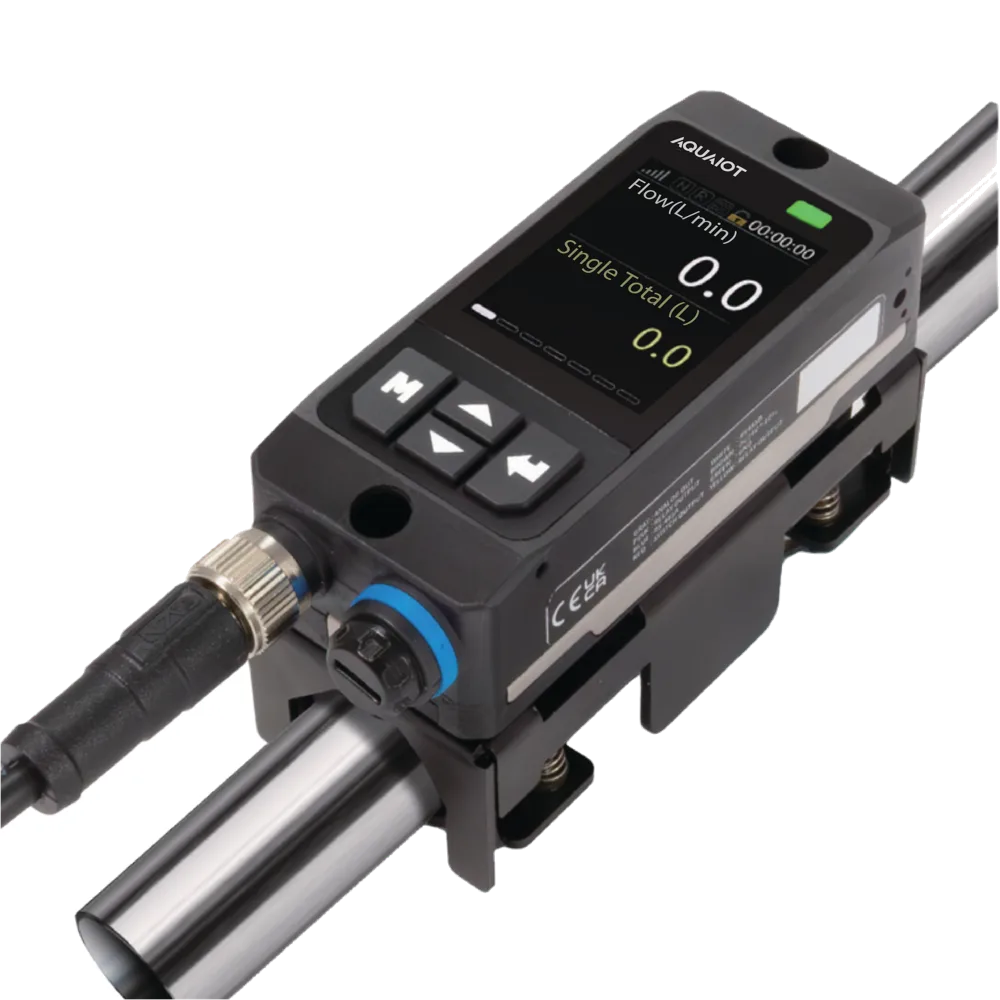
The AQUAIOT clamp-on ultrasonic flow meter.
Questions
These are the questions operations teams ask first.
Can a clamp-on meter be fitted without shutting the cooling loop down?
Yes. The meter clamps onto the outside of the pipe, so the loop stays full and running while it is fitted or replaced. Nothing is cut and nothing is opened.
Does the meter touch the coolant?
No. The transducers sit on the outside of the pipe wall and measure through it, so there is no wetted part and no added joint where a leak could start.
Which pipe sizes and materials does it suit?
The AQUAIOT clamp-on ultrasonic flow meter covers DN8 to DN100 on steel, stainless steel, HDPE, cast iron and copper pipe, which takes in the secondary loops and manifolds found in most liquid cooling plant.
How do the readings reach our building systems?
The meter has an RS485 Modbus output for on-site systems, and sends readings to the AQUAIOT dashboard over 4G or LoRaWAN.
Is this a replacement for the flow sensors inside the cooling distribution unit?
No. It is an independent second reading taken from outside the pipe. It lets you compare loops, check a loop against its own sensor, and add measuring points to plant that was built without them.
Can we add meters to a loop that is already live?
Yes. Because nothing is cut, a meter can be added to a running loop, which makes it suited to retrofits and to extending a hall that is already in service.
Speak to an expert
Tell us about your cooling loops and we will plan the metering.
An AQUAIOT engineer will look at the loops, the pipe sizes and the readings you need, and at who has to hear when a flow drops.
- System reviewWe check the loops and the pipe sizes before anything is ordered.
- Installation and commissioningMeters fitted, connected and tested on site.
- One monitoring partnerFlow metering alongside leak detection and water quality monitoring.
Prefer to talk? Call 02392 233611 or email info@aquaiot.co.uk.
Related monitoring