



 Clamp-on ultrasonic flow meters, installed and supported in the UK
Case studies
Three places a clamp-on meter does the job.
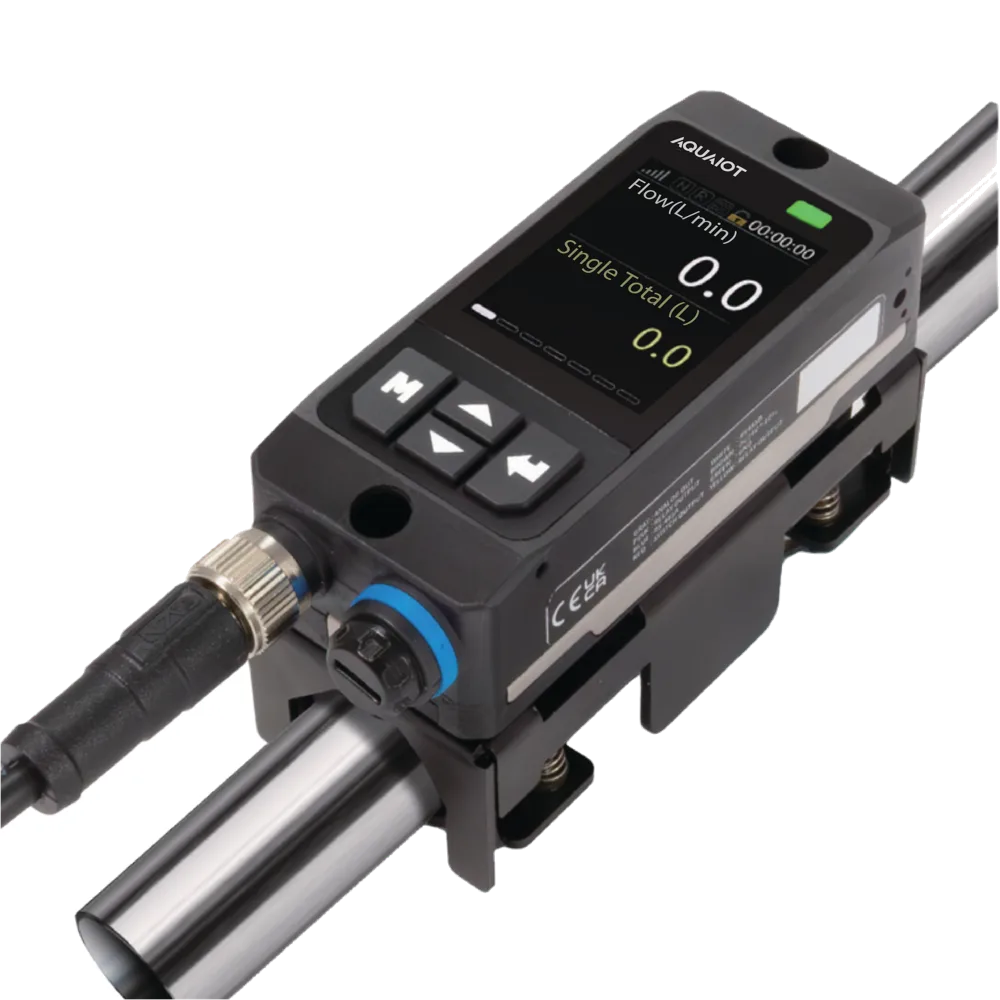
These application case studies show how the AQUAIOT clamp-on ultrasonic flow meter is used on small and large pipework. Site names are not published, and the figures are limited to what each application measures.
- Industrial furnace
- Ecological pool
- Data centre cooling
DN15 and DN25Pipe sizes in two cases
No shutdownFitted to a live line
Cloud dataReadings to the dashboard
Case study 1, industrial process
Comparing the water a vacuum furnace takes in with the water it sends out.
| Application | Vacuum furnace cooling water |
|---|---|
| Pipe size | DN15 and DN25 |
| What is measured | Water supplied to the furnace and waste water leaving it |
| Purpose | Measure water and waste water use, and compare the two |
Why a clamp-on meter
- The lines are DN15 and DN25, a size where a clamp-on meter avoids cutting and re-plumbing.
- Meters can be added on the supply and on the waste line, so the two readings can be compared.
- The same arrangement can be repeated on every furnace.
- Nothing is fitted inside the cooling circuit, so there is no extra joint on the furnace.
Case study 2, ecological pool
Measuring the water used at each water change, with the data in the cloud.
| Application | Ecological pool and water feature |
|---|---|
| Pipe size | DN15 and DN25 |
| What is measured | Water used while the pool water is changed |
| Purpose | Collect usage data through a cloud service for analysis |
Why a clamp-on meter
- The meter reads the volume of water used at each change.
- Readings go to the dashboard over 4G or LoRaWAN, so no one has to read a meter on site.
- The meters fit small pipes in places where cutting and re-plumbing would be a nuisance.
- Many measuring points can be added across one scheme, one line at a time.
Case study 3, data centre cooling
Adding flow readings to cooling loops that cannot be stopped.
| Application | Data centre and AI server liquid cooling |
|---|---|
| Pipe size | Varies by loop |
| What is measured | Coolant flow on supply and return pipes, secondary loops and manifolds |
| Purpose | See the flow on each loop, independent of the cooling unit sensors |
Why a clamp-on meter
- The loop can stay running while a meter is fitted or replaced.
- No part of the meter touches the coolant, so it adds no leak path to the circuit.
- There are no moving parts to wear in plant that runs all year.
- Existing halls can gain measuring points without any change to the pipework.
These case studies describe applications, not customer results. They name no customers and quote no volumes or savings. If you want to see how your own line would be measured, we will review it with you.
Questions
These are the questions we are asked about the case studies.
Are these customer results?
No. They describe how the meter is used in each application, in general terms. We do not publish customer names, volumes or savings.
Can you share a reference from a similar site?
Where a reference is available and the customer agrees, we will arrange it. Tell us about your application in the form below.
Does the meter work on small pipes?
Yes. The AQUAIOT clamp-on ultrasonic flow meter covers DN8 to DN100, which includes the DN15 and DN25 lines in the first two case studies.
Speak to an expert
Tell us about your application and we will compare it with these.
An AQUAIOT engineer will look at your line, the pipe size and the reading you need.
- System reviewWe check the pipework and the readings you need before anything is ordered.
- Installation and commissioningMeters fitted, connected and tested on site.
- One monitoring partnerFlow metering alongside leak detection and water quality monitoring.
Prefer to talk? Call 02392 233611 or email info@aquaiot.co.uk.
Related monitoring