



Water Fittings Regulations: Which Work Needs Your Water Supplier’s Consent Before You Start
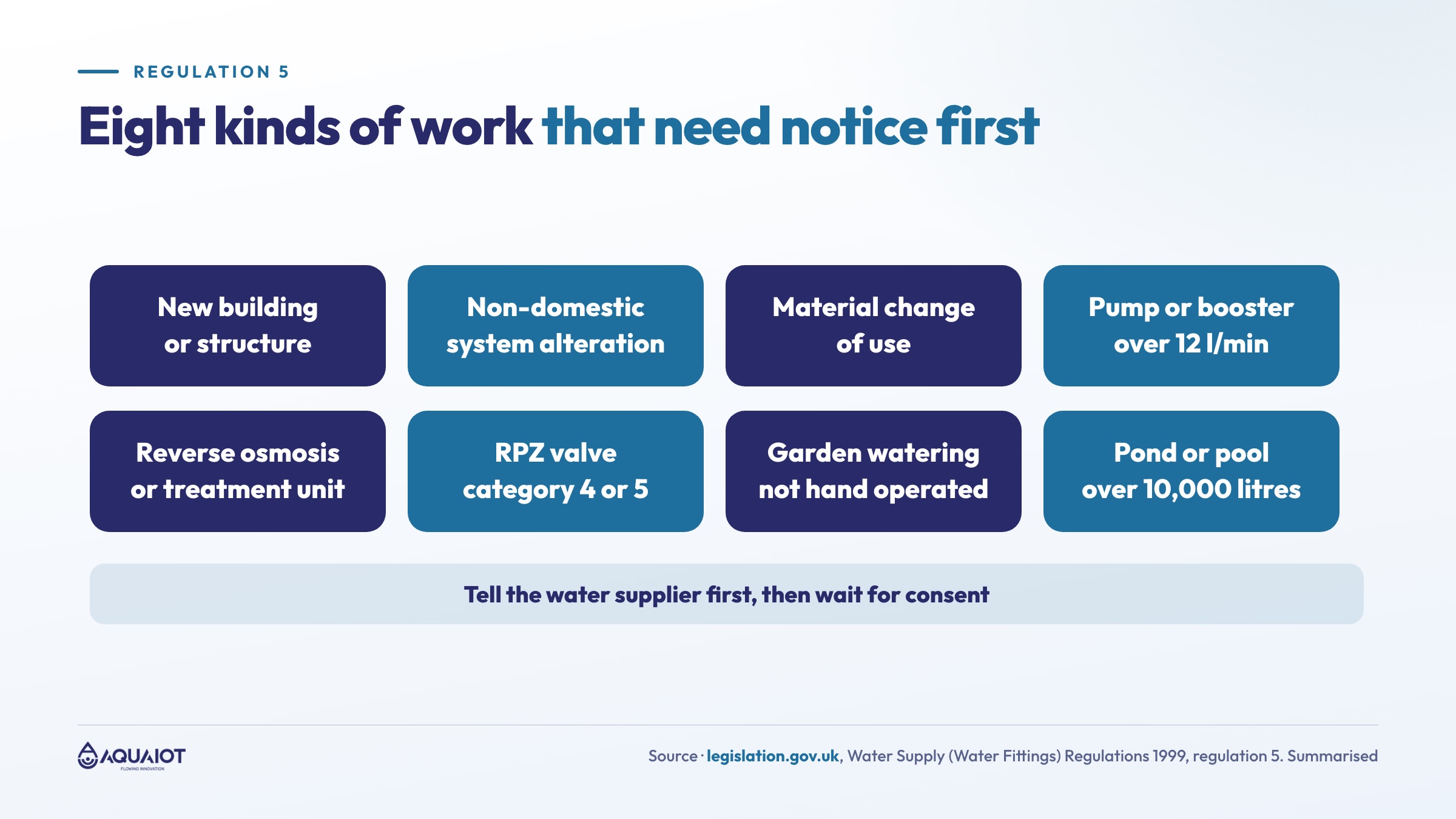
TL;DR: The water fittings regulations, formally the Water Supply (Water Fittings) Regulations 1999, require anyone planning certain work to tell the water supplier first and wait for consent. Regulation 5 lists the jobs: new buildings, alterations to a water system on non-domestic premises, a change of use, a pump or booster drawing over 12 litres a minute, reverse osmosis units, water treatment units that make waste water, reduced pressure zone valves, garden watering systems and large ponds or pools. The supplier has ten working days to object, and silence means consent. Starting without notice is an offence.
Last updated: 22 October 2026
On this page
Key takeaways
- The water fittings regulations (the Water Supply (Water Fittings) Regulations 1999) apply to every water fitting connected to the public supply, in homes and in commercial buildings. Regulation 4 requires fittings to be of appropriate quality, to meet Schedule 2 and to be installed in a workmanlike manner.
- Regulation 5 lists the work that needs notice to the water supplier and its consent before you begin. The list includes new buildings, alterations to a water system on premises other than a house, a material change of use, and specific equipment such as pumps or boosters drawing more than 12 litres a minute.
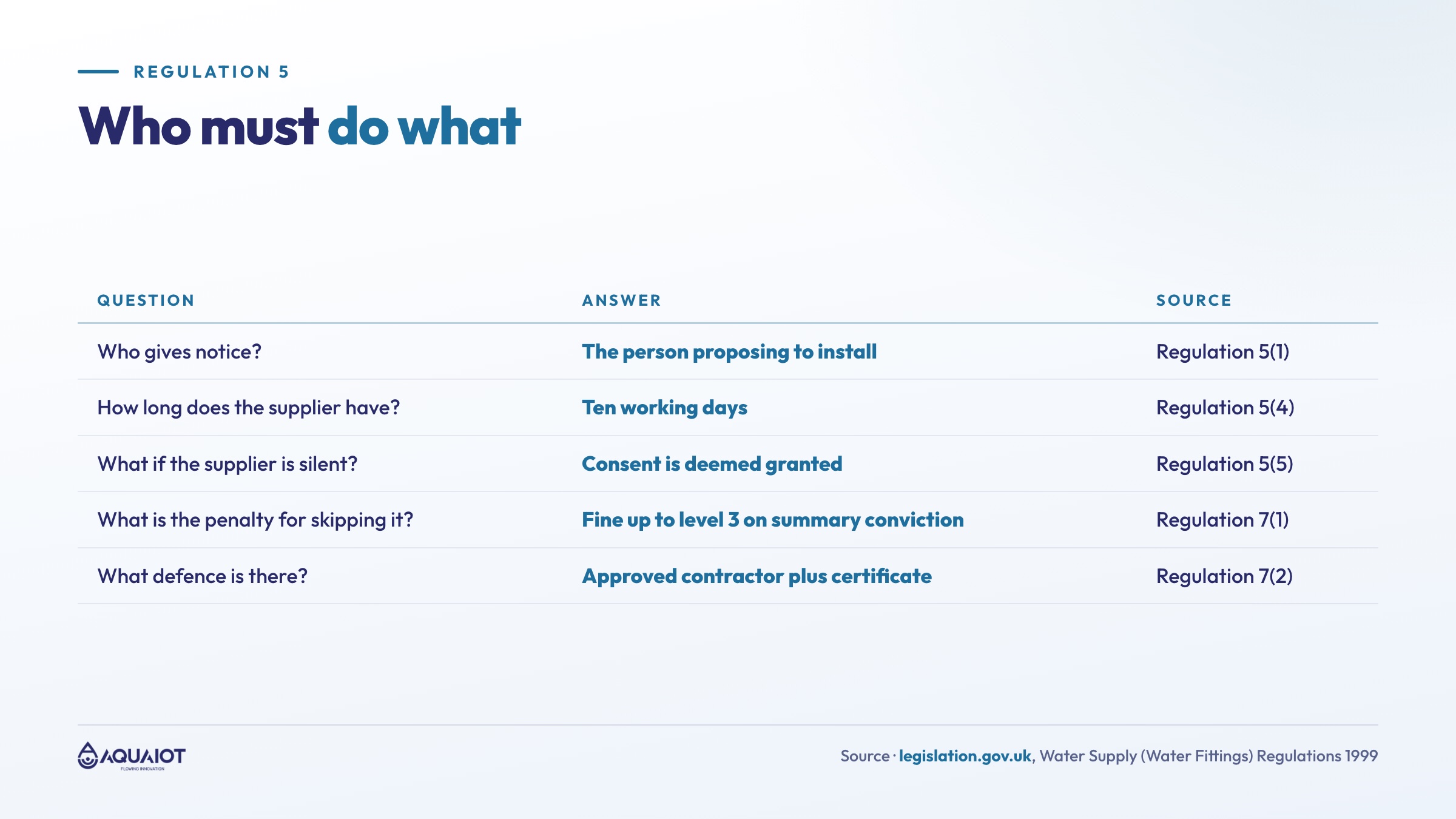
- The supplier has ten working days to withhold consent or attach conditions. If it says nothing in that time, consent is deemed to be granted unconditionally.
- Starting notifiable work without notice, without consent or in breach of a condition is an offence on summary conviction, with a fine not exceeding level 3 on the standard scale.
- Work by an approved contractor is exempt from notification for three of the listed items and gives owners and occupiers a defence if the contractor certifies compliance.
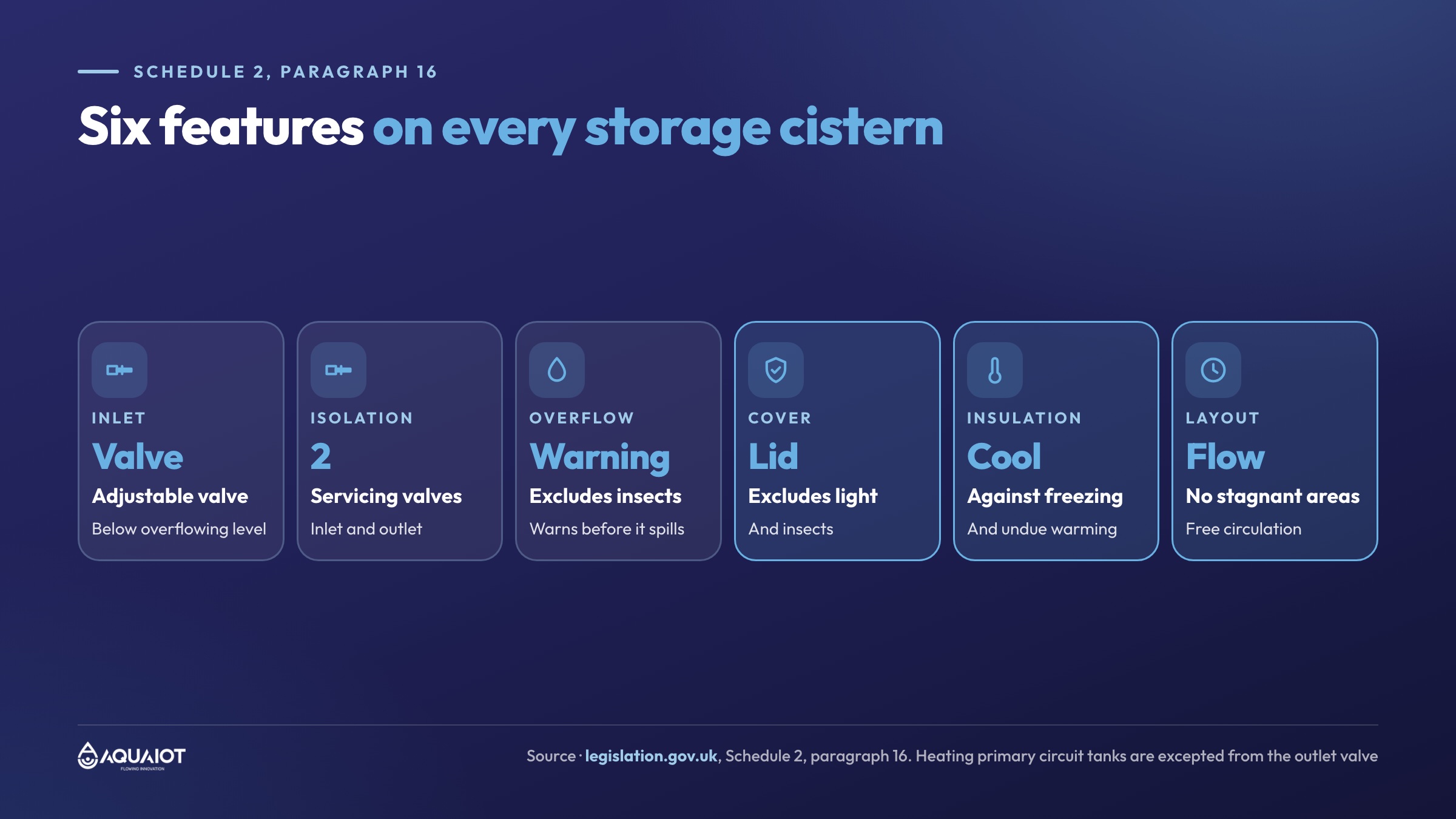
- Schedule 2 also sets design rules that matter for water quality, including a cover, thermal insulation and a warning overflow on every storage cistern, positioned to prevent stagnant areas.
A facilities manager is asked to fit a booster pump to lift water to a new plant room. The contractor says it is a routine job. The water supplier may see it differently, because a pump or booster drawing more than 12 litres a minute connected to a supply pipe is one of the items that needs notice and consent before work begins.
This guide explains what the water fittings regulations require, which jobs need notification, how the ten working day clock works, who can be held responsible, and which Schedule 2 design rules matter most for water quality. It also shows where monitoring fits. It is a plain-English reading of the legislation, not legal advice, so check the full text and your supplier’s guidance before you act.
What do the water fittings regulations cover?
The water fittings regulations set requirements for the pipes, taps, valves, tanks and other fittings that carry or receive water supplied by a water company. Their fitting-level rules deal with materials, strength, watertightness, protection from contamination and installation.
Regulation 4 sets the core duties of the water fittings regulations. Every water fitting must be of an appropriate quality and standard and suitable for the circumstances in which it is used. Every fitting must comply with Schedule 2 as it applies to that fitting. And every fitting must be installed, connected, altered, repaired or disconnected in a workmanlike manner. A fitting counts as installed in a workmanlike manner only if the work conforms to an appropriate British Standard or equivalent, to a specification approved by the regulator, or to a method of installation approved by the water undertaker. Our guide to the water fittings regulations and monitoring covers the wider picture.
The water fittings regulations apply in England and Wales. They cover commercial and industrial premises as well as houses, and the rules for non-domestic buildings are in several places tighter. A water system alteration on a house, for example, does not need notice, but the same alteration on any other premises does.
For site managers, the practical point is that this is not only a plumber’s concern. If your team adds equipment that draws water, such as a booster, a treatment unit or a garden watering system, the legal duty to notify sits with the person who proposes to install it.
Which work needs notification under the water fittings regulations?
Regulation 5 of the water fittings regulations lists the operations that need notice to the water supplier. Anyone proposing to install a water fitting in connection with one of them must give notice, must not begin without the supplier’s consent, and must comply with any conditions attached to it.
The table in Regulation 5 has five groups. The first is the erection of a building or other structure, not being a pond or swimming pool. The second is the extension or alteration of a water system on any premises other than a house. The third is a material change of use of any premises.
The fourth group names specific installations. These are a bath holding more than 230 litres to the centre line of overflow, a bidet with an ascending spray or flexible hose, a single shower unit connected to a supply pipe of a type specified by the regulator (a drench shower installed for safety or health reasons is excluded).
The list goes on with a pump or booster drawing more than 12 litres a minute connected to a supply pipe, a unit that incorporates reverse osmosis, a water treatment unit that produces waste water discharge or needs water for regeneration or cleaning, a reduced pressure zone valve assembly or other mechanical device protecting against fluid category 4 or 5, a garden watering system unless designed to be operated by hand, and any water system laid outside a building less than 750 millimetres or more than 1,350 millimetres below ground.
The fifth group is a pond or swimming pool with a capacity greater than 10,000 litres designed to be replenished by automatic means and filled with water from a water supplier.
Common commercial examples follow from the text. A treatment unit such as a softener that uses water for regeneration or produces waste water discharge falls within the treatment unit item. So is fitting an RPZ valve to protect the mains from a high-risk process. A new irrigation system outside a building is on the list unless it is designed to be operated by hand. A pump to boost pressure to an upper floor is on the list if it draws more than 12 litres a minute.
What must a water fittings regulations notice contain?
The notice must give the name and address of the person giving it, a description of the proposed work, the location and use of the premises, and, for most items, a plan and a pipework diagram. Where an approved contractor does the work, the notice also gives their name.
Regulation 5(3) is specific. The notice must include or be accompanied by the name and address of the person giving it and, if different, the name and address of the person on whom notice may be served. It must describe the proposed work or the material change of use, and give particulars of the location of the premises and their use or intended use.
Except for a bath, a single shower unit, a garden watering system or a large pond or pool, it must also include a plan of the parts of the premises to which the proposal relates and a diagram showing the pipework and fitting to be installed. Where an approved contractor is doing the work, the notice gives the contractor’s name.
A short, accurate pack saves time. A plan, a simple schematic with the pump, valves and backflow protection marked, and the make and model of the equipment answers most of the questions a supplier asks.
How long does the water supplier have to reply?
The supplier has ten working days from the day notice is given to withhold consent or grant it subject to conditions. If it gives no notice in that period, consent is deemed to be granted unconditionally.
Regulation 5(4) of the water fittings regulations says the water undertaker may withhold consent, or grant it subject to conditions, by a notice given before the expiry of the period of ten working days commencing with the day on which notice was given. Regulation 5(5) says that if no notice is given by the undertaker within that period, the consent is deemed to have been granted unconditionally.
Regulation 5(1)(b) adds that consent shall not be withheld unreasonably. In practice a supplier may ask for more detail, set a condition such as a backflow device or a particular installation method, or refuse a design that would put the public supply at risk.
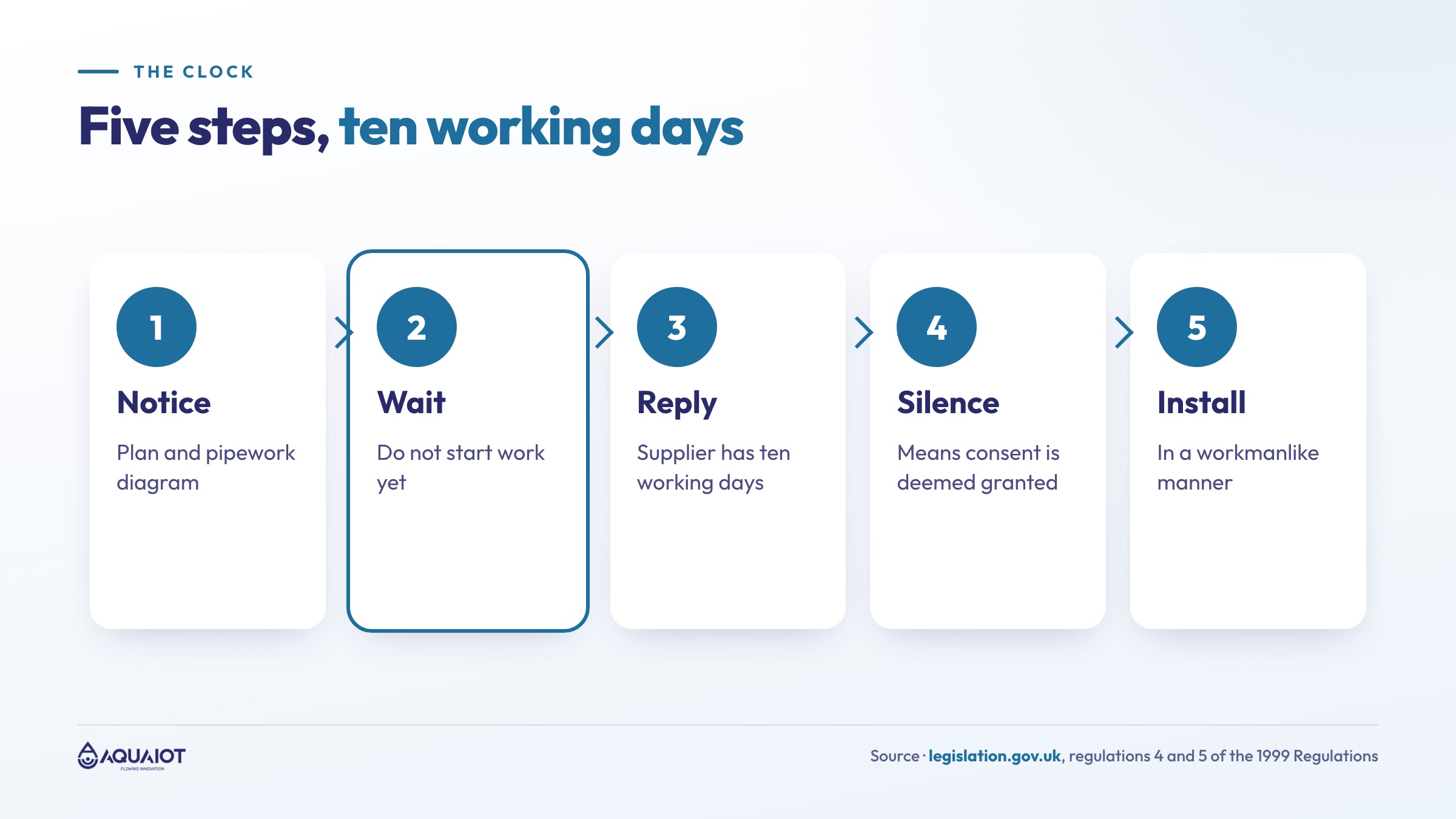
Plan the programme around the clock. A new booster or treatment unit that is needed for a shutdown or a commissioning date should be notified at least three weeks ahead, which leaves two weeks for the supplier plus time for questions.
Who is responsible under the water fittings regulations?
The person who proposes to install the fitting carries the duty to notify. Regulation 7 makes it an offence, on summary conviction with a fine not exceeding level 3 on the standard scale, to start notifiable work without notice, without consent, or in breach of a condition.
Regulation 7(1) lists the offences. A person who contravenes certain requirements of regulations 3 and 6, who commences an operation listed in the Regulation 5 table without giving notice, who commences one without the consent required, or who carries one out in breach of a condition imposed under Regulation 5(4), is guilty of an offence.
Regulation 7(2) of the water fittings regulations gives owners and occupiers a defence. In proceedings against an owner or occupier for an offence based on the installation, alteration, repair, connection or disconnection of a water fitting, it is a defence to prove that the work was carried out by or under the direction of an approved contractor and that the contractor certified to the person who commissioned the work that the fitting complied with the regulations.
Regulation 5(2) goes further for three items. The notification requirement does not apply to the installation by an approved contractor of a water fitting within group 2 (alteration of a non-domestic water system), item 4(b) (a bidet with an ascending spray or flexible hose) or item 4(g) (an RPZ valve or similar device for fluid category 4 or 5).
That makes the choice of installer a compliance decision. Ask for the contractor’s approved contractor status, keep their certificate of compliance with the commissioning records, and file both with the asset register.
What do the Schedule 2 design rules say about cisterns?
Schedule 2 sets technical requirements for fittings. For storage cisterns, paragraph 16 requires an adjustable inlet valve, servicing valves, a warning overflow that excludes insects, a cover that excludes light and insects, thermal insulation against freezing and undue warming, and a layout that avoids stagnant areas.
The text of paragraph 16 is clear. Every pipe supplying water to a storage cistern must have an effective adjustable valve that can shut off the inflow at a suitable level below overflowing level. Every inlet to a storage cistern, combined feed and expansion cistern, or flushing cistern must have a servicing valve adjacent to the cistern. Every storage cistern, except one supplying the primary circuit of a heating system, must have a servicing valve on the outlet pipe.
Every storage cistern must also have an overflow pipe with a suitable means of warning of an impending overflow that excludes insects, a cover positioned to exclude light and insects, and thermal insulation to minimise freezing or undue warming. And every cistern must be installed to minimise the risk of contamination of stored water. It must be of an appropriate size, with pipe connections positioned to allow free circulation and to prevent areas of stagnant water from developing.
These water fittings regulations rules overlap with Legionella control. HSE’s technical guidance asks dutyholders to keep cold water below 20 degrees, and the Schedule 2 wording on insulation against undue warming, covers and stagnant areas describes the same physical features. For the Legionella side, see our guides on thermostatic mixing valves and other risk systems.
Paragraph 4 adds that every fitting must be watertight, constructed and installed to prevent ingress by contaminants and to inhibit damage by freezing, and adequately supported. Paragraph 7 says no fitting may be embedded in a wall or solid floor, and that a fitting that is designed to be operated or maintained, or that consists of a joint, may not be concealed.
Where does monitoring help?
Monitoring shows whether the conditions the regulations aim at are holding between inspections: stored water not warming, no unexpected flow when a site is closed, and no pressure or level problems at the equipment you installed. It supports the records an inspector or insurer may ask for.
For the cistern rules, a temperature sensor in the tank or on the outlet shows when stored water climbs towards the range where bacteria multiply. AQUAIOT’s automated Legionella monitoring logs those readings to the cloud and alerts by SMS, email or app when cold water exceeds 20 degrees. For wider compliance records, our page on water supply regulations monitoring explains how continuous data supports the paperwork.
For leaks and unexpected flow around new pipework, boosters and treatment units, leak detection sensors and meter logging show a fault early. Paragraph 4 requires fittings to be watertight, and a sensor on a plant room floor shows when one is not.
Monitoring does not replace notification under the water fittings regulations, competent installation or inspection. It shows the trend and keeps a record.
What mistakes do sites make with the water fittings regulations?
The common mistakes under the water fittings regulations are treating a like-for-like swap as exempt, starting before the ten working days have passed, forgetting that a change of use is notifiable, using an installer without checking approved status, and keeping no record of the consent or certificate.
- Starting early. Consent can only be deemed after ten working days of silence. Starting on day three is starting without consent.
- Assuming a house rule applies. The alteration item exempts houses, not offices, factories, schools or care homes.
- Missing the change of use. Turning a store into a kitchen or a wash area may be a material change of use of the premises, so ask the supplier.
- Booster pumps. A pump drawing more than 12 litres a minute is on the list even when it is an upgrade.
- Unchecked contractors. The defence in Regulation 7(2) depends on an approved contractor and a certificate.
- No paper trail. Keep the notice, the supplier’s reply or the date of deemed consent, the plan and the certificate together.
Frequently asked questions
What are the water fittings regulations?
They are the Water Supply (Water Fittings) Regulations 1999, which set requirements for fittings that carry or receive water from a water supplier in England and Wales. Regulation 4 requires quality, compliance with Schedule 2 and workmanlike installation, and Regulation 5 requires notice before certain work.
Which jobs need notice to the water supplier?
New buildings, alterations to a water system on premises other than a house, a material change of use, large baths, certain showers, pumps or boosters drawing more than 12 litres a minute, reverse osmosis units, water treatment units, RPZ valves, garden watering systems, deep or shallow external pipework and ponds or pools over 10,000 litres filled automatically.
How long does the water supplier have to respond?
Ten working days from the day notice is given. The supplier may withhold consent or grant it with conditions. If it gives no notice in that period, consent is deemed granted unconditionally.
What is the penalty for not notifying?
Under the water fittings regulations, starting notifiable work without notice, without consent or in breach of a condition is an offence under Regulation 7, liable on summary conviction to a fine not exceeding level 3 on the standard scale.
Do approved contractors need to notify?
For three listed items, an alteration to a non-domestic water system, an ascending spray bidet and an RPZ valve or similar device, the notification duty does not apply to installation by an approved contractor. Using an approved contractor who certifies compliance is also a defence for owners and occupiers under Regulation 7(2).
What do the regulations say about storage cisterns?
Schedule 2 paragraph 16 requires an adjustable inlet valve, servicing valves, a warning overflow that excludes insects, a cover that excludes light and insects, thermal insulation to minimise freezing or undue warming, and an installation that prevents stagnant areas.
Where to start
Check the water fittings regulations against the water-using equipment planned for the next twelve months: boosters, treatment units, RPZ valves, new outlets, irrigation and any change of use. Mark which are on the Regulation 5 table, notify the supplier with a plan and diagram, and diary the ten working days. If you want temperature and leak monitoring on the new equipment from day one, contact AQUAIOT with the site details and we will suggest sensor positions.
For the source text, read the Water Supply (Water Fittings) Regulations 1999, including Regulation 5, Regulation 7 and Schedule 2.