




Remote Water Tank Level Monitoring: the 2026 UK IoT Sensor and Compliance Guide
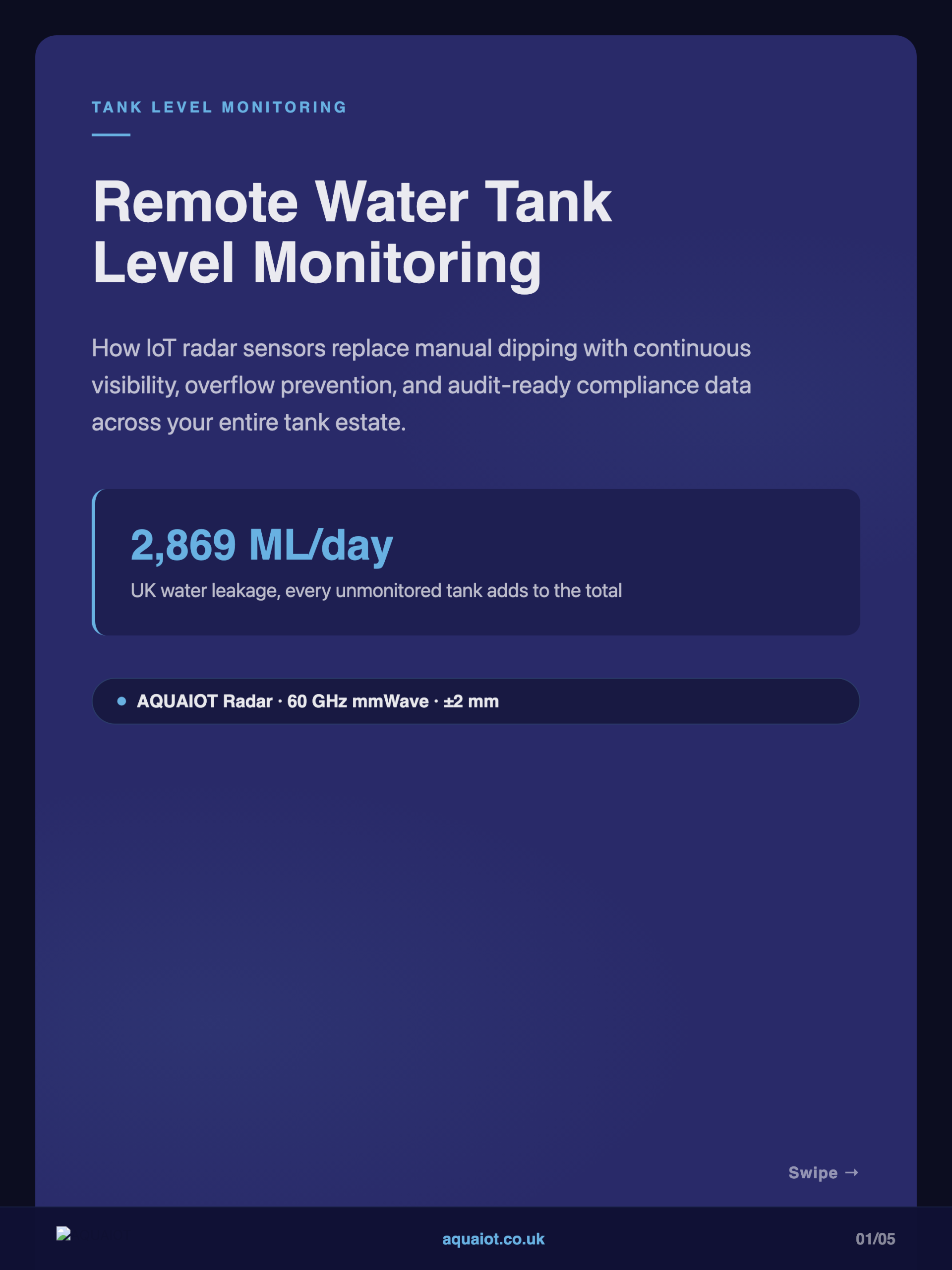
Remote water tank level monitoring uses IoT sensors and cloud dashboards to give estates, utilities, and facilities teams continuous visibility of every tank across their portfolio, replacing manual dipping and reactive call-outs with automated alerts, overflow prevention, and auditable compliance data. For UK organisations managing cold water storage, fire suppression reserves, or attenuation tanks, a modern radar-based tank level monitoring system like AQUAIOT Radar delivers non-contact measurement accurate to within two millimetres, transmitting readings over LoRaWAN or cellular telemetry to a single cloud dashboard.
Looking for a system for your site? See how AQUAIOT plans, installs and supports tank monitoring.
Key takeaways
- Remote water tank level monitoring replaces manual dipping with continuous, automated readings transmitted to a cloud dashboard.
- AQUAIOT Radar uses 60 GHz mmWave technology accurate to plus or minus 2 mm, penetrating foam, vapour, and condensation.
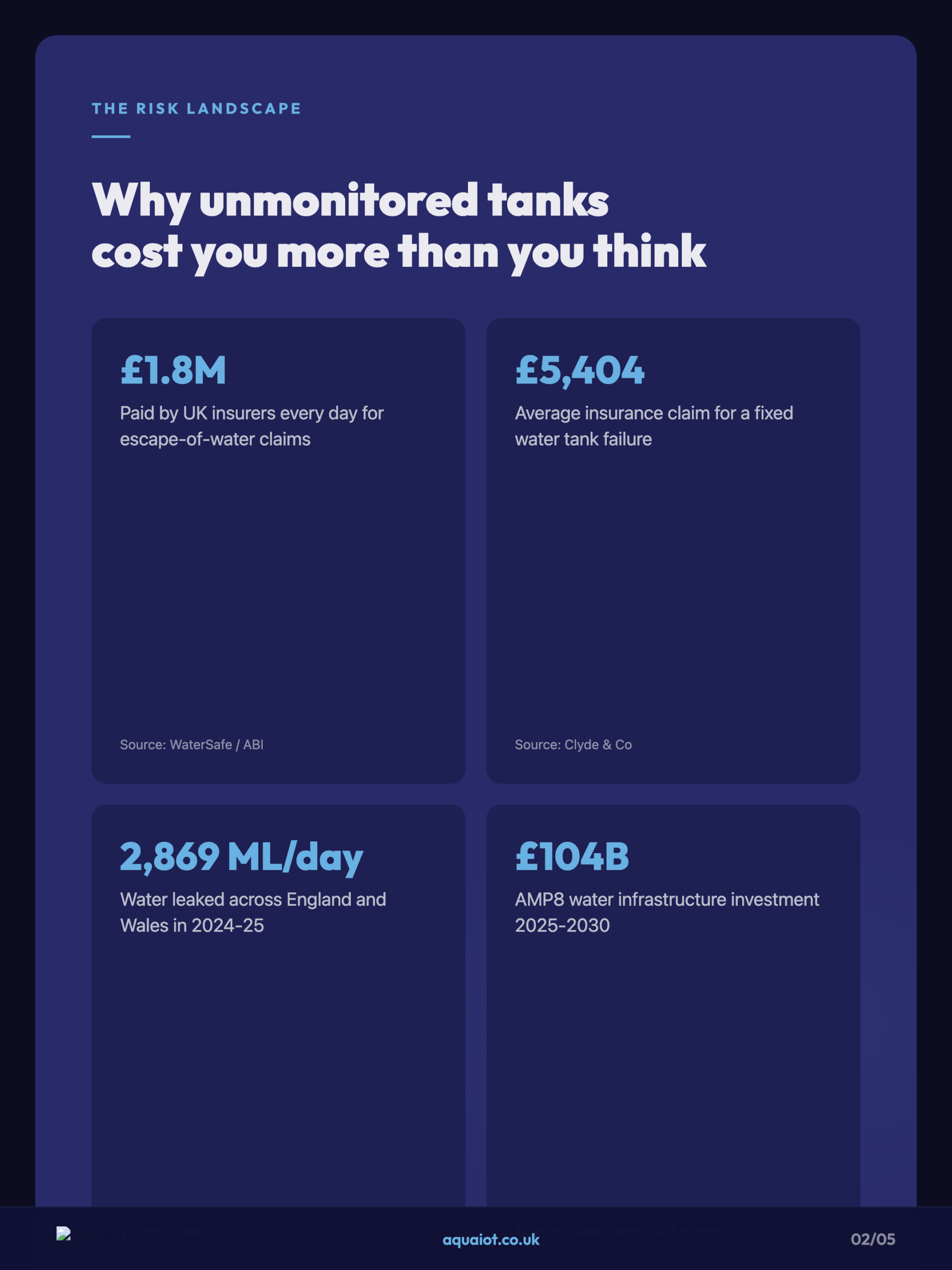
- Escape-of-water claims cost UK insurers over 1.8 million pounds every day, and tank overflows remain a leading trigger.
- HSE guidance HSG274 requires cold water storage tanks to maintain temperatures below 20 degrees Celsius with full turnover every 24 hours.
- AMP8 commits 104 billion pounds to UK water infrastructure between 2025 and 2030, with monitoring investment a core priority.
- IoT tank monitoring cuts site visits by up to 80 percent while delivering a continuous audit trail for Legionella and water quality compliance.
Contents
- What is remote water tank level monitoring and why does it matter?
- How does a remote tank level monitoring system work?
- Which water tank level sensor technology should you choose?
- What are the risks of unmonitored water tanks?
- How do you choose the right IoT tank monitoring system?
- What compliance requirements apply to water tank monitoring in the UK?
- The full AQUAIOT tank monitoring capability stack
- Frequently asked questions
What is remote water tank level monitoring and why does it matter?
Remote water tank level monitoring is the continuous, automated measurement of water levels inside storage tanks using IoT sensors that transmit real-time data to a cloud dashboard, enabling teams to track fill status, detect anomalies, and receive threshold alerts without visiting the site. It replaces the manual dipping, clipboard inspections, and reactive emergency responses that still dominate water management across thousands of UK commercial estates, council buildings, and NHS facilities.
For any organisation running cold water storage tanks, fire suppression reserves, rainwater harvesting systems, or attenuation tanks, the shift from periodic manual checks to continuous remote water tank level monitoring closes the visibility gap that causes overflows, compliance failures, and avoidable water loss. With
, every unmonitored tank is a potential source of waste, damage, or regulatory exposure.
The UK water sector is entering AMP8, the 2025 to 2030 asset management period, which commits
across England and Wales. Monitoring and telemetry are central to that investment. Organisations that deploy IoT tank monitoring now position themselves to meet tightening performance commitments and demonstrate operational resilience to regulators, insurers, and stakeholders.
How does a remote tank level monitoring system work?
A remote tank level monitoring system works by combining a water tank level sensor mounted inside or above the tank with a wireless telemetry link that transmits readings to a cloud platform, where dashboards display live levels, historical trends, and configurable threshold alarms. The sensor takes measurements at regular intervals, typically every few minutes, and transmits the data over LoRaWAN, NB-IoT, or cellular networks to a secure gateway and onward to the cloud.
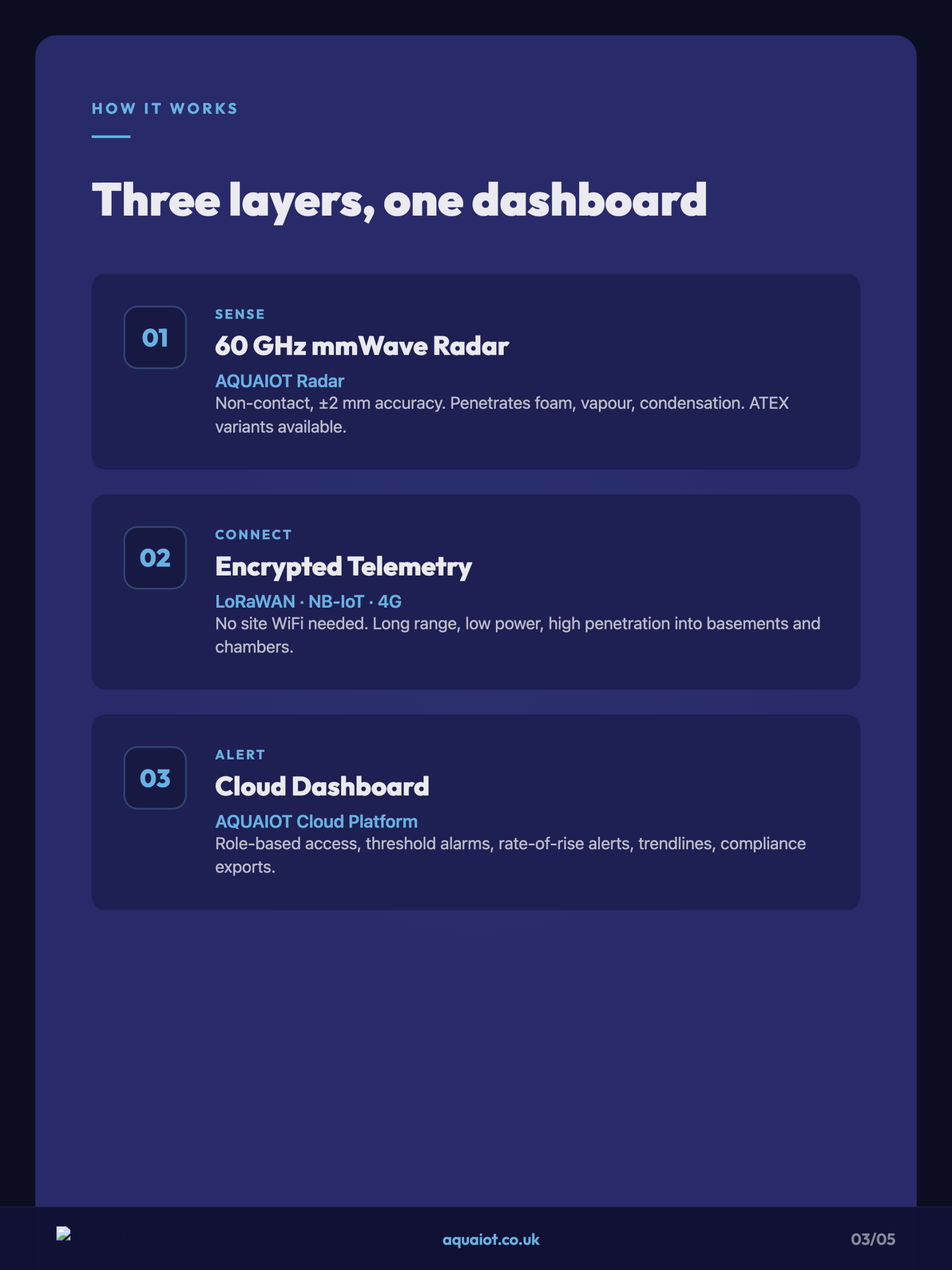
The architecture follows three layers. First, the sensing layer, where a radar, ultrasonic, or pressure-based water tank level sensor captures the distance between the sensor and the water surface. Second, the connectivity layer, where encrypted telemetry carries the reading from site to cloud without relying on site WiFi or wired infrastructure. Third, the intelligence layer, where a cloud dashboard ingests readings, runs threshold logic, generates alerts via email, SMS, or app notification, and stores an auditable history of every reading.
The AQUAIOT Radar exemplifies this architecture. Its 60 GHz mmWave radar takes non-contact measurements accurate to plus or minus 2 mm, transmits over LoRaWAN or cellular telemetry, and feeds AQUAIOT’s cloud dashboard where role-based access, trendlines, alarms, and exportable compliance reports give teams continuous visibility without site visits. ATEX variants are available for hazardous environments such as confined tank chambers or fuel-adjacent installations.
Which water tank level sensor technology should you choose?
The right water tank level sensor technology depends on the tank environment, the media being measured, and the accuracy and maintenance profile your operation requires, with radar sensors offering the strongest all-round performance for UK commercial and municipal water tanks. There are three primary sensor families used in remote water tank level monitoring, each with distinct trade-offs.
Radar sensors emit microwave pulses and measure the time of flight to calculate the distance to the water surface. Modern 60 GHz mmWave radar, such as the AQUAIOT Radar, delivers plus or minus 2 mm accuracy without any contact with the water. Radar penetrates foam, vapour, condensation, and temperature gradients, making it reliable in enclosed underground chambers, cold water storage tanks, and process vessels. It requires no recalibration for changes in water temperature or chemistry.
Ultrasonic sensors use sound waves rather than microwaves. They are effective in clean, open-top tanks but can struggle with foam, condensation, or narrow chambers where echo interference distorts the reading. Temperature compensation is needed because the speed of sound changes with air temperature.
Pressure-based (submersible) sensors sit at the bottom of the tank and infer the water level from hydrostatic pressure. They are robust for deep tanks and high-pressure environments but require physical contact with the water, which means periodic cleaning and recalibration, especially in tanks with sediment or chemical dosing.
For most UK commercial, council, and estates water tanks, radar water level sensors represent the best balance of accuracy, maintenance-free operation, and long deployment life. They are also the safest option for Legionella-sensitive cold water storage tanks because nothing enters the water, eliminating contamination pathways.
What are the risks of unmonitored water tanks?
Unmonitored water tanks expose organisations to overflow damage, Legionella growth, compliance failure, and avoidable water loss, any one of which can trigger insurance claims, enforcement action, or service disruption. The financial and operational risks are well documented.
Overflow and escape of water. Escape-of-water claims cost UK insurers over 1.8 million pounds every day, with the average cost of a fixed water tank claim reaching 5,404 pounds. Tank overflows caused by stuck float valves, failed ballcocks, or rising mains pressure surges are a leading trigger. Without continuous monitoring, the first sign of an overflow is often water coming through the ceiling below.
Legionella risk. HSE guidance HSG274 Part 2 requires cold water storage tanks to maintain temperatures below 20 degrees Celsius, with full water turnover every 24 hours. Without remote temperature and level monitoring, verifying these conditions depends on manual visits that may happen weekly or less frequently, leaving days of unrecorded drift in which Legionella bacteria can colonise.
Water loss. A leaking tank or a continuously running inlet valve can waste thousands of litres per day without detection if no one is monitoring the level trend. Leak detection relies on spotting anomalies in flow and level patterns, which is only possible with continuous data.
Compliance gaps. Organisations subject to ACoP L8, the Water Supply (Water Quality) Regulations, or sector-specific frameworks like HTM 04-01 for NHS estates need auditable records of tank conditions. Paper logs from manual inspections are difficult to verify, easy to falsify, and provide no continuous evidence between visits. A remote water tank level monitoring system generates timestamped, tamper-evident digital records that satisfy auditors and regulators.
How do you choose the right IoT tank monitoring system?
Choosing the right IoT tank monitoring system means evaluating five factors: sensor accuracy, connectivity, dashboard intelligence, compliance features, and retrofit compatibility, then matching those to your specific tank estate and operational requirements. The following selection criteria apply to any UK organisation deploying remote water tank level monitoring.
Step 1: Audit your tank estate. Map every tank, its purpose (cold water storage, fire reserve, attenuation, process), its access constraints, and any hazardous environment designations. This determines which sensor technology fits and whether you need ATEX-rated equipment.
Step 2: Match sensor to environment. For enclosed, hard-to-access, or Legionella-sensitive tanks, non-contact radar is the strongest choice. For open-top clean water tanks, ultrasonic may suffice at lower cost. For deep or pressurised vessels, submersible pressure sensors are proven.
Step 3: Confirm connectivity coverage. LoRaWAN offers excellent penetration into basements, plant rooms, and underground chambers with low power consumption. Cellular (4G or NB-IoT) works where LoRaWAN gateways are not deployed. Confirm coverage at each tank location before specifying.
Step 4: Evaluate the dashboard and alerting platform. The cloud platform should provide role-based access, configurable threshold alarms, rate-of-rise alerts, trendline analytics, exportable compliance reports, and integration capability via API, RS485/Modbus, or SCADA protocols. Check whether alerts route through email, SMS, and app with escalation rules.
Step 5: Assess retrofit compatibility and support. The system should install on existing tanks without shutdown or structural modification. Ask about engineering support from survey through installation, commissioning, and post-deployment maintenance. AQUAIOT Radar is designed for exactly this kind of retrofit deployment, with non-contact mounting, encrypted LoRaWAN telemetry, and end-to-end engineering support from site survey to live dashboard.
What compliance requirements apply to water tank monitoring in the UK?
UK water tank monitoring compliance is driven by the Health and Safety Executive’s ACoP L8 and HSG274 for Legionella control, the Water Supply (Water Quality) Regulations enforced by the Drinking Water Inspectorate, and sector-specific standards such as HTM 04-01 for NHS estates. Remote water tank level monitoring directly supports compliance across all three frameworks.
ACoP L8 requires every employer and duty holder to assess and control Legionella risk in their water systems. HSG274 Part 2 specifies that cold water storage tanks must keep temperatures below 20 degrees Celsius, achieve full turnover within 24 hours, and be inspected regularly for contamination, debris, and temperature drift. IoT tank monitoring with temperature sensing automates these checks and generates the continuous audit trail that manual inspection cannot provide.
For NHS and healthcare estates, HTM 04-01 adds stricter temperature monitoring frequencies and flushing verification requirements. Remote monitoring makes compliance provable rather than assumed, which matters when the Care Quality Commission or NHS Estates audit trail comes under scrutiny.
The AQUAIOT water quality monitoring platform supports these compliance workflows by combining continuous level and temperature data with cloud-based reporting, threshold alarms, and exportable records that map directly to the evidence requirements in L8, HSG274, and HTM 04-01. For organisations needing full water quality parameter coverage, the iSPA-T multi-parameter monitoring system adds pH, chlorine, turbidity, dissolved oxygen, and conductivity to the same dashboard.
The full AQUAIOT tank monitoring capability stack
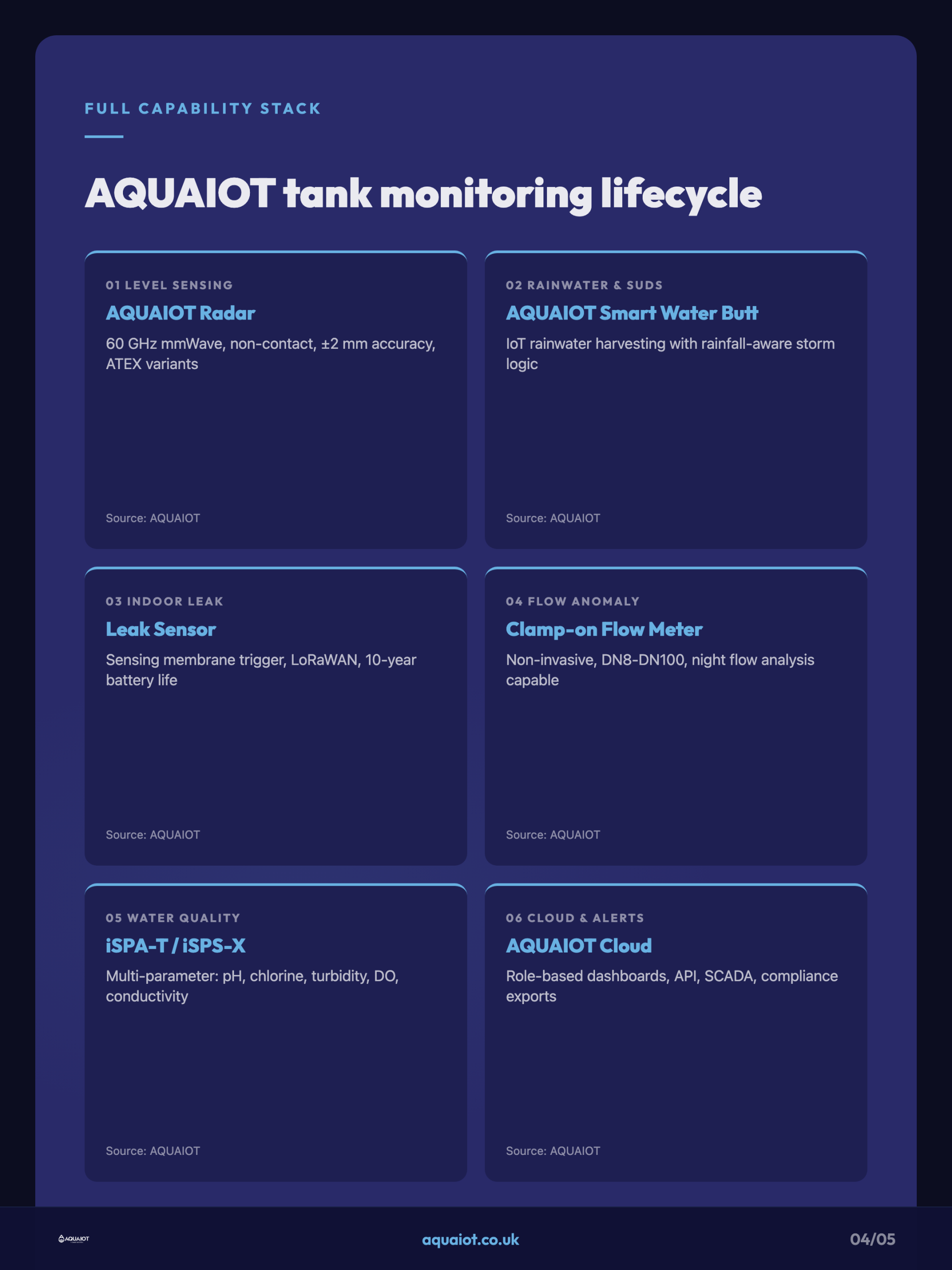
AQUAIOT covers the full tank monitoring lifecycle, from level sensing and overflow prevention through leak detection, water quality, and compliance reporting. Each layer addresses a distinct operational risk, and the entire stack feeds into a single cloud dashboard with unified alerting and audit trails.
Level sensing and overflow prevention
The AQUAIOT Radar provides continuous non-contact level measurement using 60 GHz mmWave radar, accurate to plus or minus 2 mm. It covers cold water storage tanks, fire reserve tanks, attenuation tanks, and process vessels. Rate-of-rise alerts trigger before overflow thresholds are breached, giving teams time to respond. ATEX variants handle hazardous and confined environments.
Rainwater harvesting and SuDS
The AQUAIOT Smart Water Butt brings IoT monitoring to rainwater harvesting systems. Rainfall-aware control logic optimises storage capacity before storm events, supporting sustainable drainage and climate resilience strategies. For larger SuDS and attenuation tank installations, the Radar product provides the level monitoring backbone.
Indoor leak detection
The Multifunction Water Leak Sensor catches the water that escapes tanks. Its leak sensing membrane triggers the moment water makes contact, with LoRaWAN Class A radio delivering alerts over long range on battery life up to 10 years. Paired with the AQUAIOT Cloud, it delivers multi-channel alerts via email, SMS, and voice. This is the layer that intercepts the 1.8-million-pound daily escape-of-water cost before it becomes a claim.
Flow anomaly detection
The Clamp-on Ultrasonic Flow Meter monitors flow on the pipes feeding and leaving tanks without cutting into the pipework. DN8 to DN100 coverage makes it suitable for most commercial installations. Night flow analysis using this meter reveals hidden leaks and continuously running inlet valves that waste water undetected.
Water quality and Legionella compliance
The iSPA-T multi-parameter monitoring system and the iSPS-X sensor add continuous water quality monitoring for pH, chlorine, turbidity, dissolved oxygen, conductivity, and ORP. For cold water storage tanks subject to L8 and HSG274, this closes the gap between periodic manual sampling and a continuous record. The AQUAIOT Legionella monitoring service wraps these sensors in a managed compliance workflow.
Cloud, alerts, and integration
Every sensor in the stack feeds into AQUAIOT’s cloud dashboard, providing role-based access, threshold alarms, rate-of-rise alerts, trendlines, analytics, and compliance exports. Open integration via API, RS485/Modbus, and SCADA protocols means tank monitoring data flows into existing CAFM, BMS, and asset management platforms without lock-in.
From our sister company: Where there is no fixed broadband, Indiott lists industrial 4G routers and LoRaWAN gateways with UK prices.
Frequently asked questions
How often does a remote water tank level monitoring system take readings?
Most IoT tank monitoring systems take readings every one to fifteen minutes, with the interval configurable to balance data resolution against battery life and telemetry costs. AQUAIOT Radar supports configurable intervals with LoRaWAN or cellular telemetry, and readings appear on the cloud dashboard within seconds of capture. For critical tanks such as fire reserves or Legionella-sensitive cold water storage, shorter intervals provide the continuous evidence trail that compliance frameworks require.
Can radar sensors work inside enclosed or underground tank chambers?
Radar water level sensors are specifically designed for enclosed and underground environments. The 60 GHz mmWave technology used by AQUAIOT Radar penetrates foam, vapour, condensation, and temperature gradients that defeat ultrasonic sensors. ATEX-rated variants are available for tanks in hazardous or confined spaces, making radar the most reliable water tank level sensor for hard-to-access installations.
What connectivity does IoT tank monitoring need on site?
IoT tank monitoring does not require site WiFi or wired network infrastructure. Systems connect via LoRaWAN, which offers excellent penetration into basements, plant rooms, and underground chambers with low power consumption, or via cellular networks (4G, NB-IoT) where LoRaWAN coverage is not available. AQUAIOT’s telemetry layer uses encrypted payloads and supports over-the-air firmware updates, so the system operates independently of existing IT infrastructure.
Does remote tank monitoring satisfy Legionella compliance under L8 and HSG274?
Remote tank monitoring with temperature sensing directly supports Legionella compliance under ACoP L8 and HSG274 Part 2 by providing continuous, timestamped evidence that cold water storage tanks remain below the 20 degree Celsius threshold and achieve full turnover within 24 hours. The digital audit trail replaces paper logs and gives duty holders defensible records for HSE inspections, insurer audits, and CQC reviews in healthcare settings.
Last updated: 26 May 2026
By G P, Digital and IoT lead at AQUAIOT