




Continuous Chlorine Monitoring: How IoT Sensors Protect UK Water Systems in 2026
Key takeaways
- Continuous chlorine monitoring measures free and total chlorine residual around the clock, flagging deviations within minutes rather than days.
- The Drinking Water Inspectorate requires operators using chemical disinfection to verify residual effectiveness continuously, not just at scheduled intervals.
- WHO guidance recommends a minimum free chlorine concentration of 0.5 mg/l after 30 minutes contact time at pH below 8.0.
- In 2024, 463 confirmed Legionnaires’ disease cases were recorded in England and Wales, with a 2.8% case fatality rate.
- AQUAIOT’s SPA-Chlorine Analyzer delivers inline free and total chlorine monitoring integrated with cloud dashboards, threshold alarms, and audit-ready reporting.
- Continuous monitoring supports ACoP L8 and HSG274 compliance by providing tamper-evident temperature and water quality records exportable for HSE inspections.
Contents
- What is continuous chlorine monitoring and why does it matter?
- Why do UK buildings need chlorine residual monitoring?
- How does an IoT continuous chlorine monitoring system work?
- What chlorine levels should UK water systems maintain?
- How does continuous chlorine monitoring support Legionella control?
- How do you choose a continuous chlorine monitoring system for your site?
- The full AQUAIOT water quality capability stack
- Frequently asked questions
What is continuous chlorine monitoring and why does it matter?
Continuous chlorine monitoring is the practice of measuring free and total chlorine residual in a water system around the clock using inline sensors and IoT telemetry, rather than relying on periodic manual grab samples. It matters because chlorine residual can change within hours due to temperature fluctuations, biofilm growth, or demand spikes, and a grab sample taken on Tuesday tells you nothing about what happened on Wednesday night.
For UK duty holders managing hot and cold water systems in hospitals, housing estates, council buildings, and commercial property, chlorine is the primary chemical barrier against waterborne pathogens. When residual levels drop below safe thresholds, bacteria including Legionella pneumophila can colonise pipework within days. Traditional monitoring catches this on the next scheduled visit. Continuous chlorine monitoring catches it in minutes.
The shift from reactive to continuous monitoring is not just about safety. It is driven by regulatory pressure. The Drinking Water Inspectorate’s guidance on Regulation 7 frames monitoring as the way to verify that control measures, including chemical disinfection, remain effective. Continuous inline measurement is the most defensible way to demonstrate that duty.
AQUAIOT’s SPA-Chlorine Free/Total Chlorine Water Quality Analyzer provides exactly this: automated, inline chlorine residual measurement with cloud-connected dashboards and threshold alarms. It removes the reliance on manual test kits and gives estates teams a continuous, auditable record of disinfection performance.
Why do UK buildings need chlorine residual monitoring?
UK buildings need chlorine residual monitoring because chlorine is the disinfectant that stands between building occupants and waterborne illness, and its concentration is not static.
Many of those community-acquired infections originated in building water systems where control measures had drifted.
Three regulatory frameworks converge on this requirement:
- ACoP L8 requires duty holders to implement control measures that prevent or control the risk of Legionella exposure. Temperature control is the primary measure, but chemical treatment including chlorination is a recognised supplementary control, and where it is used, its effectiveness must be verified.
- HSG274 Part 2 provides the technical detail. It specifies monitoring frequencies for hot and cold water systems and expects records of all control measures, including disinfectant residual where chemical treatment is applied.
- The Water Supply (Water Quality) Regulations set standards for drinking water quality across England and Wales. For private water supplies using chlorination, the DWI requires residual monitoring to verify treatment effectiveness.
Beyond compliance, there is a financial case.
Since April 2020, Ofwat has taken enforcement action totalling more than 416 million pounds against seven water companies for performance failures.
Building operators face their own liability: a single Legionella outbreak can trigger HSE prosecution, civil claims, and reputational damage that dwarfs the cost of continuous monitoring equipment.
The AQUAIOT water quality monitoring service is built for this operating environment, connecting inline chlorine sensors to cloud dashboards that log every reading, flag every exceedance, and export audit packs on demand.
How does an IoT continuous chlorine monitoring system work?
An IoT continuous chlorine monitoring system works by combining an inline electrochemical or amperometric sensor with secure wireless telemetry and a cloud analytics platform, so that chlorine residual data flows from the pipe to the dashboard without manual intervention. The sensor sits in a flow cell on the pipework, continuously measuring free chlorine, total chlorine, or both, and transmitting readings at configurable intervals.
The architecture has three layers:
- Sense: The chlorine sensor (electrochemical or optical) measures residual concentration inline. AQUAIOT uses the SPA-Chlorine Analyzer for free and total chlorine, and the iSPA-T Multi-Parameter Water Quality Online Monitoring System where chlorine needs to be measured alongside pH, turbidity, conductivity, and dissolved oxygen in a single deployment.
- Connect: Readings travel via LoRaWAN or cellular telemetry with encrypted payloads to AQUAIOT’s cloud platform. The system supports RS485/Modbus on site for integration with existing BMS, SCADA, or CAFM systems.
- Alert: The cloud dashboard applies threshold logic: if free chlorine drops below 0.2 mg/l or rises above 1.0 mg/l, the system triggers role-based alerts via email, SMS, or app notification. Escalation rules ensure the right person responds at the right time.
This three-layer architecture means facilities managers no longer wait for the next scheduled DPD test to discover a chlorine shortfall. The system tells them within minutes, and the audit trail proves it.
What chlorine levels should UK water systems maintain?
UK water systems should maintain a free chlorine residual between 0.2 mg/l at the point of delivery and 0.5 mg/l after 30 minutes of contact time, based on World Health Organisation guidance and Drinking Water Inspectorate recommendations.
Most UK water companies aim to keep residual chlorine below 1 mg/l, and typically maintain levels at 0.5 mg/l or less at the tap.
The practical challenge for building operators is that chlorine decays as water moves through the distribution system and through internal pipework. A reading of 0.4 mg/l at the incoming main can fall to 0.1 mg/l at a distant outlet, especially in systems with long pipe runs, dead legs, or intermittent demand. This decay is temperature-dependent: warmer water consumes chlorine faster. Without continuous chlorine monitoring, operators have no way to see this decay happening between scheduled checks.
Key thresholds for UK building water systems:
| Parameter | Minimum | Target | Maximum |
|---|---|---|---|
| Free chlorine at point of delivery | 0.2 mg/l | 0.2 to 0.5 mg/l | Less than 1.0 mg/l |
| Free chlorine after contact time (30 min, pH below 8.0) | 0.5 mg/l | 0.5 mg/l | WHO guideline max 5 mg/l |
| Total chlorine (where combined chlorine is present) | Site-specific | Record and trend | Site-specific |
Continuous chlorine monitoring makes these thresholds actionable. Instead of a monthly grab sample that might catch an exceedance or might not, the iSPS-X Multi-Parameter Sensor and SPA-Chlorine Analyzer log every reading, flag drift, and give operators the evidence they need to adjust dosing or investigate the cause before the residual falls to zero.
How does continuous chlorine monitoring support Legionella control?
Continuous chlorine monitoring supports Legionella control by providing a second, independent verification layer alongside temperature monitoring, confirming that the chemical barrier against bacterial colonisation is present and effective at all times. Under ACoP L8, temperature control is the primary measure, but where chemical treatment is used as a supplementary control, its effectiveness must be demonstrable.
Legionella pneumophila proliferates in water between 20 and 45 degrees Celsius. Maintaining hot water above 60 degrees at the calorifier and above 50 degrees at outlets is the first line of defence. But in complex building water systems, especially those with long pipe runs, infrequently used outlets, or fluctuating demand, temperature alone does not guarantee safety. Chlorine residual acts as the chemical safety net, and chlorine monitoring confirms it is present.
A continuous chlorine monitoring system integrated with the AQUAIOT platform delivers three things that manual testing cannot:
- Real-time gap detection. If chlorine residual drops at a sentinel point, the system alerts the responsible person immediately, not at the next monthly visit.
- Correlation with temperature data. When AQUAIOT’s Legionella monitoring service is deployed alongside chlorine monitoring, operators can cross-reference temperature excursions with chlorine decay on a single dashboard, identifying systemic risks faster.
- Audit-ready evidence. HSE inspectors reviewing an L8 logbook want to see that control measures are working. A continuous, timestamped chlorine record is stronger evidence than a clipboard entry made once a month.
For NHS estates and large housing providers, where
21 healthcare-associated Legionella cases were reported in England and Wales in 2024
, continuous chlorine monitoring is not a luxury. It is a practical layer in a defence-in-depth water safety strategy.
How do you choose a continuous chlorine monitoring system for your site?
Choosing a continuous chlorine monitoring system requires matching the sensor technology, connectivity, and integration capability to your site’s water system complexity, regulatory obligations, and operational resources. The right system measures accurately, transmits reliably, and fits into your existing compliance workflow without creating a parallel data silo.
Follow these steps to select the right system:
- Define what you need to measure. Free chlorine only, or free and total chlorine? If your system uses chloramine or has significant combined chlorine, you need a sensor capable of measuring both. The AQUAIOT SPA-Chlorine Analyzer covers free and total chlorine in a single unit.
- Map your critical monitoring points. Identify the locations where chlorine residual matters most: incoming main, calorifier outlet, distribution loop return, sentinel outlets, and any dead-leg remediation points. More points need more sensors, but not every outlet needs one.
- Check connectivity options. LoRaWAN suits distributed estates with many monitoring points and long battery life requirements. Cellular suits remote or standalone sites. Ethernet or Wi-Fi suits plant rooms with existing network infrastructure. AQUAIOT supports all four.
- Confirm integration requirements. If you run a BMS, SCADA system, or CAFM platform, the chlorine monitoring system must feed data into it. AQUAIOT systems support RS485/Modbus on site and open APIs for cloud integration.
- Verify the audit trail. The system must produce timestamped, tamper-evident logs that satisfy HSE and DWI expectations. Look for automated PDF/CSV export and role-based access so auditors can pull records without IT involvement.
- Assess maintenance burden. Electrochemical chlorine sensors require periodic calibration and membrane replacement. Understand the maintenance interval and whether the supplier provides engineering support. AQUAIOT provides end-to-end engineering support including installation, commissioning, and ongoing calibration.
The goal is a system that runs continuously, alerts reliably, integrates cleanly, and produces the evidence your compliance team needs without adding manual workload. That is the standard AQUAIOT’s water quality monitoring platform is built to meet.
The full AQUAIOT water quality capability stack
Effective chlorine monitoring does not operate in isolation. Effective water quality management requires a layered approach, from chemical residual measurement through multi-parameter sensing to temperature profiling and flow analysis. AQUAIOT provides the full stack.
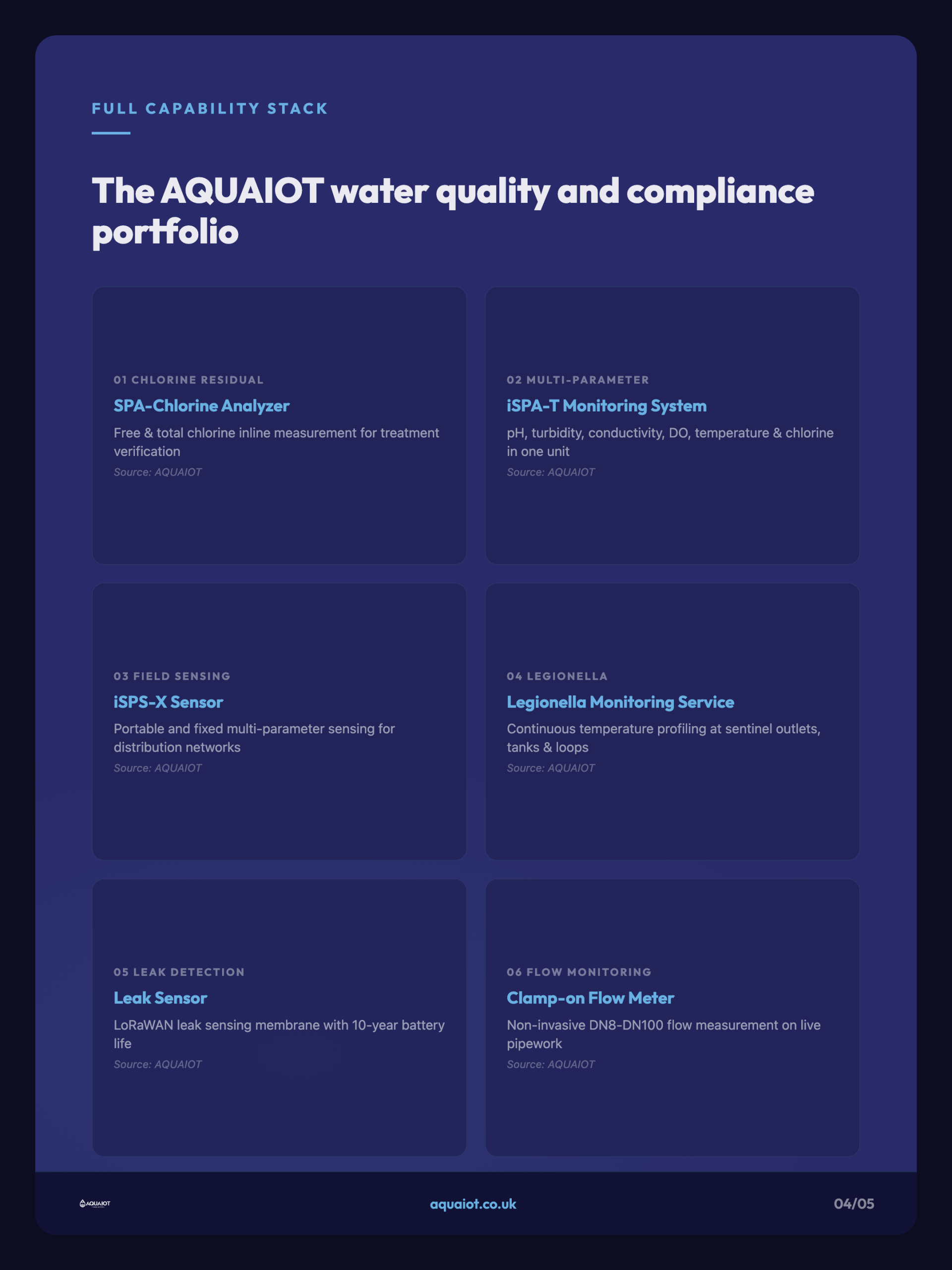
Chlorine residual measurement
The SPA-Chlorine Free/Total Chlorine Water Quality Analyzer delivers continuous inline measurement of free and total chlorine for treatment verification and distribution monitoring.
Multi-parameter water quality monitoring
The iSPA-T Multi-Parameter Water Quality Online Monitoring System measures pH, turbidity, conductivity, dissolved oxygen, temperature, and chlorine simultaneously, providing a complete water quality picture from a single deployment point.
Field-deployable multi-parameter sensing
The iSPS-X Multi-Parameter Sensor extends multi-parameter capability to field and distribution network monitoring, supporting portable and fixed deployment configurations.
Legionella temperature profiling
AQUAIOT’s Legionella monitoring service continuously profiles sentinel outlets, tanks, and distribution loops against HSE temperature thresholds, alerting the moment conditions drift into risk zones.
Leak detection
The Multifunction Water Leak Sensor, with its leak sensing membrane and LoRaWAN connectivity, detects moisture the moment water makes contact. In water quality contexts, leak detection protects against ingress contamination that can compromise chlorine residual.
Flow monitoring
The Clamp-on Ultrasonic Flow Meter provides non-invasive flow measurement on live pipework (DN8 to DN100), identifying low-flow zones where chlorine residual decays fastest and stagnation risk is highest.
Cloud platform, alerts, and integration
Every sensor feeds into AQUAIOT’s cloud dashboard with role-based access, threshold alarms, trendlines, analytics, and automated report export. Integration via RS485/Modbus, APIs, and SCADA/CAFM connectors means chlorine data sits alongside every other water parameter in a single operational view.
Frequently asked questions
What is the difference between free chlorine and total chlorine?
Free chlorine is the active disinfectant available to kill bacteria in water, while total chlorine is the sum of free chlorine and combined chlorine (chloramines formed when free chlorine reacts with ammonia or organic nitrogen). For disinfection effectiveness monitoring, free chlorine is the critical measurement because it represents the residual that is actually available to neutralise pathogens. Total chlorine measurement matters where chloramine dosing is used or where operators need to understand how much chlorine demand the water system is consuming.
How often should chlorine levels be checked in a building water system?
Where chemical disinfection is part of the water treatment regime, chlorine levels should be checked continuously using inline sensors rather than relying solely on periodic manual tests. HSG274 Part 2 expects regular monitoring of control measures, and the DWI requires operators using chlorination to verify effectiveness on an ongoing basis. Continuous monitoring provides the most complete record and the fastest response to exceedances, which is why it is increasingly the standard for NHS estates, housing associations, and commercial property operators across the UK.
Can IoT chlorine monitoring integrate with existing building management systems?
Yes, IoT chlorine monitoring systems from AQUAIOT integrate with existing building management systems through RS485/Modbus protocols on site and open APIs for cloud-level connection to SCADA, AIMS, and CAFM platforms. This means chlorine residual data appears alongside temperature, flow, and other water parameters in the operator’s existing management interface, eliminating the need for a separate monitoring portal.
What maintenance does a continuous chlorine sensor require?
A continuous chlorine sensor typically requires calibration every one to three months and periodic membrane or reagent replacement depending on the sensor technology. Electrochemical sensors need membrane and electrolyte changes at intervals set by the manufacturer. AQUAIOT provides end-to-end engineering support including scheduled calibration, membrane replacement, and remote diagnostics through the cloud platform, so the maintenance burden on facilities teams is minimal. This means chlorine monitoring runs continuously without drawing on your operations team’s time.
Continuous chlorine monitoring is no longer a premium option reserved for water utilities. For any UK organisation operating building water systems where chemical disinfection is part of the control regime, it is the practical standard for demonstrating that your chlorine monitoring obligations are met, your occupants are protected, and your records are ready for the next audit.
Last updated: 24 May 2026
By GP, Digital and IoT lead at AQUAIOT