




Wastewater compliance monitoring: what Ofwat’s £300m sector-wide enforcement is really about
TL;DR: The regulator Ofwat now has enforcement action under way against all 11 water and wastewater companies in England and Wales, with penalties and enforcement packages already totalling more than £300 million. The common finding is blunt: companies failed to operate, maintain and upgrade their wastewater assets well enough to cope with the flows reaching them, so the excess spilled. Underneath that sits a visibility problem, because you cannot operate an asset to a standard you cannot see. Continuous wastewater compliance monitoring is how that standard becomes measurable, and provable.
Last updated: 29 June 2026
On this page
Key takeaways
- Ofwat’s wastewater investigation is its largest and most complex, with enforcement now under way against all 11 water and wastewater companies in England and Wales.
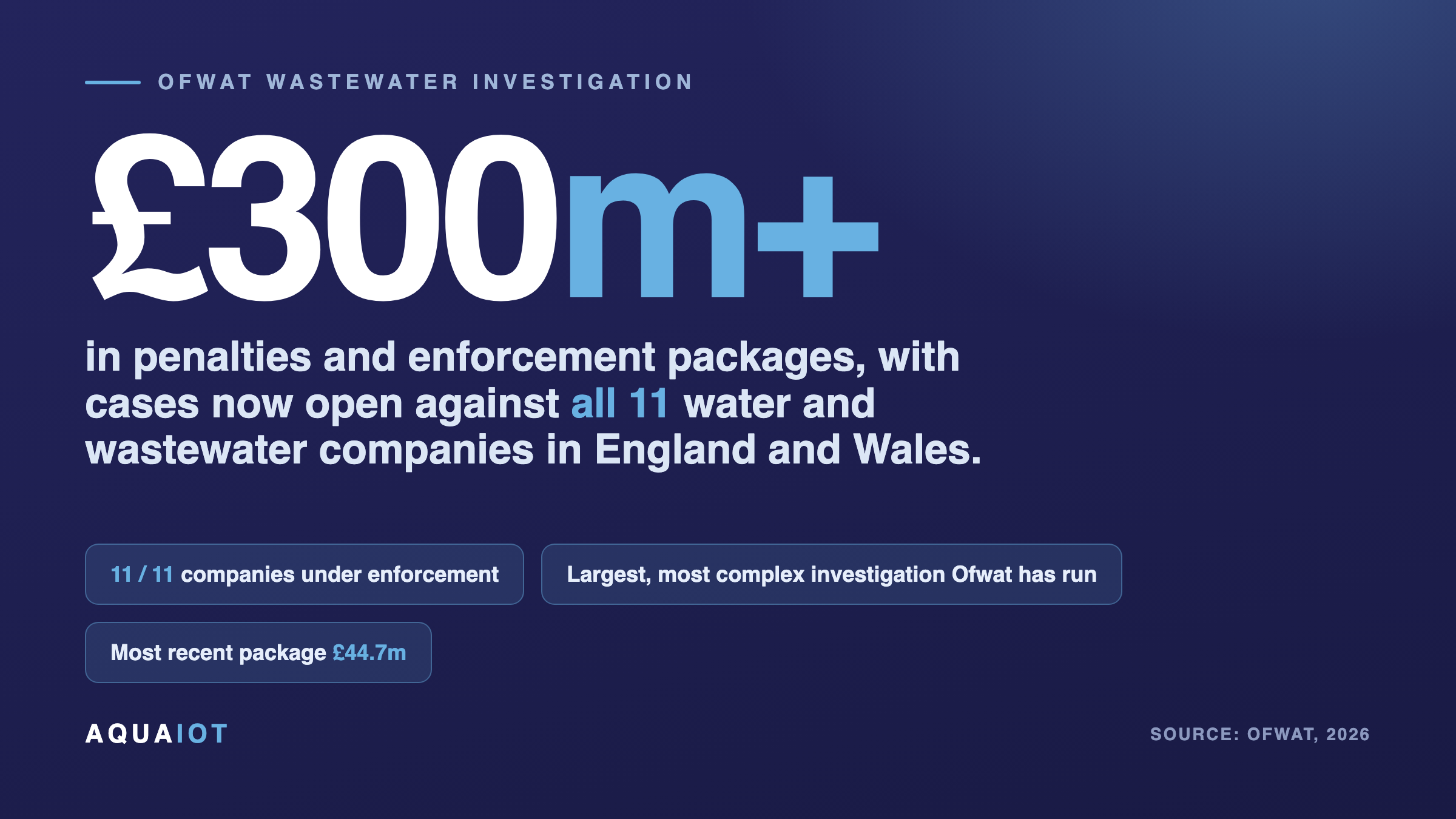
- Penalties and enforcement packages across the investigation already exceed £300 million; the most recent package was £44.7 million.
- The consistent finding is a failure to operate, maintain and upgrade wastewater assets so they can cope with the flows reaching them.
- From April 2026, Pollution Incident Reduction Plans are a mandatory duty, and they must set out better monitoring as a specific action to cut pollution.
- The root issue is visibility. Continuous wastewater compliance monitoring is what turns “we think it is fine” into evidence.
What is Ofwat’s wastewater investigation about?
It is the regulator’s largest and most complex investigation, with enforcement action now in progress against all 11 water and wastewater companies in England and Wales over how they have operated their wastewater networks. Penalties and enforcement packages across the cases so far total more than £300 million, and the most recent package was £44.7 million.
This is not a single bad operator being singled out. It is a sector-wide finding about how wastewater treatment works and sewerage networks have been run, and about whether companies could prove they were managing those assets to limit spills and environmental harm. That distinction matters, because it moves the question from “did one site fail” to “can you demonstrate, with data, that your assets are coping”.
What do the enforcement cases have in common?
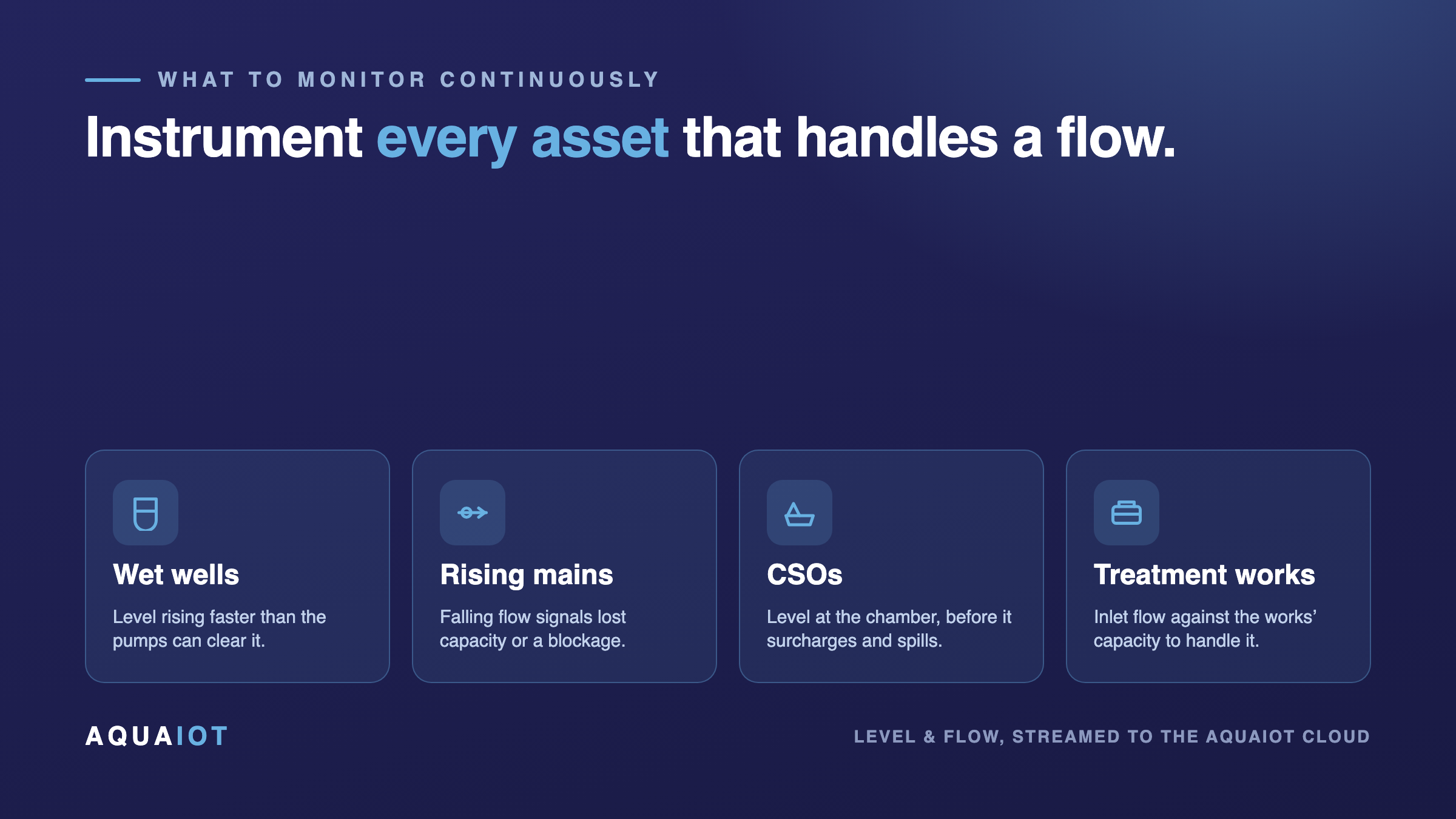
Across the cases the finding is strikingly consistent: companies did not operate, maintain and upgrade their wastewater assets adequately to ensure they could cope with the flows of sewage and wastewater reaching them. When a pumping station, a rising main or a treatment works cannot handle the flow it receives, the excess has to go somewhere, and that somewhere is a storm overflow spilling into a watercourse.
The enforcement is about the asset management that allowed this to happen, repeatedly, without it being caught and corrected in time. A spill is the visible event, but it is the end of a chain that began much earlier, with an asset quietly losing the ability to cope while nobody had a live view of it.
Why is wastewater compliance monitoring a visibility problem first?
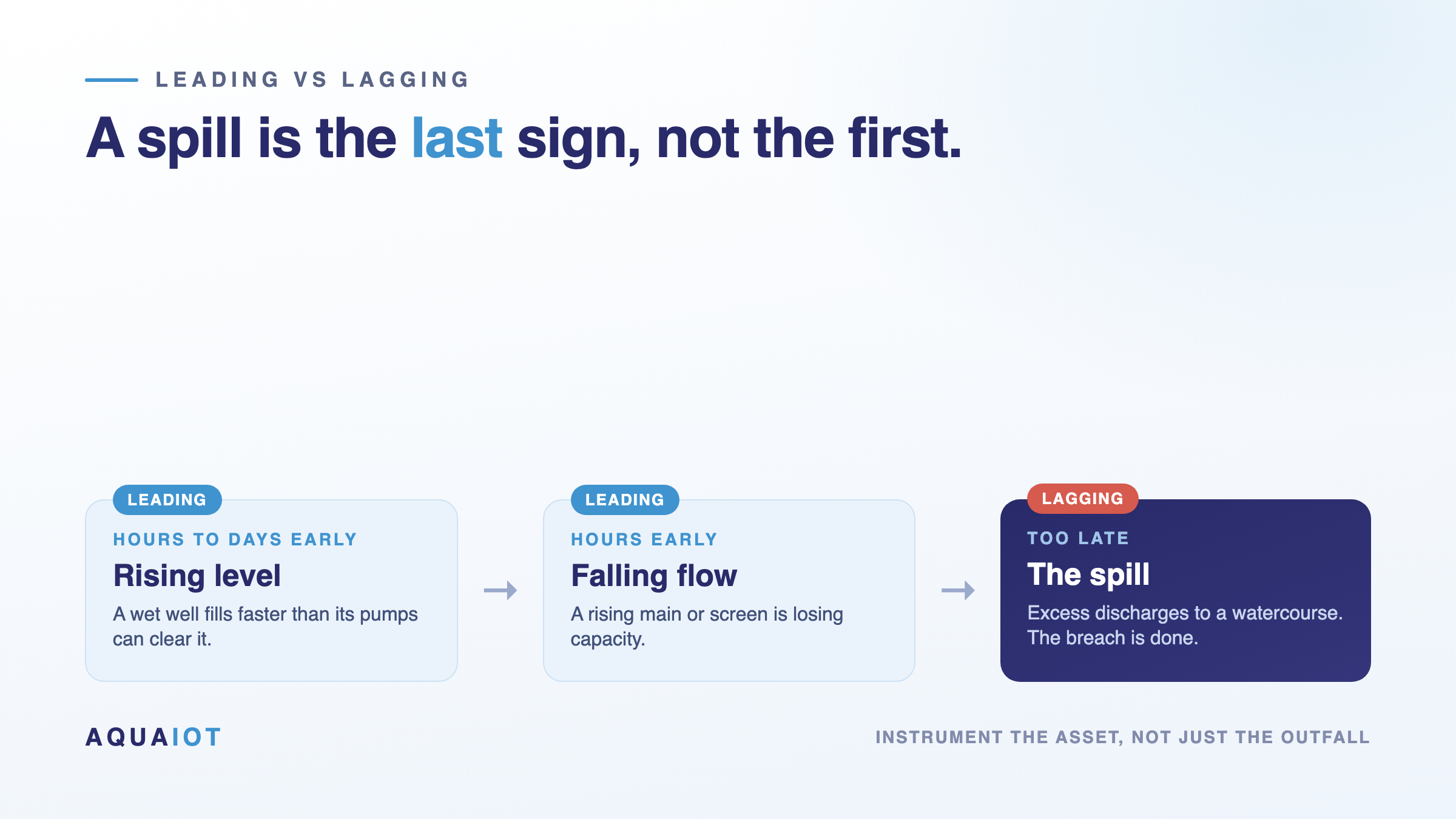
Because an asset failing to cope with its flow is a monitoring problem before it is a maintenance problem. Wastewater compliance monitoring exists to close the gap between what is happening in an asset and what an operator can actually see. If a wet well is filling faster than its pumps can clear it, if a rising main is losing capacity, or if a screen is blinding, that condition is present in the level and flow data long before it shows up as a spill.
Without continuous instrumentation, the first sign is often the spill itself, or the regulator’s letter afterwards. By then the breach has already happened and the evidence trail is thin. With continuous data, the same condition is visible while it is still a routine maintenance job, not yet an enforcement case, and every reading is logged as part of the record.
What does continuous wastewater compliance monitoring change?
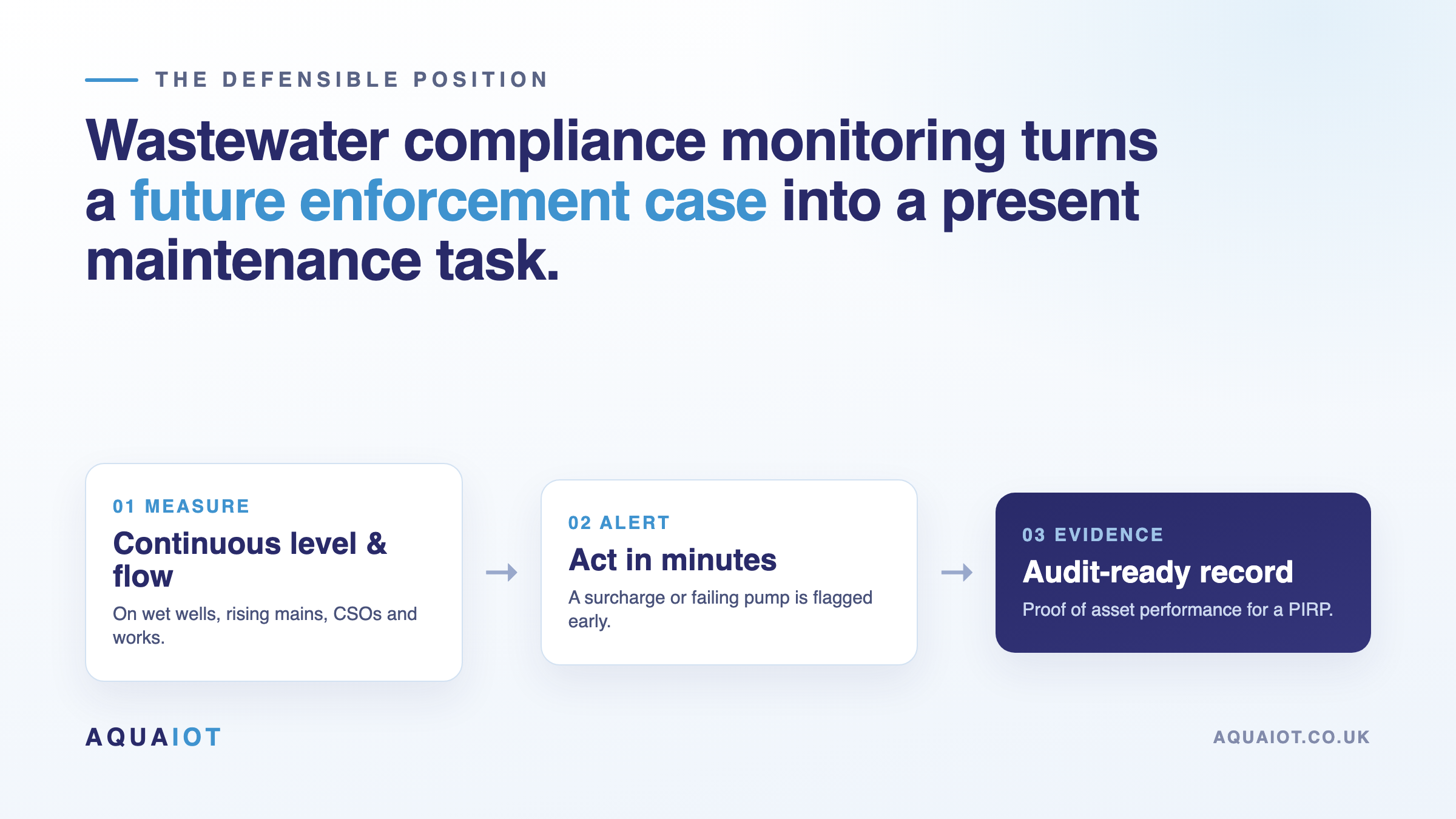
It gives an operator a live picture of whether each asset is coping with its flow, and it creates the auditable record that proves it. Level and flow sensors on the assets that matter, wet wells, pumping stations, rising mains and combined sewer overflows, are the foundation of effective wastewater compliance monitoring. The AQUAIOT Radar measures level non-contact, through foam and debris, and streams it to the AQUAIOT Cloud, which raises an alert the moment a level or a flow crosses a threshold.
A surcharging chamber, a failing pump or a blockage building up is flagged in minutes, while there is still time to act. Just as importantly, every reading becomes an auditable record of how the asset was performing. That record is what separates a defensible position from a hopeful one, and it is exactly what the next phase of regulation will ask operators to produce.
What do Pollution Incident Reduction Plans mean from April 2026?
From April 2026, Pollution Incident Reduction Plans become a mandatory annual duty under the Water (Special Measures) Act 2025. Companies must publish plans that set out the specific actions they will take to cut pollution, and the government guidance names better monitoring as one of those actions, alongside clearing blockages and identifying the root causes of incidents.
The bar is high. Failing to publish a compliant plan is a criminal offence for both the company and its chief executive, and from April 2027 operators must produce annual implementation reports showing progress. A plan that promises better monitoring has to be backed by data, and continuous wastewater compliance monitoring is the most direct way to generate it.
What should anyone running wastewater assets do now?
Treat continuous visibility as the project, not an extra. The enforcement is sector-wide, the standard is rising, and the ability to demonstrate asset performance with data is becoming the expectation rather than the exception. The practical steps are straightforward.
- Map your assets by visibility: which wet wells, rising mains and overflows stream live level and flow data today, and which are still checked by eye.
- Instrument the blind spots first. Spills are a lagging indicator, so monitor the asset, not just the outfall.
- Set thresholds and alerts so a surcharge or a failing pump is caught as a maintenance task, not an incident.
- Keep the evidence. An auditable record of asset performance is what a Pollution Incident Reduction Plan will rest on.
Frequently asked questions
What is Ofwat’s wastewater investigation?
It is Ofwat’s largest and most complex investigation, with enforcement action now under way against all 11 water and wastewater companies in England and Wales over the operation of their wastewater networks. Penalties and enforcement packages across the cases so far total more than £300 million, the most recent being £44.7 million.
What is wastewater compliance monitoring?
Wastewater compliance monitoring is the continuous measurement of level and flow on the assets that handle sewage and wastewater, such as wet wells, rising mains, combined sewer overflows and treatment works. It shows in real time whether each asset is coping with its flow and creates an auditable record of how it performed.
How does continuous monitoring help with wastewater compliance?
It flags a surcharge, a failing pump or a building blockage in minutes, while it is still a maintenance task rather than a spill, and it produces the data trail that proves how an asset was performing. That record is exactly what a Pollution Incident Reduction Plan and any later enforcement question will rest on.
What changes for water companies from April 2026?
From April 2026, Pollution Incident Reduction Plans are a mandatory annual duty under the Water (Special Measures) Act 2025, and they must set out specific actions to cut pollution, including better monitoring. Failing to publish a compliant plan is a criminal offence for the company and its chief executive.
More than £300 million in penalties across an entire sector is a clear signal about where wastewater regulation is heading. The defensible position is continuous visibility of every asset that handles a flow. Talk to AQUAIOT about continuous wastewater compliance monitoring for wet wells, rising mains and overflows, or explore the full range of AQUAIOT monitoring solutions.