

Storm Overflow Monitoring: The 2026 UK Compliance and IoT Sensor Guide
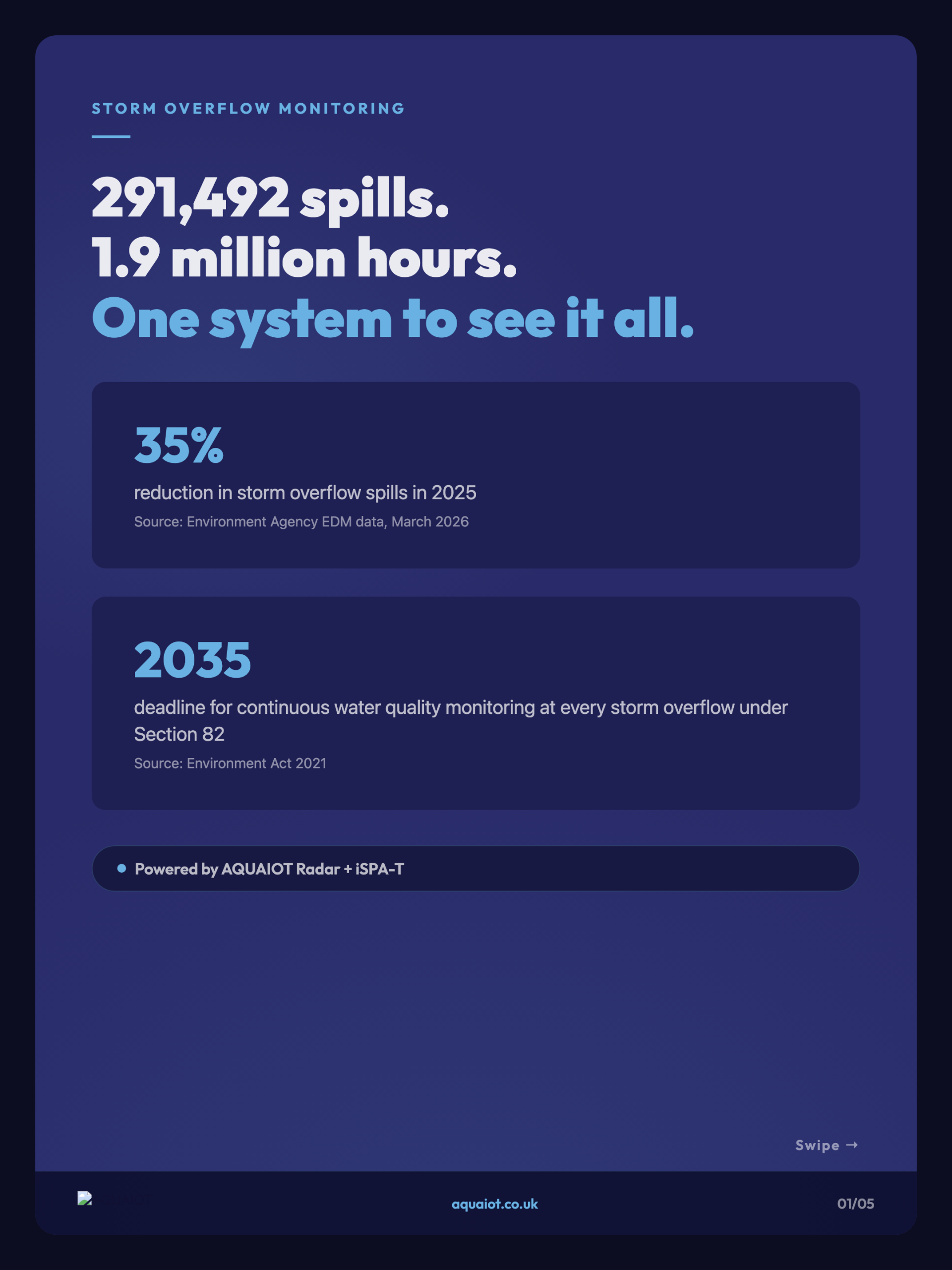
Storm overflow monitoring uses IoT sensors, telemetry and cloud dashboards to track sewer levels, spill events and water quality at combined sewer overflows in real time. England recorded 291,492 storm overflow spills in 2025 lasting 1.9 million hours, and the Environment Act 2021 now requires continuous water quality monitoring at every storm overflow by 2035. This guide explains the regulatory framework, the sensor technology behind effective storm overflow monitoring, and how to choose a system that delivers compliance evidence and faster operational response.
Key takeaways
- England logged 291,492 storm overflow spills in 2025, a 35% reduction on 2024, but still totalling 1.9 million hours of discharge.
- Section 82 of the Environment Act 2021 mandates continuous water quality monitoring at every storm overflow and treatment works in England by 2035.
- Event duration monitors (EDMs) now cover 100% of England’s 14,000-plus storm overflows, supporting the government’s target to halve total spills to 225,199 by 2029.
- AQUAIOT Radar delivers non-contact 60 GHz mmWave level sensing accurate to plus or minus 2 mm, penetrating foam, vapour and condensation in enclosed sewer chambers.
- Effective storm overflow monitoring combines level sensing, flow measurement, water quality analytics and a cloud platform with real-time alerts and audit-ready reporting.
Contents
- What is storm overflow monitoring and why does it matter in 2026?
- How many storm overflow spills happen in England each year?
- What does the law require for storm overflow monitoring?
- How do IoT sensors monitor storm overflows in real time?
- How should you choose a storm overflow monitoring system?
- Which companies provide storm overflow event duration monitoring?
- Frequently asked questions
What is storm overflow monitoring and why does it matter in 2026?
Storm overflow monitoring is the continuous measurement of sewer levels, spill events and discharge quality at combined sewer overflow (CSO) points using IoT sensors, telemetry and cloud-based dashboards. It matters in 2026 because England has reached 100% event duration monitor (EDM) coverage across its 14,000-plus storm overflows, and the regulatory regime is shifting from simply counting spills to demanding continuous water quality data under Section 82 of the Environment Act 2021.
Combined sewer overflows exist by design. When rainfall overwhelms a combined sewer’s capacity, the overflow discharges a diluted mix of rainwater and sewage into rivers, estuaries or the sea. The system prevents sewage from backing up into streets and properties. The problem is not that overflows exist but that they spill too often, for too long, and without adequate visibility. Storm overflow monitoring closes that visibility gap by giving operators, regulators and the public near real-time evidence of what is happening at every discharge point.
For water companies facing Ofwat performance commitments under AMP8 (2025 to 2030), storm overflow monitoring is no longer a nice-to-have. It underpins spill-reduction targets, Section 82 compliance, pollution-incident reporting and the public transparency that regulators and communities now expect. For councils, housing providers and estates teams responsible for private drainage networks, the same monitoring technology provides early warning of surcharging, blockage and flood risk before incidents escalate.
How many storm overflow spills happen in England each year?
England recorded
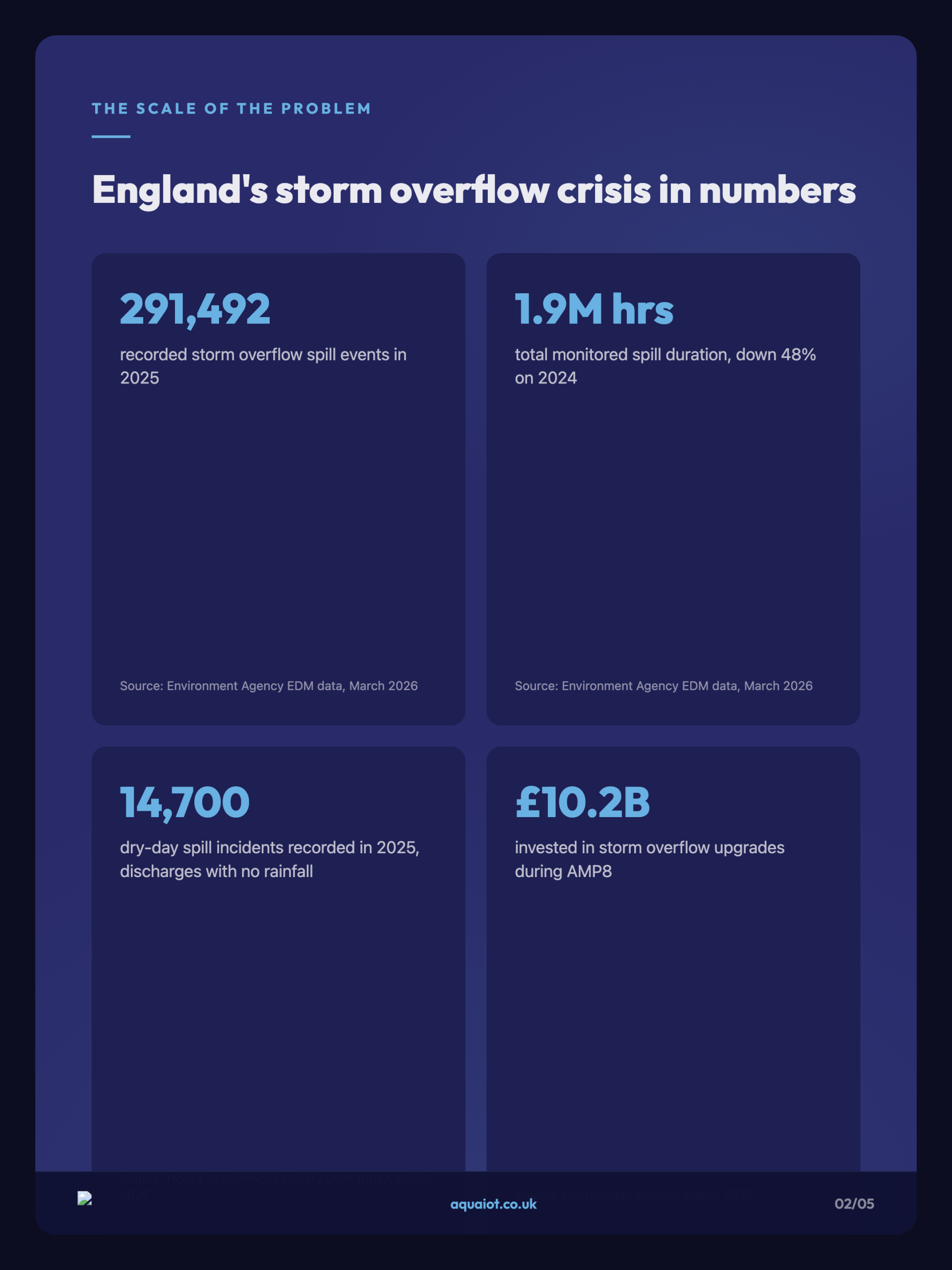
291,492 storm overflow spill events in 2025, a 35% reduction on 2024, with total monitored spill duration falling 48% to approximately 1.9 million hours
. The average number of spills per overflow dropped from 31.8 in 2024 to 20.5 in 2025. While the direction is positive, much of the improvement reflects rainfall levels 24% lower than the previous year rather than systemic infrastructure change.
The Environment Agency’s 2025 EDM data also flagged 14,700 dry-day spill incidents, discharges that occurred without rainfall and are considered illegal because there is no excess rainwater to justify the release or dilute the waste. The government’s storm overflow discharge reduction plan targets halving total spills to a maximum of 225,199 by the end of 2029, backed by 10.2 billion pounds of investment in storm overflow upgrades as part of the wider 104 billion pounds being spent on water infrastructure during AMP8.
These numbers matter for anyone operating or overseeing drainage assets. Storm overflow monitoring is the mechanism that turns raw spill data into actionable insight, and without it, operators cannot distinguish between a weather-driven event and a system failure that demands intervention.
What does the law require for storm overflow monitoring?
UK law now requires three overlapping layers of storm overflow monitoring: event duration monitoring under existing permits, continuous water quality monitoring under Section 82 of the Environment Act 2021, and performance reporting under Ofwat’s AMP8 framework. Together, these create the most demanding regulatory regime for sewer discharge visibility that England has ever had.
Event duration monitoring (EDM). Every storm overflow in England must have an EDM fitted. The programme reached 100% coverage in December 2023, and the data now feeds public maps within an hour of a spill. EDM tells regulators when a spill started, how long it lasted and how often it recurs. Under the Water (Special Measures) Act 2025, penalties for pollution incidents have been strengthened, and dry-day spills now count towards the Environment Agency’s total pollution incidents metric.
Section 82 continuous water quality monitoring. Section 82 mandates continuous, near real-time monitoring of six water quality parameters (dissolved oxygen, temperature, pH, turbidity, ammonia and conductivity) upstream and downstream of every storm overflow and treatment works. The rollout is phased: at least 25% of applicable assets by 2030, starting with high-priority sites such as chalk streams, SSSIs, bathing waters and urban areas, and full coverage by 2035. Data must be published within one hour of measurement.
Ofwat AMP8 performance commitments. Ofwat’s PR24 framework ties storm overflow monitoring directly to company performance. Water companies must create four million cubic metres of additional storm overflow storage capacity by 2030, and their reported spill counts feed the EPA methodology updated in 2026. Enforcement undertakings in 2025 already totalled 6.9 million pounds, with unlimited fines available for confirmed breaches.
For operators of private drainage networks, councils overseeing surface water systems and housing providers managing shared infrastructure, the regulatory direction is clear: storm overflow monitoring must deliver auditable, real-time evidence that stands up to scrutiny from regulators, insurers and the public.
How do IoT sensors monitor storm overflows in real time?
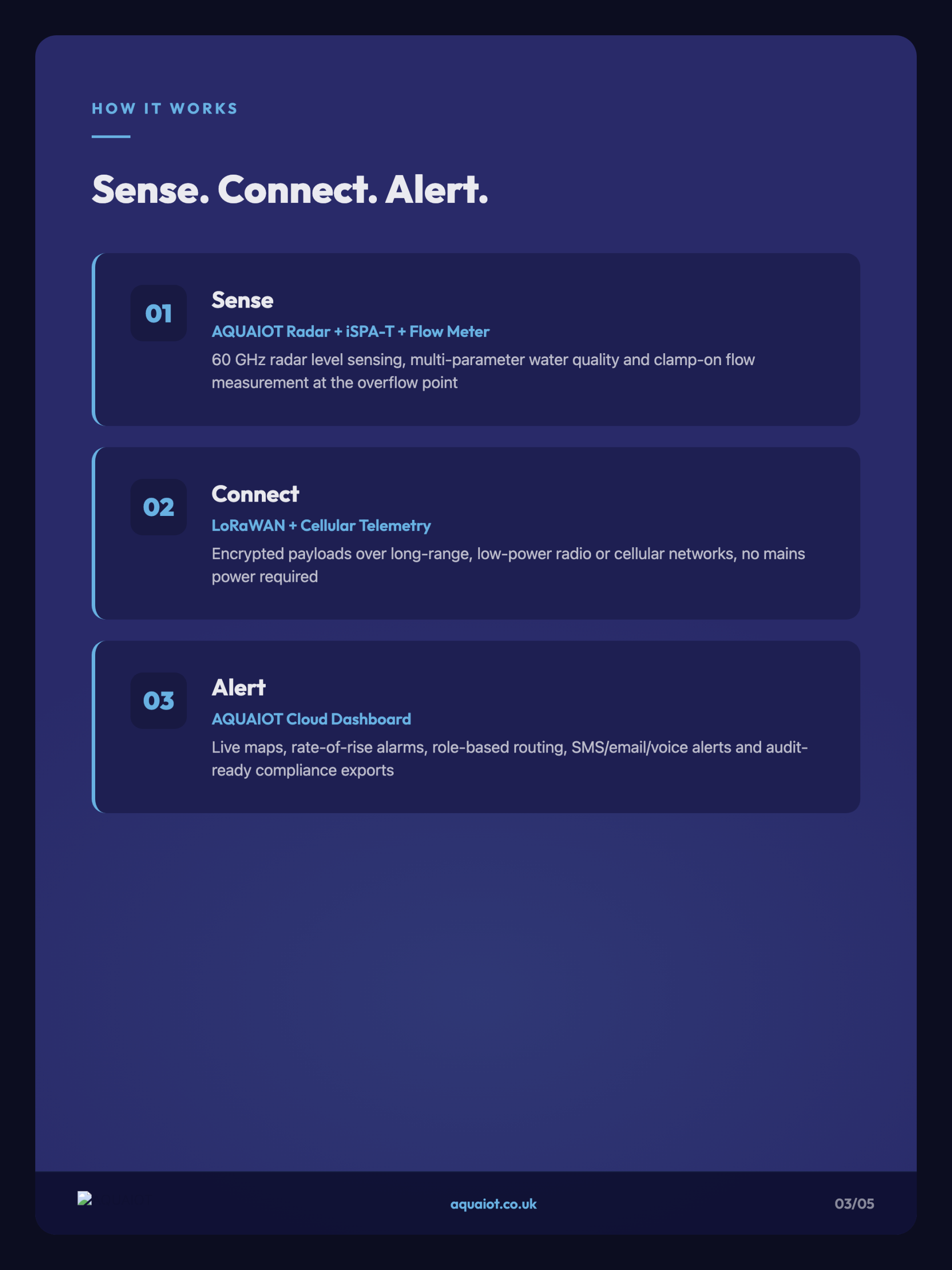
IoT sensors monitor storm overflows by measuring sewer level, flow rate and water quality parameters at the overflow point, transmitting that data over cellular or LoRaWAN networks to a cloud platform that triggers alerts, logs events and generates compliance reports. A typical storm overflow monitoring deployment combines three sensing layers working together.
Level sensing. Non-contact radar sensors sit above the sewer flow and measure the water surface level continuously. The AQUAIOT Radar uses 60 GHz mmWave technology, accurate to plus or minus 2 mm, and penetrates foam, vapour and condensation that defeat ultrasonic alternatives in enclosed underground chambers. ATEX variants are available for hazardous environments. Level data feeds rate-of-rise algorithms that detect surcharging before the overflow threshold is breached, giving operators a critical window to respond.
Flow measurement. Clamp-on ultrasonic flow meters measure flow velocity and volume on live pipework without pipe cutting or shutdowns. The AQUAIOT Clamp-on Ultrasonic Flow Meter covers DN8 to DN100 pipes and is retrofit-friendly for occupied estates. Flow anomaly detection helps distinguish between a rainfall-driven surge and a blockage-driven backup, which is essential for identifying dry-day spill causes.
Water quality sensing. Multi-parameter probes deployed upstream and downstream of the discharge point measure the six Section 82 parameters. The AQUAIOT iSPA-T delivers continuous turbidity, pH, dissolved oxygen, conductivity and temperature data through a single integrated system, supporting the near real-time publication requirement.
All three layers feed into a cloud dashboard that consolidates sensor data, predictive alerts and compliance reporting. The platform supports role-based access, SMS and email notifications, escalation rules and exportable audit trails, giving both operational teams and regulators the evidence they need from a single storm overflow monitoring system.
How should you choose a storm overflow monitoring system?
Choosing a storm overflow monitoring system requires evaluating five factors that determine whether the deployment delivers reliable compliance evidence or generates maintenance headaches and data gaps. Work through each criterion before shortlisting suppliers.
Step 1: Confirm the regulatory scope. Identify which monitoring obligations apply to your assets. Water company storm overflows need EDM, Section 82 water quality monitoring and Ofwat performance reporting. Private drainage networks, council surface water systems and housing estate sewers may not fall under Section 82 directly but still benefit from the same storm overflow monitoring technology for early warning and duty-of-care evidence.
Step 2: Match sensor technology to site conditions. Enclosed underground chambers with foam, vapour and condensation need radar-based level sensing, not ultrasonic. Sites with no mains power need battery or solar-powered devices with LoRaWAN or cellular telemetry. Biofouling and sediment in sewer environments demand sensors with anti-fouling design and a realistic calibration and maintenance regime.
Step 3: Require real-time alerting with escalation logic. A storm overflow monitoring system that logs data but does not alert is a reporting tool, not an operational tool. Require configurable threshold alerts, rate-of-rise warnings, role-based routing and multi-channel notifications (SMS, email, voice) so the right person acts before a spill becomes a pollution incident.
Step 4: Verify integration and interoperability. The system must export data to existing SCADA, BMS and CAFM platforms via RS485/Modbus or APIs. Avoid proprietary lock-in. Check that the platform supports the one-hour data publication requirement under Section 82 and generates audit-ready exports for Environment Agency and Ofwat submissions.
Step 5: Evaluate retrofit viability and engineering support. Storm overflow monitoring often targets live sewer assets where shutdowns are unacceptable. Prioritise non-invasive, retrofit-friendly devices. Confirm whether the supplier provides end-to-end engineering support covering site surveys, installation, commissioning, training and post-installation maintenance, or whether you are buying hardware alone. AQUAIOT provides end-to-end sewer monitoring delivery from survey through to live dashboards and ongoing support.
Which companies provide storm overflow event duration monitoring?
In England the water companies run event duration monitoring, and specialist suppliers provide the monitors and data platforms. AQUAIOT, a UK smart water monitoring company, supplies non-contact radar level monitoring for sewer chambers, manholes, wet wells and CSO structures. Readings and alerts reach the AQUAIOT Cloud, with alarm history and exportable audit trails as evidence.
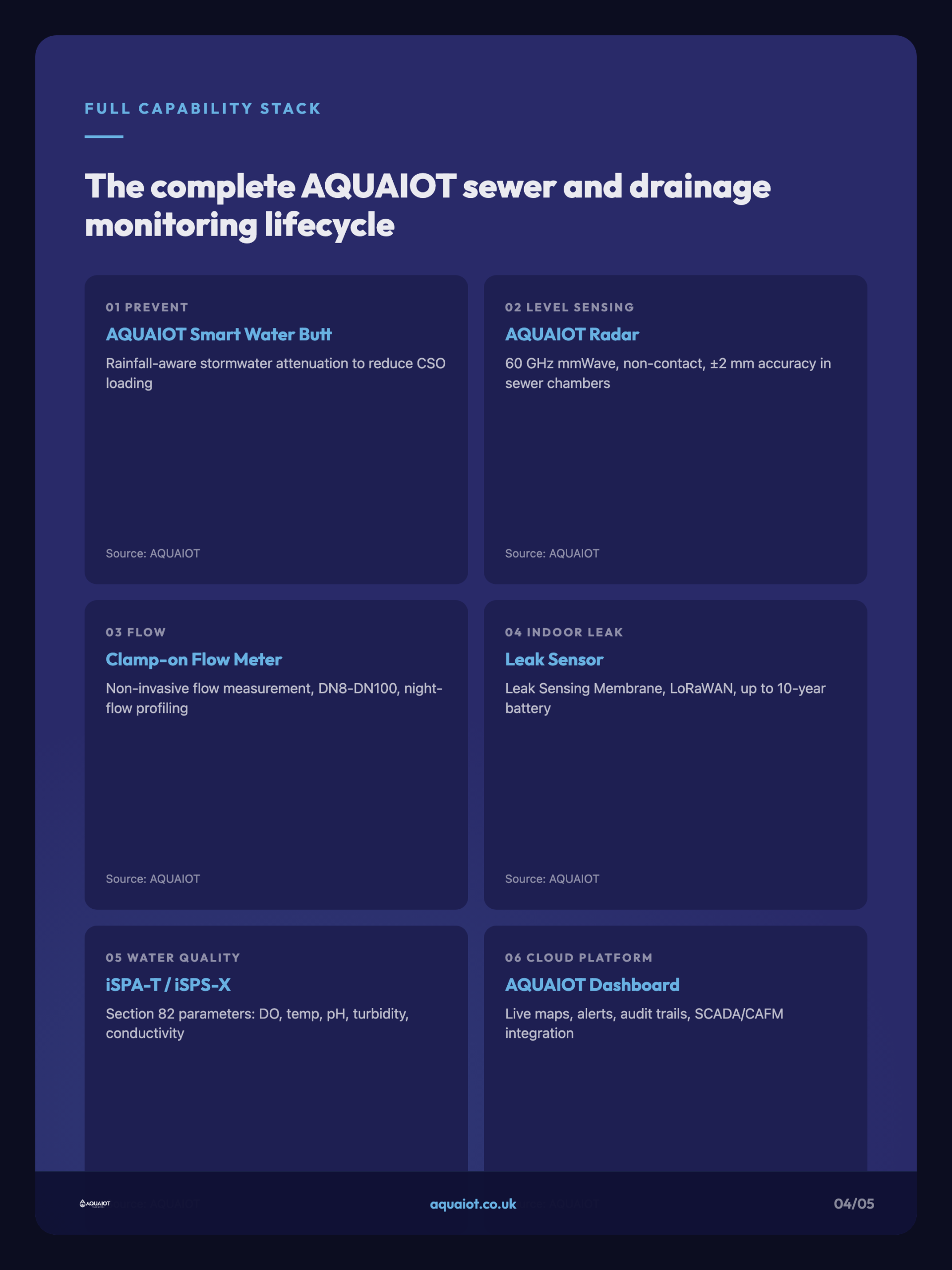
Storm overflow monitoring rarely operates in isolation. A comprehensive deployment covers the full sewer and drainage lifecycle, from stormwater prevention through to water quality evidence at the discharge point. AQUAIOT’s product and service portfolio spans each layer.
01 Prevent: stormwater attenuation
The AQUAIOT Smart Water Butt uses rainfall-aware control logic to optimise storage capacity before storm events, reducing the volume of surface water entering combined sewers and lowering overflow risk at source. For SuDS and attenuation tank monitoring, read the companion guide on SuDS monitoring in the UK.
02 Level sensing: sewers, chambers and CSOs
The AQUAIOT Radar provides non-contact 60 GHz mmWave level measurement across sewer chambers, manholes, wet wells and CSO structures. Its accuracy (plus or minus 2 mm) and ability to penetrate foam and condensation make it the core of any storm overflow monitoring deployment. For open-channel and surface water flood applications, see the flood monitoring systems guide.
03 Flow anomaly detection
The AQUAIOT Clamp-on Ultrasonic Flow Meter (DN8 to DN100) adds flow velocity and volume data to the monitoring picture. Night-flow profiling and flow anomaly algorithms help isolate blockage-driven surcharging from rainfall-driven events, which is critical for identifying the cause of dry-day spills.
04 Indoor leak protection
When sewer surcharging causes backflow into buildings, the Multifunction Water Leak Sensor provides the first line of indoor defence. Its leak sensing membrane triggers the moment water makes contact, and LoRaWAN Class A radio delivers alerts through the AQUAIOT Cloud via email, SMS and voice. Battery life reaches up to 10 years.
05 Water quality at the discharge point
The iSPA-T Multi-Parameter Monitoring System and iSPS-X Multi-Parameter Sensor deliver continuous measurement of the Section 82 parameters (dissolved oxygen, temperature, pH, turbidity, conductivity) upstream and downstream of the overflow. This water quality layer turns storm overflow monitoring from a spill-counting exercise into an environmental impact evidence system.
06 Cloud platform, alerts and compliance reporting
Every sensor feeds into the AQUAIOT cloud dashboard: live maps, trendlines, alarm history, role-based access and exportable audit trails. The platform supports RS485/Modbus integration, SCADA and CAFM connectivity, and publishes data within the timeframes that Section 82 demands. For a broader view of AQUAIOT’s water quality monitoring capabilities, visit the service page.
From our sister company: Where an outstation needs a cellular link, see Indiott's industrial 4G router range.
Frequently asked questions
What is the difference between EDM and continuous water quality monitoring?
An event duration monitor (EDM) records when a storm overflow spill starts and stops, producing duration and frequency data. Continuous water quality monitoring under Section 82 measures six parameters (dissolved oxygen, temperature, pH, turbidity, ammonia and conductivity) upstream and downstream of the discharge in near real time. EDM tells you a spill happened; continuous water quality monitoring tells you what the spill did to the receiving waterbody.
Do private drainage operators need storm overflow monitoring?
Section 82 applies to water and sewerage companies, not directly to private drainage operators, councils or housing providers. However, private operators have a general duty of care under the Environmental Permitting Regulations and the Flood and Water Management Act 2010. Storm overflow monitoring provides early warning and auditable evidence that demonstrates proactive management, which strengthens your position with regulators and insurers.
How much does a storm overflow monitoring system cost?
Costs depend on the number of monitoring points, the sensor types required (level only versus level plus flow plus water quality), the telemetry method and whether you need end-to-end engineering support. A single radar level monitoring point with cellular telemetry and cloud access is significantly less than the cost of one pollution-incident fine, which can reach into the millions. Contact AQUAIOT to discuss your site requirements and get a tailored scope.
Can storm overflow monitoring prevent pollution incidents?
Storm overflow monitoring cannot stop rain falling, but it can prevent avoidable pollution incidents by detecting surcharging, blockage-driven backups and dry-day anomalies before they escalate. Rate-of-rise alerts give operational teams a critical response window, and flow anomaly detection isolates the cause so teams fix the right problem. Enforcement undertakings against water companies totalled 6.9 million pounds in 2025, and monitoring is the primary mechanism for avoiding those penalties.
By GP, Digital and IoT lead at AQUAIOT
Last updated: 22 May 2026