



Groundwater recharge: why a drought ends in winter, not when it rains
TL;DR. A drought does not end when it rains, it ends when the aquifer refills, and in England that only happens in winter. The Environment Agency’s own figure is that chalk aquifers need above 120% of long-term average rainfall to return to normal levels. That means an average winter is not a recovery. Groundwater recharge between roughly October and March, not August rain, decides what next summer looks like.
Key takeaways
- Groundwater recharge happens in winter, because summer rain is intercepted by dry soil, growing vegetation and evaporation before it reaches the aquifer.
- The Environment Agency states that above 120% of long-term average rainfall is needed for chalk aquifer levels to return to normal at most sites.
- Around 30% of public water supply in England and Wales comes from groundwater, rising to about 50% in the south-east.
- In November 2025 the Environment Agency forecast drought in 2026 unless winter delivered at least average rainfall. Seven areas of England were in drought by late July 2026.
- Reservoir storage stood at 84.9% in early January 2026 and 72% by 30 July 2026, around 9.5% below the long-term average.
- Because recharge is seasonal, the window to influence next summer closes in spring, not in August.
Table of Contents
On this page
Last updated: 13 August 2026
What is groundwater recharge and when does it happen?
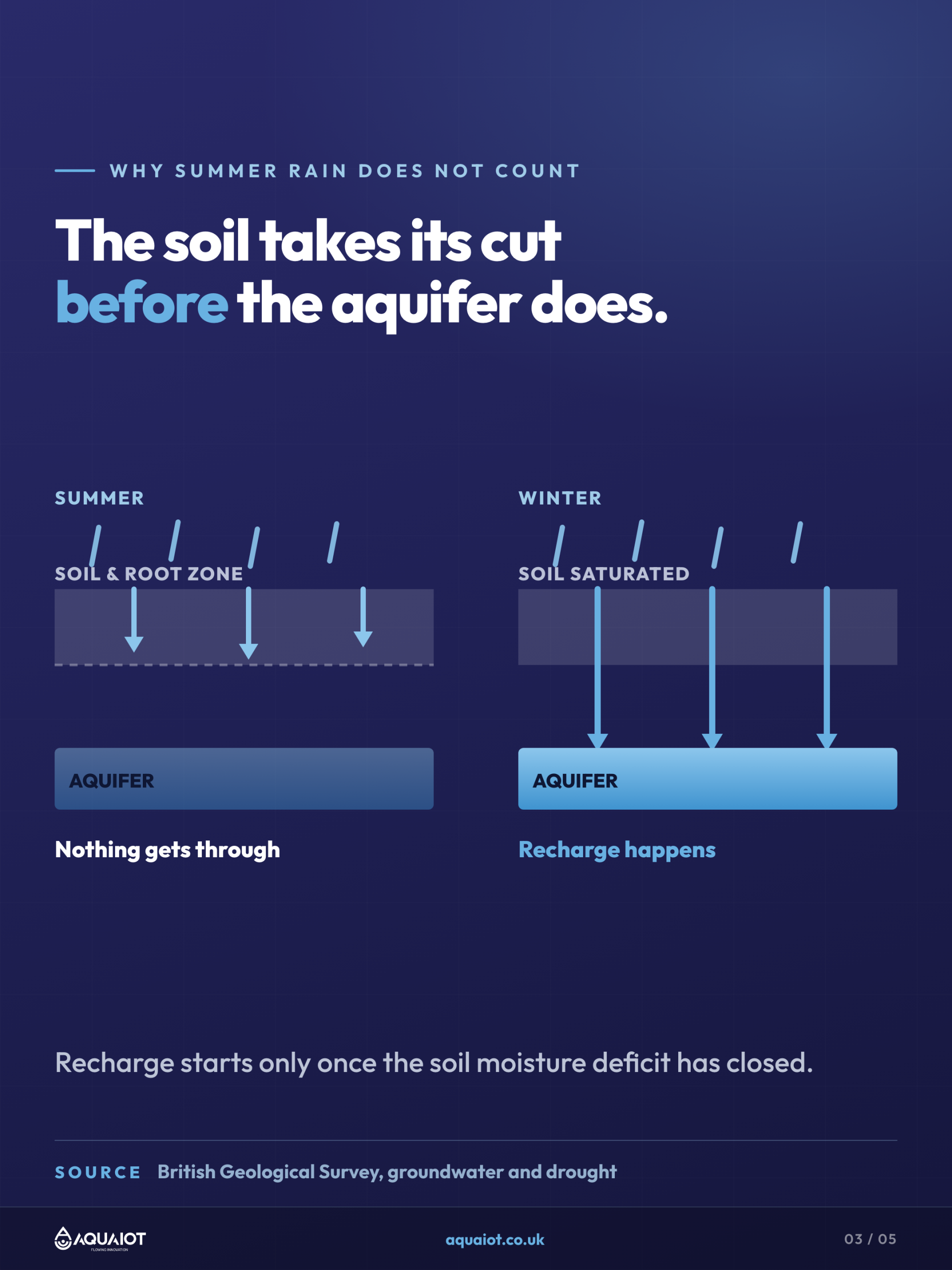
Groundwater recharge is rainfall that gets past the soil and the root zone and reaches the aquifer. In England it is overwhelmingly a winter process. Through spring and summer, rain is intercepted before it can travel: it wets dry soil, it is taken up by growing vegetation, and it evaporates back to the atmosphere. Only when those demands are satisfied does water move downward.
The British Geological Survey describes aquifers as natural reservoirs that fill from rainfall in wet winter months, and notes that in summer any rain is taken up by wetting the soil, growing vegetation, or evaporating back to the atmosphere. This is why a thunderstorm in August changes the news but not the resource, and why groundwater recharge is effectively a winter-only account.
It matters more than most people outside the sector assume. BGS puts groundwater at around 30% of public supply nationally, roughly 50% across the south-east of England, and up to 100% in some local areas. In much of southern England, the aquifer is not a backup to the reservoir. It is the supply, which makes groundwater recharge a supply-security question rather than an environmental one.
Why is an average winter not enough for groundwater recharge?
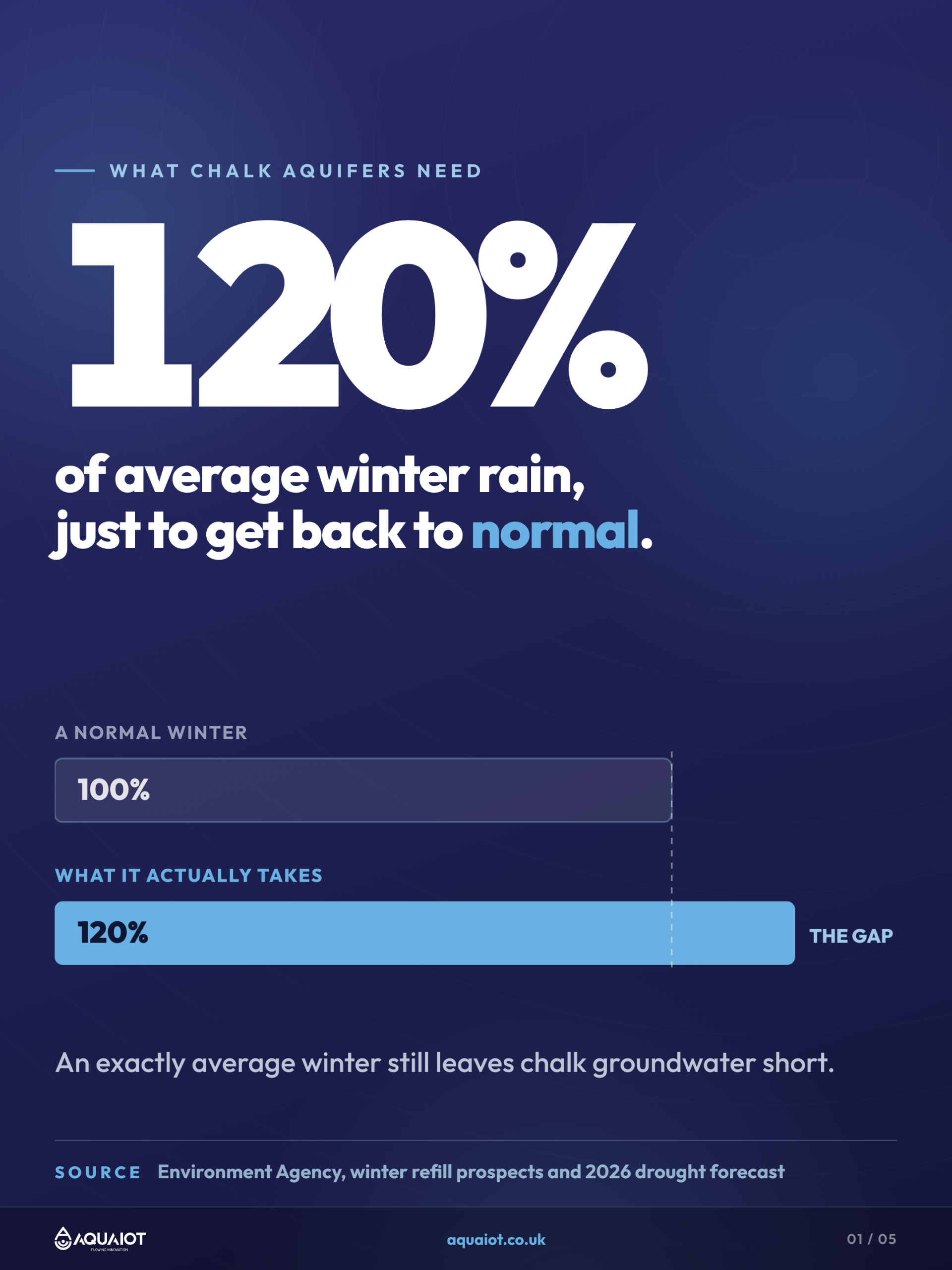
Because recovery costs more than maintenance. Returning a depleted aquifer to normal requires more than the rainfall that would have kept it there in the first place, and the Environment Agency has published the number. Its assessment ahead of winter 2025 to 2026 stated that above 100% of long-term average rainfall was needed for rivers to return to normal by spring, and above 120% of LTA rainfall is needed for groundwater levels in chalk aquifers to return to normal levels in most sites.
Read that carefully, because it reframes the whole seasonal cycle. A perfectly normal winter, delivering exactly average rainfall, leaves chalk groundwater short of normal. Groundwater recharge to normal is not the default state that a wet spell restores. It is an above-average outcome that has to be achieved, and if it is not achieved the deficit is carried forward into the next summer.
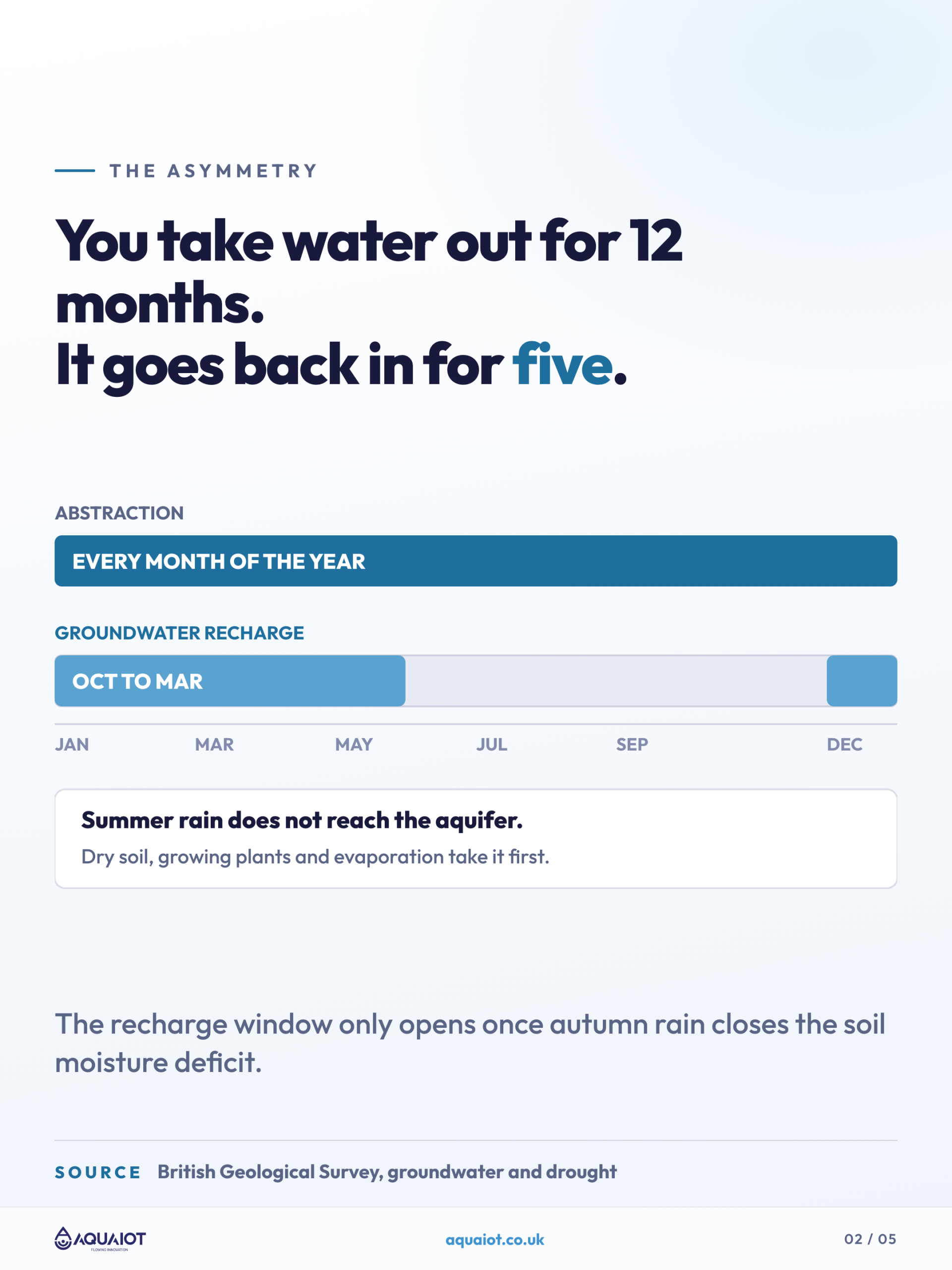
That asymmetry is the structural problem. Abstraction runs twelve months a year. Groundwater recharge gets roughly five, and only if the soil moisture deficit closes early enough in the autumn for the season to be useful.
Did the Environment Agency see this summer coming?
Yes, and it said so in writing nine months in advance. In November 2025 the Environment Agency published its prospects for winter refill and a drought forecast for 2026, modelling three winter rainfall scenarios at 100%, 80% and 60% of the long-term average. Its answer to whether there would be a drought in 2026 was yes unless there is at least average rainfall through the winter.
The context it gave was already unfavourable for groundwater recharge. England had taken 149% of average rainfall in September 2025 and 90% in October, but the same document noted this had not been enough to recover from eight of the previous ten months being drier than average, and the Environment Agency was already reporting declining conditions by late June 2026. The Met Office three-month outlook carried a 30% chance of a dry winter.
What followed is instructive rather than dramatic. By early January 2026 the picture looked reasonable: groundwater levels were rising at the majority of boreholes across England and reservoir storage stood at 84.9%. The Environment Agency still flagged that the risk of drought impacts depended on the rest of the winter’s rainfall and groundwater recharge. By 30 July 2026, storage was 72%, around 9.5% below the long-term average, seven areas were in drought and England had received 7% of its average rainfall for the period.
So a winter that broadly worked was still not enough to absorb the summer that followed. That is the argument for treating groundwater recharge as a planning variable rather than a weather outcome.
What does this mean for sites that abstract their own water?
It means the constraint arrives before the shortage does. Licence conditions bite on hands-off flow and, in agriculture, on section 57 spray irrigation restrictions, and both are triggered by catchment river and groundwater levels rather than by whether your own borehole is still producing. Poor groundwater recharge across the catchment restricts you even when your own asset looks healthy. The Environment Agency’s 60% rainfall scenario explicitly anticipated widespread hands-off flow restrictions.
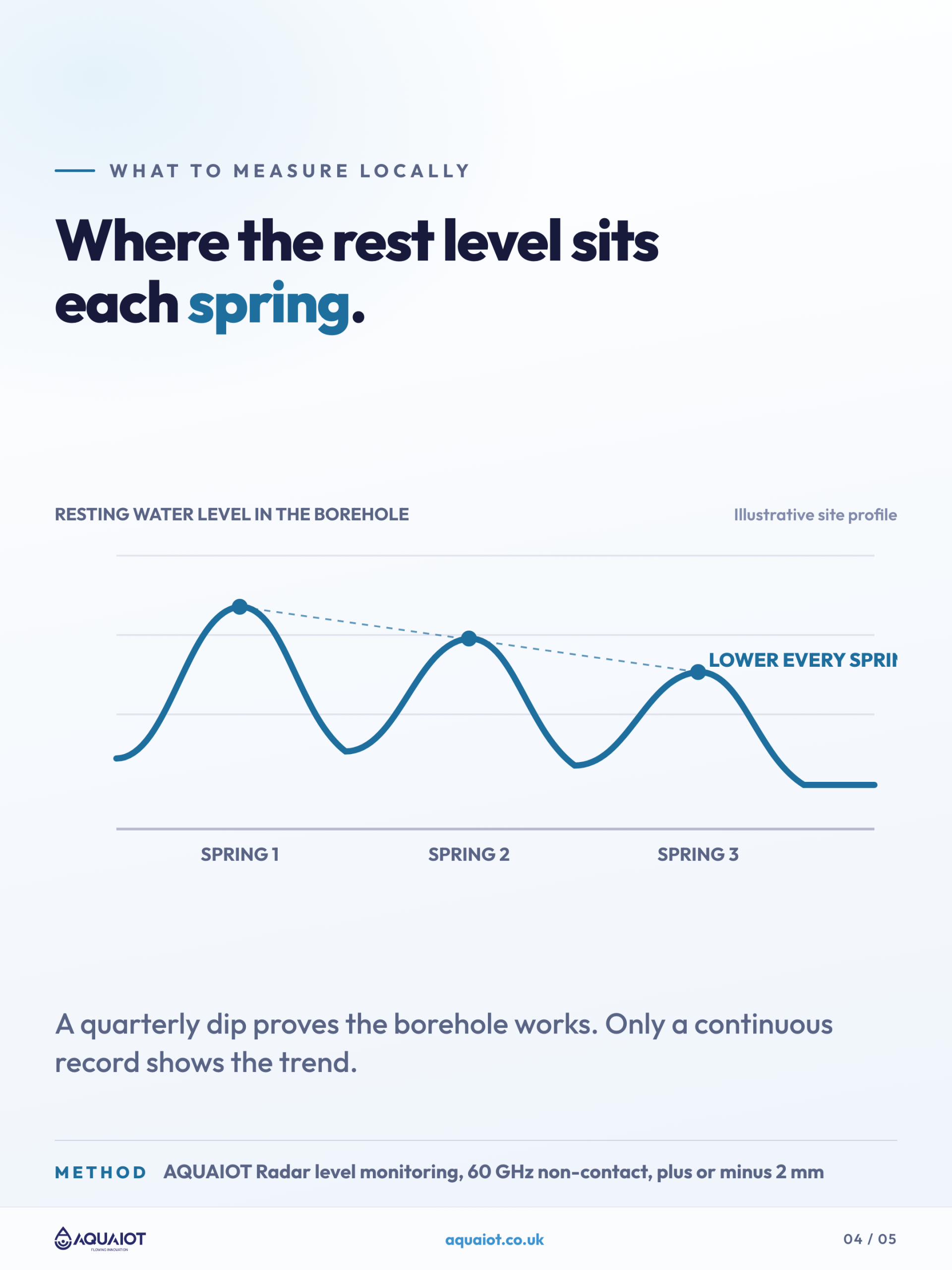
The measurement that answers this is the resting water level in your own borehole, recorded continuously rather than dipped occasionally. One reading a quarter tells you the borehole is working. A continuous record tells you whether each winter is returning the level to where the last one did, which is the only local evidence of whether groundwater recharge is keeping pace with what you take out.
An AQUAIOT Radar smart water level sensor suits the headworks position: 60 GHz mmWave, non-contact and accurate to within ±2 mm, reading through vapour and condensation in an enclosed chamber, with nothing suspended in the water column to foul or drift. ATEX variants are available where the installation requires them.
Pair it with what you take out. A clamp-on ultrasonic flow meter retrofits to live rising main pipework across DN8 to DN100 with no cutting and no shutdown, which turns abstraction from an annual return into a running total you can set against the level. Both feed the AQUAIOT Cloud, where a threshold on the resting level gives you warning before a licence condition does.
The duty side of this is covered in our guide to abstraction licence monitoring, and the escalation ladder above a hosepipe ban in our explainer on drought permits and drought orders. Both assume you already know what your own levels are doing.

Frequently asked questions
When does groundwater recharge happen in the UK?
Broadly between October and March. Groundwater recharge needs rainfall to exceed what the soil and vegetation take first, which in practice means it starts once autumn rain has closed the soil moisture deficit and stops once spring growth and evaporation resume. A late-closing deficit shortens the season even if total winter rainfall looks adequate.
Does summer rain contribute to groundwater recharge at all?
Very little. Summer rainfall is intercepted by dry soil, taken up by growing vegetation, or evaporated back to the atmosphere before it can travel down to the aquifer. Intense summer storms are worse than useless for groundwater recharge, because water that runs off the surface never enters the soil at all.
How much rain is needed to end a groundwater drought?
The Environment Agency’s published figure is above 100% of long-term average rainfall for rivers to return to normal, and above 120% for chalk aquifer groundwater levels at most sites. An exactly average winter therefore leaves chalk groundwater below normal, and the shortfall carries into the following summer.
Why monitor a borehole continuously instead of dipping it?
A dip tells you the level on the day. A continuous record shows the resting level each spring, which is the only way to see whether successive winters are returning your aquifer to the same starting point or to a slightly lower one each time. That trend is what determines whether your abstraction is sustainable against local groundwater recharge.
The window that actually matters
Most drought coverage peaks in August, when nothing can be done about the resource. The decisions that shape next summer are made in the recharge season, and the evidence needed to make them well is a level record that spans more than one winter. Groundwater recharge is the only mechanism that refills an aquifer, and it runs on a calendar that has nothing to do with the news cycle.
If your site abstracts its own water, the useful thing to do before October is establish a baseline. Speak to an AQUAIOT engineer about instrumenting the borehole and the abstraction main together.
By GP, Digital and IoT lead at AQUAIOT.