



Storm Names 2026/27: The Full List and How to Get Your Site Storm Ready
TL;DR: The Met Office, Met Éireann and the Dutch weather service KNMI announced the storm names 2026/27 list on 1 September 2026. The first three names are Austen, Boelo and Chloe, and the list runs to Wende. A storm is named when it is expected to bring disruption or damage serious enough for an amber or red warning. For sites, a named storm is the signal to check drains, basements, pumps and alarms before the rain arrives.
Last updated: 25 September 2026
On this page
Key takeaways
- The storm names 2026/27 list was published on 1 September 2026 by the Met Office with Met Éireann and the Netherlands’ KNMI. It has 21 names, from Austen to Wende.
- More than 40,000 names were suggested by the public. Chloe was nominated more than 130 times, and Shaun was chosen in a public vote run with Aardman.
- A storm is named when it is expected to cause disruption or damage significant enough to warrant an amber or red warning, whether from wind, heavy rain or snow.
- Last season four storms were named, reaching the letter D with Storm Dave in April 2026. The first season, in 2015/16, named 11.
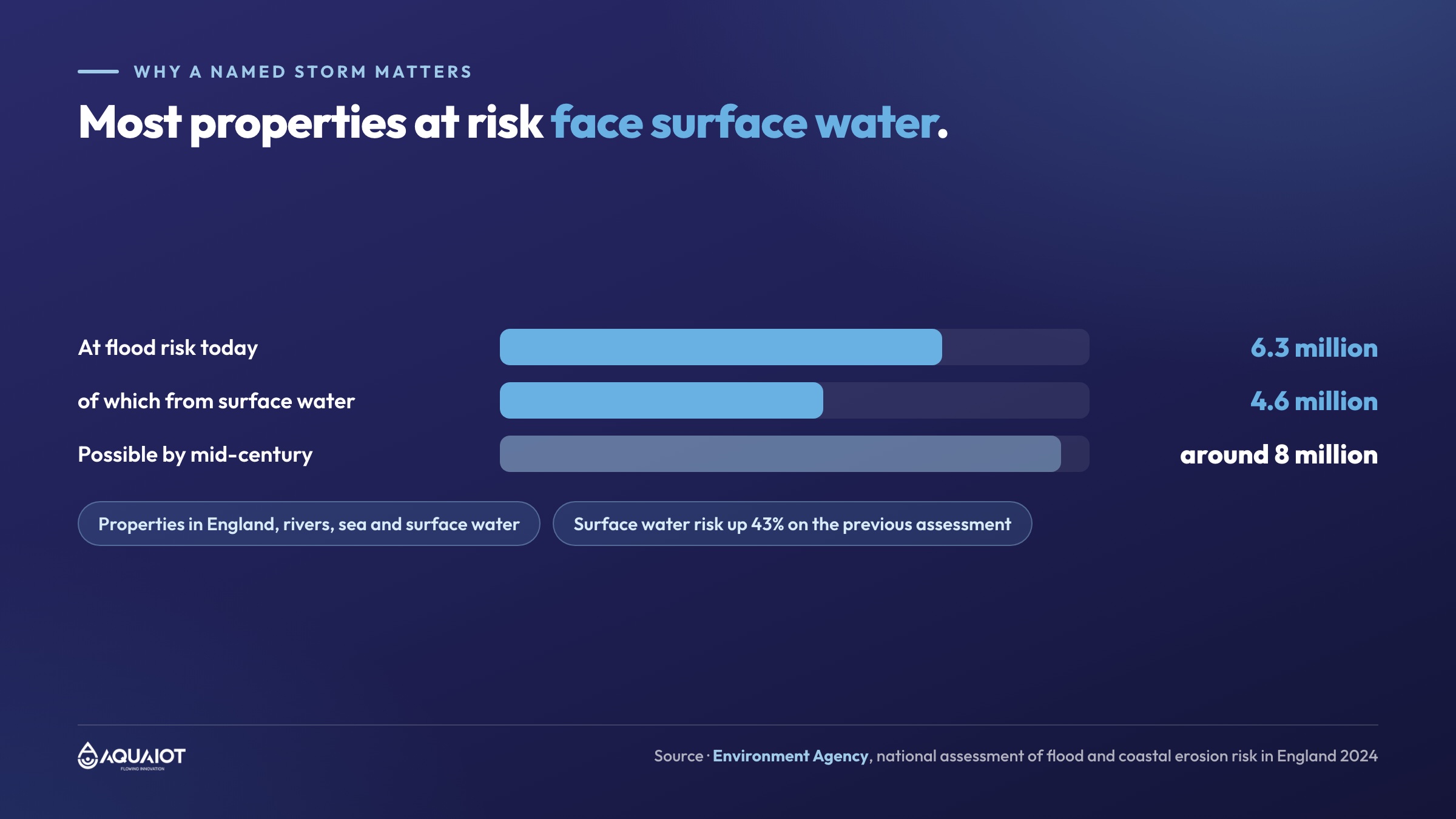
- The Environment Agency estimates that around 6.3 million properties in England are in areas at risk of flooding, 4.6 million of them from surface water.
- A named storm gives a site a few days of warning. Checking drains, basements, pumps and alarms in that window is the cheapest flood protection there is.
What are the storm names 2026/27?
The Met Office published the storm names 2026/27 on 1 September 2026, alongside its partners in the western storm naming group, Met Éireann in Ireland and KNMI in the Netherlands. The full list, in the order storms will be named, is:
| Name | Name | Name |
|---|---|---|
| Austen | Heather | Olaf |
| Boelo | Ivy | Phelim |
| Chloe | Jade | Ruban |
| Dano | Kilian | Shaun |
| Evelyn | Laoise | Theo |
| Finn | Miriam | Vesna |
| Gwendolyn | Nicola | Wende |
The first storm of the season to reach amber or red warning level will be Storm Austen, the second Boelo and the third Chloe. According to the Met Office announcement, more than 40,000 names were submitted by members of the public last year.

Where do this season’s names come from?
Several of the names carry a story, and the Met Office shared many of them:
- Austen, put forward by Met Éireann in honour of Austen Nagle, the first director of the Irish Meteorological Service.
- Boelo, from KNMI, a nearly extinct name from the East Groningen region, passed down through the nominator’s family.
- Chloe, nominated more than 130 times, including once by the mother of a five-year-old weather enthusiast.
- Evelyn, from Met Éireann, a tribute to Evelyn Murphy, the first woman to present the weather on the Irish broadcaster RTÉ.
- Finn, suggested for a two-year-old described by his family as wild and a force to be reckoned with.
- Ivy, nominated for a nine-month-old Labrador puppy known at home as the absolute destructor.
- Nicola, a tribute to a mother who has weathered many storms of her own.
- Theo, inspired by a cat that hides before thunderstorms, so reliably that his owner jokes he can forecast them.
- Shaun, chosen in a public vote run with Aardman, the animation studio behind Wallace and Gromit.
The light-hearted names serve a serious purpose. In the Met Office’s own words, storms are named to raise awareness of severe weather before it hits, so people can stay safe. Its head of warnings and guidance, Holly Clements, describes a named storm as giving a clear focus for forecasts and warnings.
How does a storm get a name?
A storm is named when it is expected to have a medium or high impact. The Met Office’s explainer on how it names storms puts the threshold simply: in the UK, a storm is named when it is expected to cause disruption or damage significant enough to warrant an amber or red warning.
Wind is the classic trigger, but it is not the only one. The same explainer says storms can be named for heavy rain that could lead to flooding, or for significant snowfall. That matters for estates and facilities teams, because a rain-led named storm can flood a site without a single tree coming down.
The naming year runs from early September to late August, and a new list is announced each September. Names are also checked for how easily they can be pronounced, what they mean in different languages and cultures, and whether they are linked to well known public figures.
The system is now more than ten years old. The Met Office’s review of the 2015/16 storm season records that the collaboration with Met Éireann was launched in September 2015, that the first named storm was Abigail, which crossed the UK on 12 and 13 November, and that 11 storms were named that season. Last season was quieter by count: four named storms, ending with Storm Dave in April 2026.

What do yellow, amber and red warnings mean for a site?
The colour of a warning is set by two things together: how much impact the weather could have and how likely those impacts are. The Met Office’s guide to weather warnings sets this out as an impact matrix, and it issues warnings for rain, thunderstorms, wind, snow, lightning, ice, extreme heat and fog up to seven days ahead.
For an estates or facilities team, the three colours translate into three levels of action:
- Yellow. Often issued when the weather is likely to cause some low level impacts, including disruption to travel in a few places. For a site, this is the prompt to check that drains, alarms and contact lists are in order.
- Amber. An increased likelihood of impacts from severe weather that could disrupt plans. The Met Office advises people to think about changing plans and to take action to protect themselves and their property. This is the level at which a storm gets a name, and the point to run the full storm checklist below.
- Red. Dangerous weather is expected, and the advice is to take action now to keep people safe. For a site, that means the plan is already running: people are briefed, vulnerable areas are protected and the alarms are being watched.
Because a named storm always carries an amber or red warning, the name itself is a useful shorthand. When a storm is named, the site plan should move from checking to doing.
What should a site storm plan include?
A storm plan is a short document that turns a warning into actions, owners and times. It does not need to be long, but it does need to be written down before the season starts, because the week of a named storm is the worst time to invent one. Five parts cover most sites:
- Triggers. Which warning colours and which alarms start which actions. For example, a yellow rain warning starts the drain check, and an amber warning or a named storm starts the full checklist.
- People. Who is responsible for each building, who deputises, and who is on call out of hours. Include contractors for drainage, pumping and roofing, with numbers that work at night.
- Places. A simple site plan marking gullies, interceptors, sump pits, attenuation tanks, basements, plant rooms and the stop taps and isolation valves, so a stand-in can find them in the dark.
- Kit. Pumps, sandbags or flood barriers, wet vacuums and spare fuel where needed, with a note of where they are stored and when they were last tested.
- Records. A log of what was checked, when levels rose and what was done, kept during the storm and reviewed afterwards. The review is what turns one wet night into a better drain, a new sensor or a changed routine.
The plan is only as good as its first signal. A written plan that waits for someone to notice water on the floor starts too late. A plan that is triggered by a rising level in a chamber, or water touching a sensor in a basement, starts while there is still time to act.
Why does a named storm matter for your site?
Because flooding is often what closes a building, and flooding needs no wind at all. The Environment Agency’s 2024 national assessment, summarised on its blog, found that around 6.3 million properties in England are in areas at risk of flooding from rivers, the sea or surface water. Around 4.6 million of them are at risk from surface water, a 43% increase on the previous assessment, which the agency attributes mostly to better data and modelling.
The same assessment looks ahead. With climate change, the total number of properties in areas at risk from rivers and the sea or surface water could rise to around 8 million by the middle of the century.
Surface water flooding is the one that catches sites out. It happens when rain falls faster than drains, gullies and sewers can carry it away, and it can happen far from any river. Our guide to surface water flood monitoring explains how it forms and where it collects.
A named storm, announced a few days ahead, is the best warning a site will get. The question is what the site does with those days.
How do you get a site ready for a named storm?
Treat the name as a trigger for a short, practised routine. These eight checks cover the ways storms most often get into buildings and grounds:
- Clear gullies, grates and channel drains. Leaves in autumn are the usual culprit. Our guide to highway and car park drainage monitoring covers the assets that block first.
- Check roofs, gutters and outlets. Valley, parapet and flat roof gutters can overflow into the building itself. See our post on gutter overflow and roof drainage.
- Test sump pumps and their alarms. A pump that has not run since spring should be run now, with the high level alarm tested at the same time.
- Walk the basements and plant rooms. Look for the low points where water will gather, and move stock and equipment off the floor.
- Check storage and attenuation. Know how full your attenuation tanks, ponds and rainwater tanks are, and draw down harvested water before the rain if you can.
- Know your flood risk. Check the long term flood risk for your postcode, and sign up for flood warnings where they are offered.
- Confirm who gets the alarm. Make sure out of hours alerts reach a person who can act, with a named deputy.
- Record what happens. Photos, levels and times after each storm build the evidence for drainage improvements and insurance conversations.
The best version of this routine is automatic. A site that already knows its water levels and receives an alarm when they rise does not depend on someone remembering the checklist at 5pm on a Friday.
The AQUAIOT storm readiness stack
AQUAIOT’s flood and drainage monitoring is built for exactly this window between the name and the rain. Each layer watches a different place water gathers.
Levels in drains, chambers and tanks
The AQUAIOT Radar is a 60 GHz radar level sensor that measures water level without touching it, accurate to within 2 mm, and works in enclosed underground chambers. Fitted above a gully chamber, culvert, attenuation tank or watercourse, it shows the level rising in real time and raises an alarm at the threshold you set.
Sewers and wet wells
The same radar hangs in wet wells, manholes and overflow chambers as part of our sewer monitoring service, where a surcharging sewer is often the first sign that a storm has overwhelmed the network downstream of a site.
Water inside the building
The AQUAIOT leak sensor triggers the moment its sensing membrane touches water. Laid along basement floors, plant rooms and lift pits, it catches the first centimetre of water that a storm pushes in. Our guide to basement flood monitoring covers placement.
Rainwater held back before the storm
The AQUAIOT Smart Water Butt uses rainfall-aware logic to optimise its storage capacity before storm events, so there is room to catch the rain instead of overflowing when it arrives.
Alerts that reach people
The AQUAIOT Cloud sends alarms by email, SMS and app, with role based routing and escalation so the alert reaches someone who can act, and keeps the level history for the post-storm review.

Frequently asked questions
What are the storm names 2026/27?
Austen, Boelo, Chloe, Dano, Evelyn, Finn, Gwendolyn, Heather, Ivy, Jade, Kilian, Laoise, Miriam, Nicola, Olaf, Phelim, Ruban, Shaun, Theo, Vesna and Wende. The list was published on 1 September 2026 by the Met Office, Met Éireann and KNMI.
What will the first named storm of 2026/27 be called?
Storm Austen. The name honours Austen Nagle, the first director of the Irish Meteorological Service. The next two will be Boelo and Chloe.
When does the Met Office name a storm?
When a storm is expected to cause disruption or damage significant enough to warrant an amber or red warning. Strong winds are the usual trigger, but heavy rain that could cause flooding and significant snowfall can also lead to a name.
When does the UK storm season start?
The storm naming year runs from early September to late August, and a new list of names is announced each September.
How many storms were named last season?
Four storms were named in 2025/26, reaching the letter D with Storm Dave in April 2026. In the first season of naming, 2015/16, eleven storms were named.
What should a business do when a storm is named?
Treat the name as the start of the storm plan. Check gullies, gutters and roof outlets, test sump pumps and their alarms, move stock and equipment off basement floors, confirm who receives out of hours alerts, and watch water levels in chambers and tanks as the rain arrives.
Where to start
Start this week, before Storm Austen has a date. Walk the site with the checklist, note every gully, chamber, pump and low point, and decide which three would cause the most damage if they failed during a storm. Those are the places to monitor first.
Then make the alarm automatic. A water level that raises its own alert does not need anyone to remember that a storm has been named.
Speak to an AQUAIOT engineer about level and leak monitoring for storm season, and read our flood monitoring system guide for the full picture.