



Nitrate Sensor: How Optical UV Monitoring Measures Nitrate in Real Time
TL;DR: A nitrate sensor measures the concentration of nitrate in water continuously. Optical UV nitrate sensors work because nitrate absorbs ultraviolet light strongly, and the absorbance measured near 220 nanometres is proportional to the nitrate concentration. Organic matter and turbidity absorb in the same region, which is why multi-wavelength sensors that correct for them give better readings. In the UK nitrate matters for drinking water, wastewater discharges and the 55% of England designated as Nitrate Vulnerable Zones.
Last updated: 1 October 2026
On this page
Key takeaways
- A nitrate sensor measures nitrate in water continuously, without taking samples to a laboratory.
- Optical nitrate sensors rely on ultraviolet absorbance. The US Geological Survey explains that the absorbance at a peak wavelength of 220 nanometres is proportional to the concentration of nitrate ions in solution.
- Other substances absorb in the same region, including nitrite, bromide, dissolved organic matter and turbidity. The USGS stresses that their effect must be negligible or removed from the reading, which is what multi-wavelength sensors are designed to do.
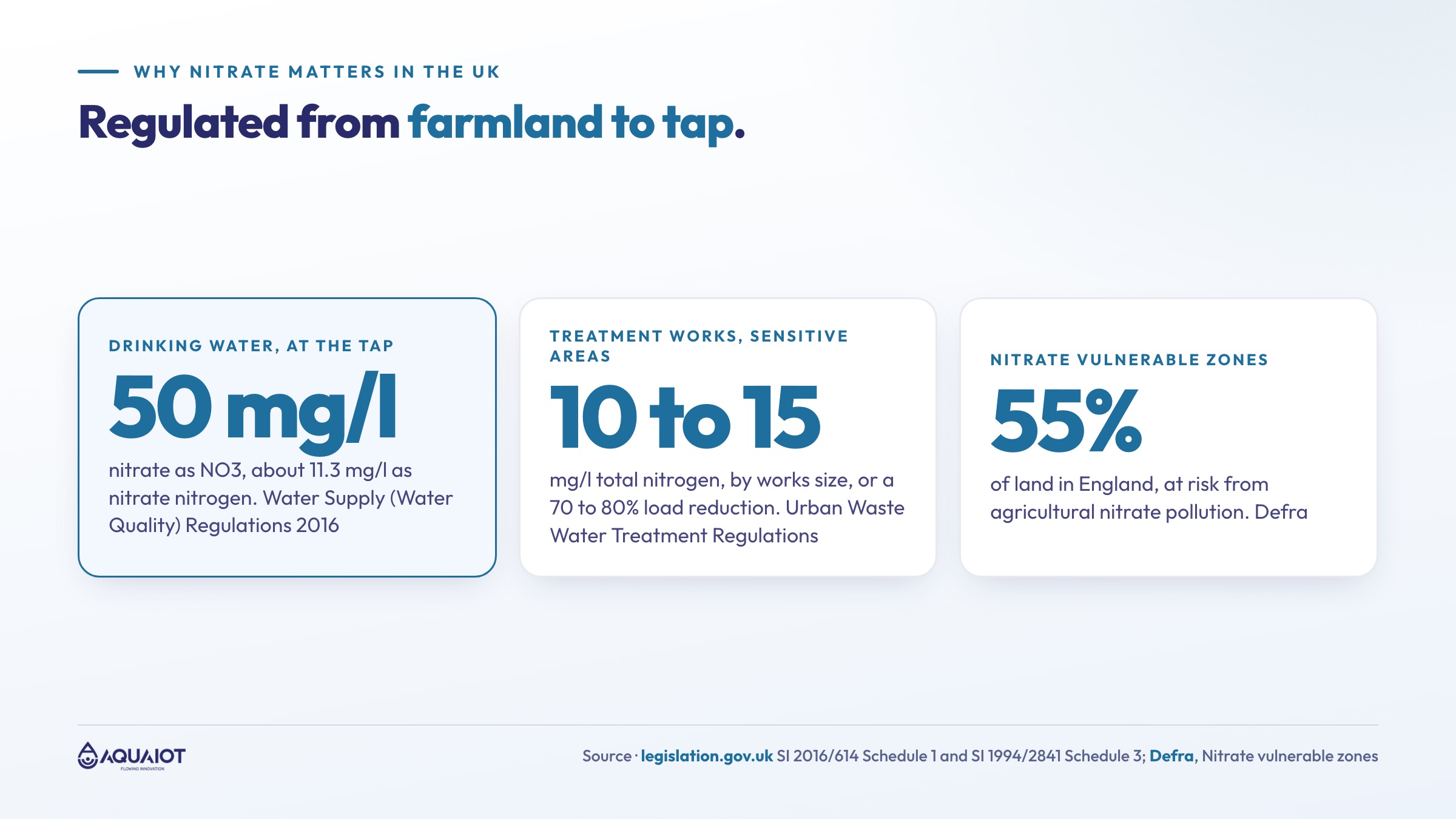
- In the UK, the drinking water limit for nitrate is 50 milligrams per litre at consumers’ taps, and larger wastewater treatment works discharging to sensitive areas face total nitrogen limits of 10 or 15 milligrams per litre.
- Defra designates about 55% of land in England as Nitrate Vulnerable Zones, at risk from agricultural nitrate pollution.
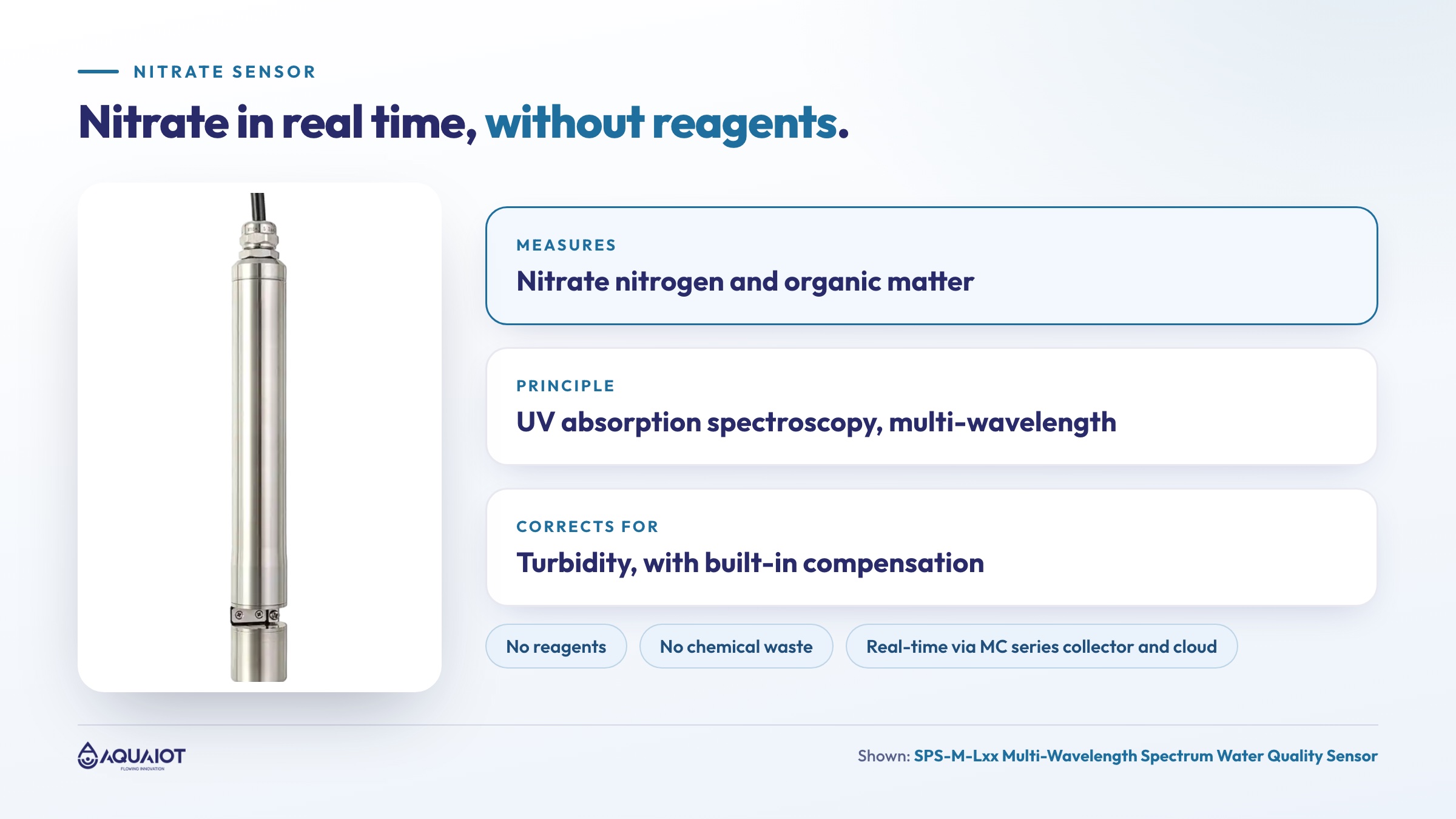
- The SPS-M-Lxx measures organic matter and nitrate nitrogen by UV absorption spectroscopy, with turbidity compensation and no reagents.
What is a nitrate sensor?
A nitrate sensor is an instrument that measures the concentration of nitrate in water continuously, usually reported as milligrams per litre of nitrate or of nitrate nitrogen. It replaces or supplements the traditional approach of taking grab samples and analysing them in a laboratory, which gives accurate numbers but only a handful of them each month.
There are three main kinds. The US Geological Survey’s guidelines on optical techniques for nitrate compare them: ultraviolet sensors that measure spectral absorption, wet chemical analysers that react the sample with reagents and read the colour, and ion-selective electrodes that measure nitrate as a voltage. The USGS lists the strengths of UV sensors as high resolution, accuracy and precision, a large nitrate range, fast response and being chemical free. It lists their weaknesses as cost, power demand, maintenance and a range of optical interferences.
Wet chemical analysers need reagents and generate waste. Ion-selective electrodes are inexpensive and easy to use but, in the same USGS comparison, have lower resolution and accuracy, suffer ionic interferences and drift more. The USGS notes that UV sensors, long used in oceanography, have gained much broader use in freshwater systems in recent years.
How does an optical UV nitrate sensor work?
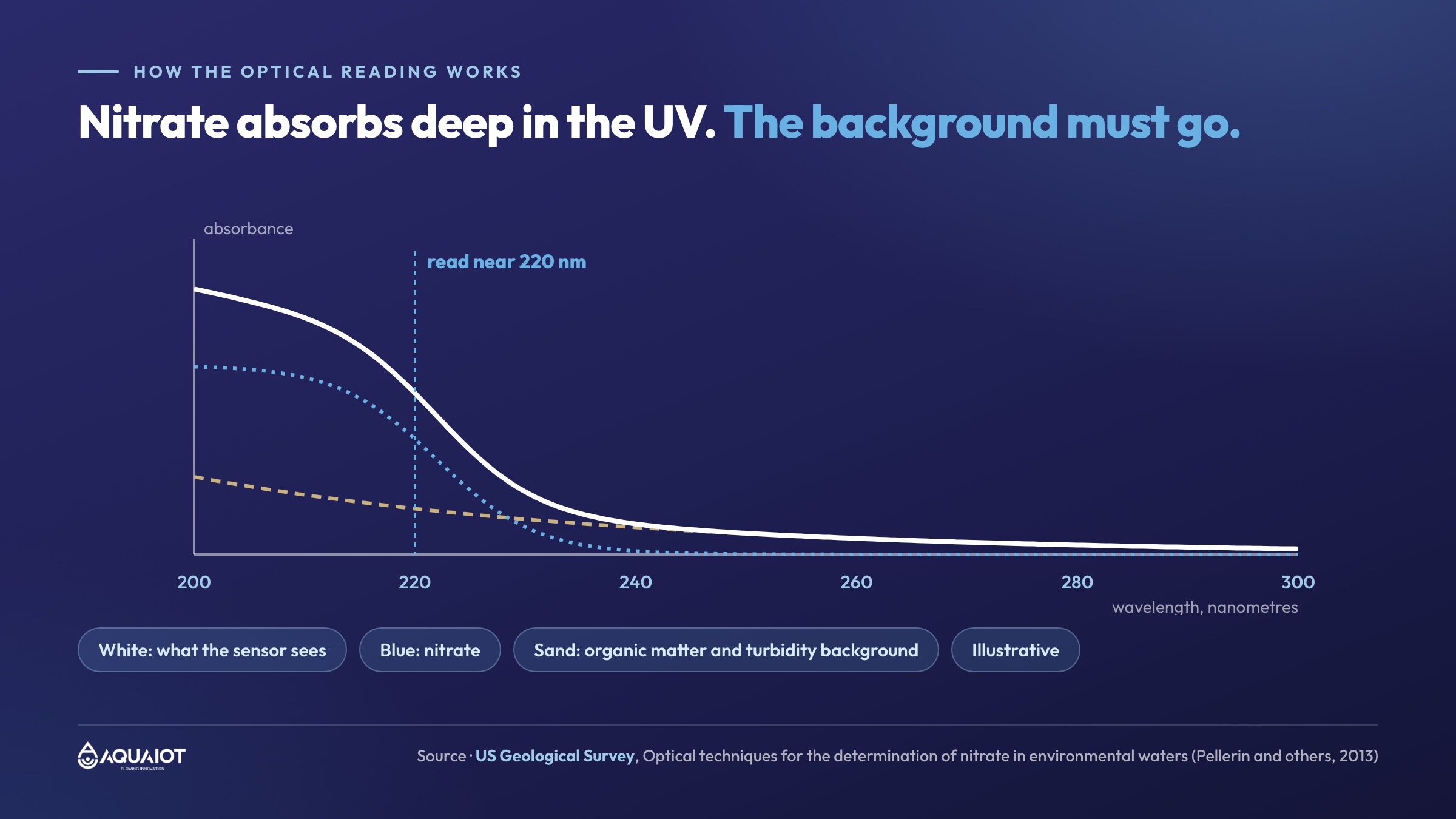
It measures how much ultraviolet light the water swallows. Nitrate ions absorb UV light strongly at short wavelengths. The USGS explains that in the UV method the magnitude of the absorbance at a peak wavelength of 220 nanometres is proportional to the concentration of nitrate ions in solution. The same principle underpins a standard laboratory screening method for nitrate, Standard Method 4500-NO3 B.
Inside the sensor, a UV lamp shines light through a short path of sample to a detector. The more nitrate in the path, the less light reaches the detector at around 220 nm. The sensor converts that loss into a concentration using Beer’s law, which links absorbance to concentration for a known path length.
The catch is that nitrate is not the only thing that absorbs there. The USGS lists nitrite, bromide, chromophoric dissolved organic carbon and turbidity as substances that reduce the transmission of light at wavelengths similar to nitrate. Its guidance is direct: accurate determination of nitrate requires that light attenuation by interfering substances is negligible or is removed from the absorbance value used to calculate nitrate.
That is why better sensors look at more than one wavelength. By measuring across a spectrum, a multi-wavelength sensor can see the shape of the organic matter and particle signal and separate it from the nitrate signal before calculating the concentration.
Why does nitrate matter in the UK?
Because it is regulated at every stage of the water cycle, from farmland to tap.
In drinking water. Schedule 1 of the Water Supply (Water Quality) Regulations 2016 sets the limit for nitrate at 50 milligrams per litre, as NO3, at consumers’ taps, and for nitrite at 0.50 milligrams per litre at taps and 0.10 at treatment works. Expressed as nitrate nitrogen, the 50 mg/l limit is about 11.3 mg/l, because nitrogen makes up about 14 of the 62 atomic mass units in a nitrate ion. Sensors and laboratories can report either unit, so it pays to check which one a reading uses.
In wastewater. Schedule 3 of the Urban Waste Water Treatment Regulations sets requirements for treatment works discharging to sensitive areas subject to eutrophication: total nitrogen of 15 mg/l for works serving 10,000 to 100,000 population equivalent and 10 mg/l above 100,000, or a 70 to 80% reduction in the load. Total nitrogen includes nitrate nitrogen, nitrite nitrogen and Kjeldahl nitrogen.
In the catchment. Defra’s Nitrate Vulnerable Zones are areas designated as being at risk from agricultural nitrate pollution, and they cover about 55% of land in England. Farmers in them must follow rules on using nitrogen fertiliser and storing organic manure, and Defra reviews the designations every four years.
Nitrate also sits at the heart of nutrient neutrality, where new development in some catchments must show it will not add to nutrient loads. Our guide to nutrient neutrality monitoring explains how that works.
Why measure nitrate continuously?
Because nitrate moves fast and samples are slow. The USGS guidelines open with the reason optical sensors have spread so quickly: they make it possible to monitor water quality on the time scales in which changes actually occur. Rainfall can wash a pulse of nitrate off farmland into a river, and a treatment process can drift overnight. A monthly sample misses both.
Continuous data changes what a site can do with nitrate:
- Catch pulses. Rainfall, fertiliser application and process upsets create short peaks that grab samples rarely hit.
- Support treatment control. Wastewater works can use nitrate readings to help manage the stages of treatment that remove nitrogen.
- Prove compliance. A continuous record shows not just that a discharge met its limit on sampling day, but how it behaved in between.
- Understand a catchment. Nitrate loads, concentration multiplied by flow, reveal where nutrients come from and when.
What limits the accuracy of an optical nitrate sensor?
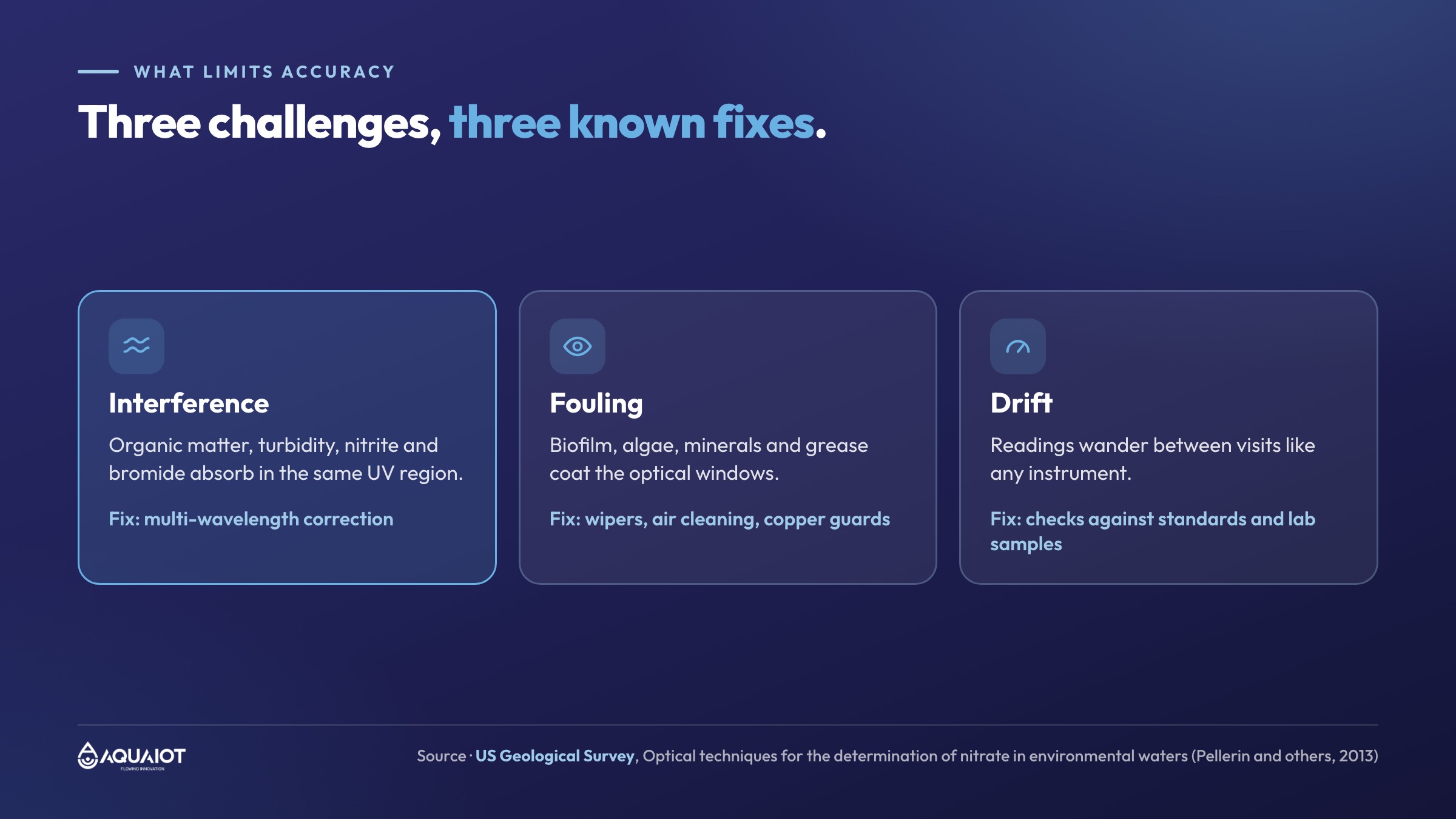
Mostly the water it sits in. The USGS guidelines identify three practical challenges.
Interference. Dissolved organic matter, turbidity, nitrite and bromide all absorb in the same UV region as nitrate. Sensors designed for clear waters and sensors designed for wastewater handle this differently, and multi-wavelength instruments that correct for turbidity and organic matter perform better in real, variable water.
Fouling. Anything that coats the optical windows, such as biofilm, algae, mineral deposits or grease, reduces the light reaching the detector and makes nitrate appear higher than it is. The USGS describes passive defences such as copper guards and active ones such as mechanical wipers and compressed air cleaning, and recommends sensors with integrated wipers where biofouling is high or site visits are infrequent.
Drift and calibration. Like any instrument, an optical sensor needs checking. The USGS sets out routines for verifying sensors against standards and laboratory samples, and for correcting data for fouling and drift between visits.
The practical lesson is to match the sensor to the water, keep the optics clean, and check the readings against laboratory samples on a schedule.
How do you choose and install an optical nitrate sensor?
Match the instrument to the water first. The USGS guidelines include a practical selection table that links water conditions to sensor design, and its advice translates directly to UK sites:
- Very turbid water, above about 500 NTU, calls for a shorter optical path, under 10 millimetres, or a filtered flow path.
- High dissolved organic carbon, above about 5 to 10 milligrams per litre, calls for an instrument that measures the full UV spectrum. Above about 30 mg/l, the USGS suggests a full spectrum instrument with a shorter path as well.
- High nitrate, above about 20 milligrams per litre as nitrogen, also suits a shorter path, while a low detection limit, below about 0.5 mg/l as nitrogen, needs a longer path of 10 mm or more.
- High fouling risk or infrequent visits, for example sites visited less often than every three to four weeks, call for instruments with integrated wipers.
Mounting matters too. The USGS notes that manufacturers typically recommend mounting instruments horizontally in the water column with the measuring gap open vertically in the flow, which reduces the build-up of bubbles and sediment on the optical windows, and that corrosion resistant brackets protect the housing and cables. It describes deployments in pipes, cages, pumped chambers and on buoys, depending on the site.
Finally, plan the data route. The USGS observes that digital outputs such as RS-485 are generally preferable to analogue signals, because analogue data cannot be routed over long cable runs and must be converted before it can be sent by telemetry. A sensor that feeds a controller over RS-485 and Modbus, and from there a cloud platform, keeps the reading intact from the probe to the dashboard.
What does the SPS-M-Lxx measure?
The SPS-M-Lxx Multi-Wavelength Spectrum Water Quality Sensor is based on the ultraviolet absorption spectroscopy principle and is designed to measure organic matter and nitrate nitrogen concentrations in water. It includes an advanced turbidity compensation function, which improves measurement accuracy on real water samples where particles would otherwise skew the reading.
Compared with conventional chemical detection methods, the sensor offers high reliability, no chemical reagents and therefore no chemical waste, and real-time, delay-free monitoring. Paired with an MC series data collector and the cloud platform, it provides remote, real-time data as well as remote operation and maintenance.
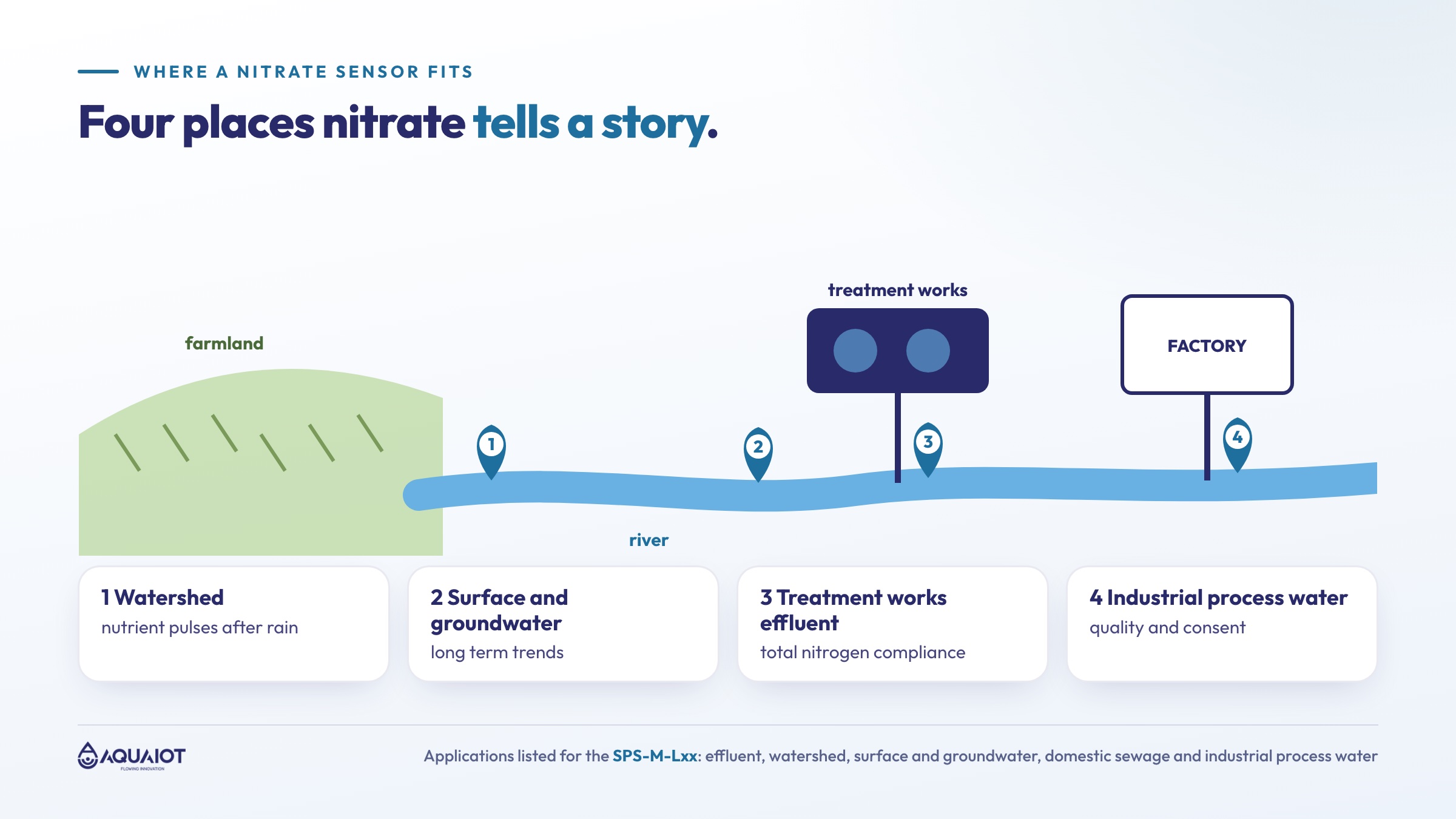
AQUAIOT lists four main applications for it:
- Effluent monitoring at sewage treatment works, tracking nitrate nitrogen and organic load leaving the works.
- Watershed, surface water and groundwater surveillance, following nutrient levels in rivers, lakes and aquifers.
- Urban domestic sewage monitoring, understanding the load arriving at treatment.
- Industrial process water monitoring, where nitrate or organics affect product quality or discharge consent.
The full AQUAIOT nutrient and water quality stack
A nitrate reading is most useful alongside the parameters that explain it and the platform that turns it into action.
Nitrate and organics
The SPS-M-Lxx measures nitrate nitrogen and organic matter in one optical probe. For organic carbon in drinking water, our guide to the TOC sensor for drinking water covers the SPS-M-SCx, and for wastewater organics our post on the UV COD sensor covers optical COD.
The full spectrum
Where a site needs the richest optical picture, the full-spectrum UV-Vis sensor range measures across the whole ultraviolet and visible band, which supports several parameters from a single instrument.
Ammonia and the rest of the nitrogen cycle
Nitrate is one part of nitrogen in water. Our explainer on ammonia monitoring in wastewater covers the form that treatment works convert into nitrate.
Data and alarms
The AQUAIOT Cloud brings the readings into role based dashboards with trendlines, alarms, analytics and exports, and supports RS485 and Modbus on site and APIs for SCADA and analytics platforms. Our water quality monitoring service covers survey, installation and commissioning.
Frequently asked questions
How does a nitrate sensor work?
Most continuous nitrate sensors are optical. They shine ultraviolet light through the water and measure how much is absorbed near 220 nanometres, where nitrate absorbs strongly. Multi-wavelength sensors also measure the background absorbance from organic matter and turbidity so it can be removed from the nitrate reading.
What is the legal limit for nitrate in UK drinking water?
Under the Water Supply (Water Quality) Regulations 2016, the limit for nitrate is 50 milligrams per litre, measured as nitrate at consumers’ taps. That is about 11.3 milligrams per litre when expressed as nitrate nitrogen.
What is the difference between nitrate and nitrate nitrogen?
They are two ways of reporting the same substance. Nitrate as NO3 counts the whole ion. Nitrate nitrogen counts only the nitrogen in it, which is about 22.6% of the mass. To convert nitrate nitrogen to nitrate, multiply by about 4.43.
Do optical nitrate sensors need reagents?
No. UV nitrate sensors measure light absorption directly, so they need no chemical reagents and produce no chemical waste. Wet chemical nitrate analysers, by contrast, react the sample with reagents and generate waste.
What interferes with UV nitrate measurement?
Dissolved organic matter, turbidity, nitrite and bromide all absorb ultraviolet light in the same region as nitrate. Fouling of the optical windows also reduces light. Multi-wavelength correction, wipers or air cleaning, and regular checks against laboratory samples keep readings reliable.
Where should a nitrate sensor be installed?
Where the answer matters most: at a discharge point for compliance, at the inlet or outlet of a treatment stage for process control, or in a watercourse to follow nutrient loads. Mount it in steady flow, horizontally with the measuring gap open vertically, so bubbles and sediment do not settle on the optics.
How often does an optical nitrate sensor need cleaning?
It depends on the water. In clean water with low fouling, periodic checks may be enough. In wastewater, rivers in summer or any water with high biofouling, the USGS recommends instruments with integrated wipers, particularly where site visits are less frequent than every three to four weeks.
Where to start
Start with the question you need nitrate to answer. Is it compliance at a discharge point, the performance of a treatment stage, or the nutrient load in a watercourse next to your site? Each one points to a different location and a different check schedule.
Then put one sensor where the answer matters most and run it alongside your laboratory samples for a season. The comparison builds confidence in the data, and the continuous record almost always shows peaks the samples never saw.
Speak to an AQUAIOT engineer about continuous nitrate monitoring with the SPS-M-Lxx on your effluent, process water or watercourse.