



Clamp-On, Electromagnetic or Insertion: Which Flow Meter Fits a Pipe You Cannot Cut?
TL;DR: Three kinds of flow meter suit water pipes that are already in service. An electromagnetic meter is the most accurate when it is installed well, but it goes inside the pipe, so the pipe has to be cut and isolated. An insertion meter goes in through a single tapping. A clamp-on ultrasonic meter never touches the water at all. The right choice depends less on the meter than on the pipe, the straight run in front of it, and whether the site can stop.
Last updated: 23 September 2026
On this page
Key takeaways
- An electromagnetic flow meter measures the voltage created as a conductive liquid moves through a magnetic field, so it only works on liquids that conduct electricity.
- An insertion flow meter measures velocity at one point and infers the average, so it depends on a steady, fully developed flow profile.
- A clamp-on ultrasonic flow meter times sound pulses sent with and against the flow from outside the pipe, with no cutting and no shutdown.
- Environment Agency guidance asks for at least 5 straight pipe diameters upstream of an electromagnetic sensor and 2 downstream.
- A partly closed gate valve directly upstream can put a flow reading out by up to 18%, according to the same guidance.
- New permitted installations must leave at least 450 mm, or 1.5 pipe diameters, of exposed pipe so a clamp-on flow meter can check them.
What types of flow meter suit an existing water pipe?
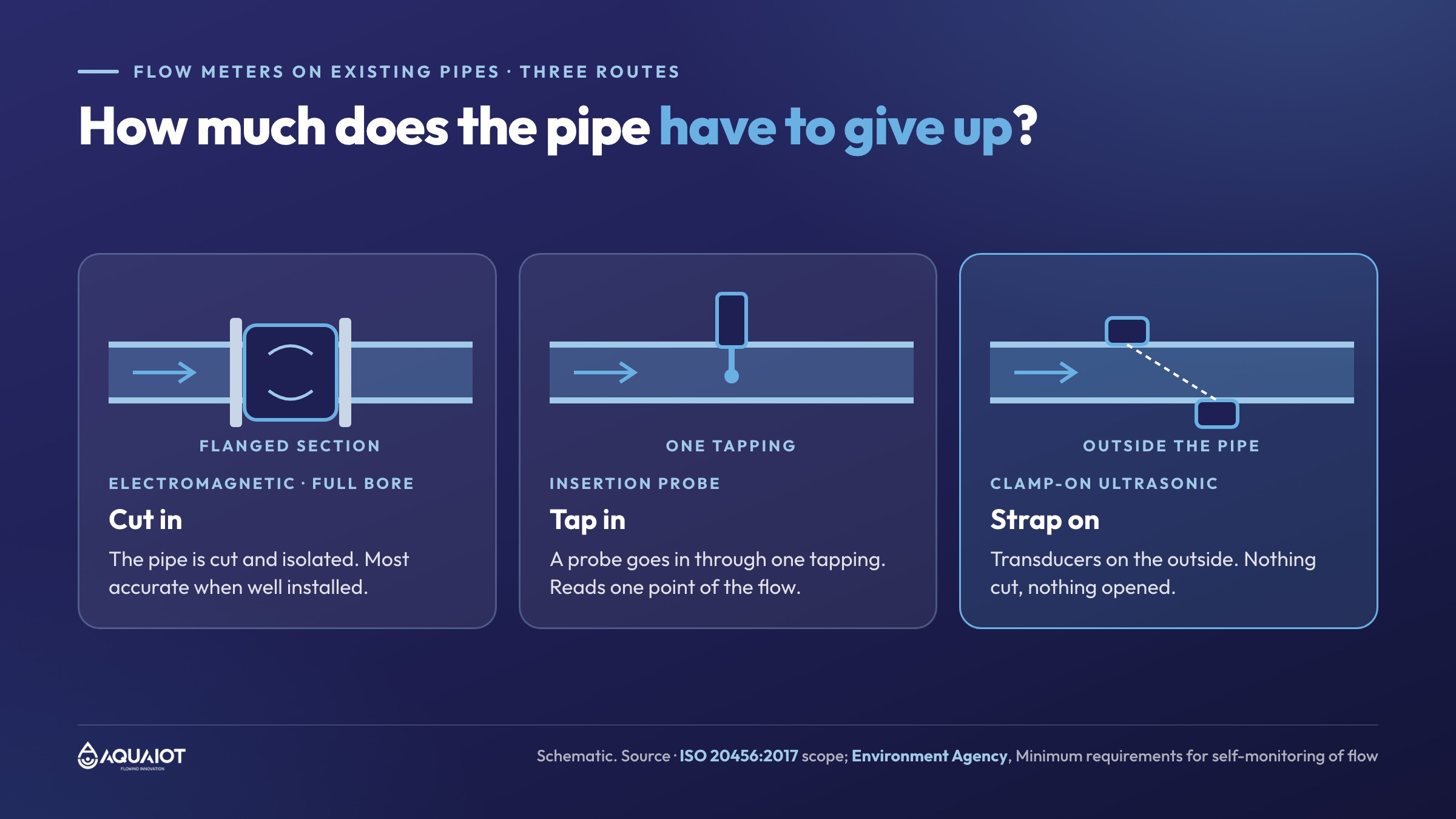
Three types of flow meter suit a water pipe that is already in service: electromagnetic meters, which sit inside the pipe as a full-bore section; insertion meters, which push a probe through one tapping; and clamp-on ultrasonic meters, which strap to the outside. They differ most in what the pipe must give up to take them.
That difference is what decides most jobs. On a new build, cutting a meter into the line costs little. On a hospital cold water main, a plant room serving a data hall or a school’s incoming supply, an isolation means a shutdown, a permit to work, a drain down and a risk of contamination when the system is refilled. The more the site depends on the water, the more the installation method matters.
Mechanical meters, the turbine and positive displacement types used for billing, are a fourth family. They are cut into the pipe like an electromagnetic meter and add moving parts that wear. They are not covered here because the question most estates teams ask is a different one: how do we see the flow in a pipe we already have?
Electromagnetic vs insertion vs clamp-on flow meters compared
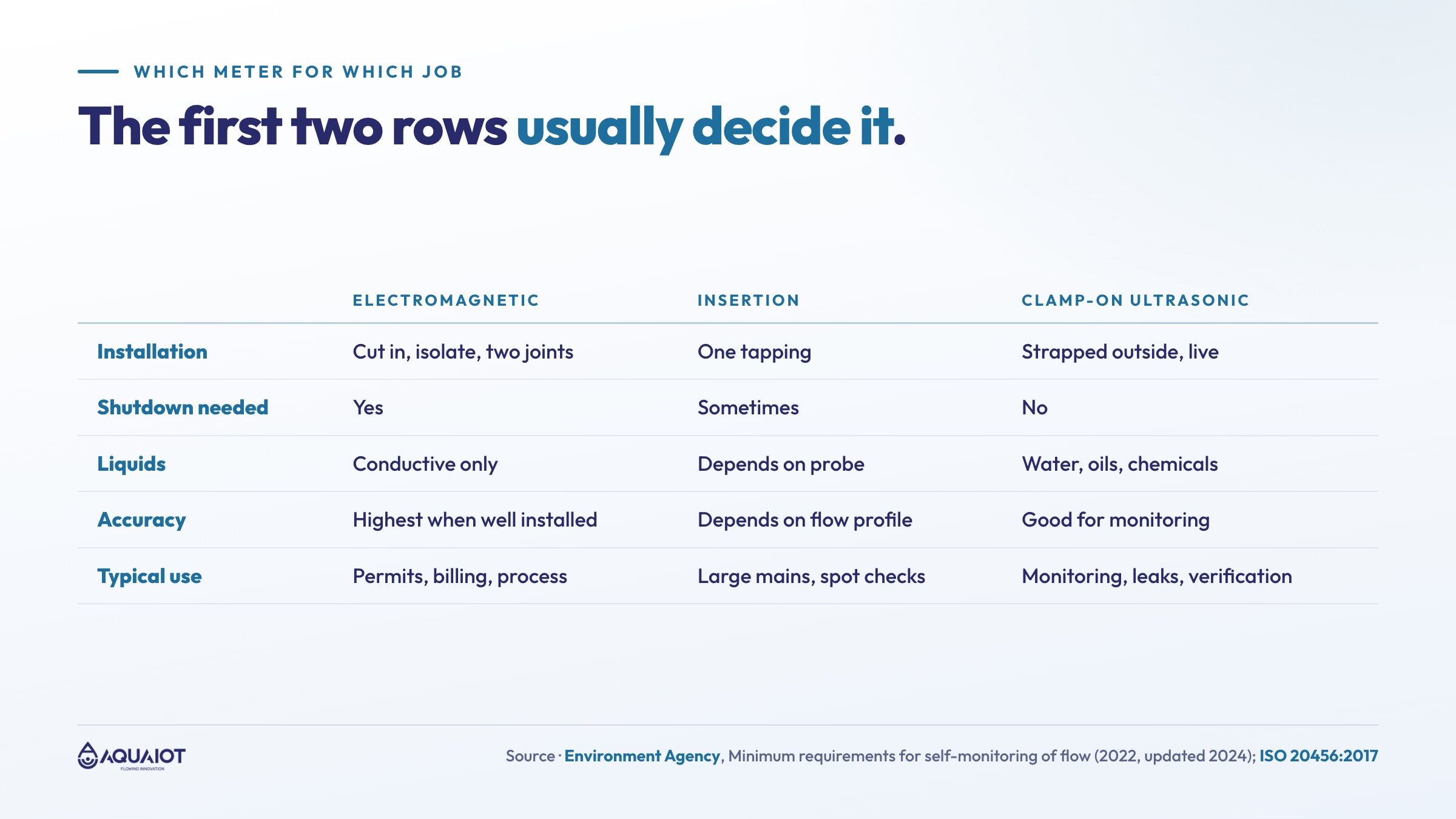
The three types trade accuracy against disruption. An electromagnetic meter is the most accurate but needs the pipe cut and isolated, an insertion meter needs one tapping, and a clamp-on ultrasonic meter fits a live pipe with no cutting at all. The table sets out the differences covered in the sections below.
| Electromagnetic (full bore) | Insertion | Clamp-on ultrasonic | |
|---|---|---|---|
| How it measures | Voltage induced as a conductive liquid crosses a magnetic field | Velocity at one point, scaled up to the whole pipe | Difference in travel time of sound pulses sent with and against the flow |
| What the pipe gives up | The line is cut, isolated and joined twice | One tapping | Nothing: the pipe stays live |
| Liquids | Conductive liquids only, so not oils | Any liquid with a steady, fully developed flow | Water, oils and chemicals |
| Straight pipe and set-up | At least 5 diameters upstream and 2 downstream (Environment Agency) | Needs a steady profile; any error in the internal diameter feeds straight into the result | Outside diameter, wall thickness and material entered at set-up; heavy scale weakens the signal |
| Accuracy | Usually the most accurate when well installed | Reference method with considerably more uncertainty | Reference method with considerably more uncertainty |
| Best fit | Permitted discharges that need a certified meter | Large pipes where a tapping exists | Pipes that cannot be shut down, monitoring and leak detection |
| Standard | ISO 20456:2017 | ISO 7145 (1982) | BS 8452:2010 |
How does an electromagnetic flow meter work?
An electromagnetic flow meter works by electromagnetic induction. Coils create a magnetic field across the pipe, and a conductive liquid moving through that field generates a small voltage proportional to its velocity. Electrodes pick the voltage up. There is nothing in the flow path to wear out or block.
The catch is in the conditions. The magnetic flow meter needs a conducting fluid, such as water containing dissolved ions, and an insulating surface inside the meter tube, such as a rubber-lined steel section. Mains water, effluent and most process water conduct well enough. Oils and hydrocarbons do not.
The international guidance for these meters, ISO 20456:2017, covers conductive liquids in a closed conduit running full. It specifically excludes insertion-type meters and pipes running partly full, which is a reminder that a full-bore electromagnetic meter is a section of pipe in its own right. Fitting one means cutting the line, isolating the supply and making two flanged or coupled joints.
Where it is installed matters as much as what it is. The Environment Agency’s minimum requirements for self-monitoring of flow say that, ideally, the sensor should sit in a straight length of pipe of the same nominal diameter, with at least 5 straight diameters upstream and 2 downstream.
How does an insertion flow meter work?
An insertion flow meter measures the velocity of the water at one point in the pipe, or along one line across it, and calculates the total flow from that reading, the internal diameter and an assumed velocity profile. It goes in through a single tapping, so it disturbs the pipe far less than a full-bore meter and suits large diameters.
The assumption is the weakness. The international method for measuring flow from the velocity at a single point, set out in ISO 7145 in 1982, assumes steady, fully developed flow in a full circular pipe. Bends, valves and pumps upstream distort the profile, and an error in the assumed internal diameter feeds straight into the answer, because the flow is velocity multiplied by area.
Insertion meters still have a clear place. They are common where the pipe is too large for an affordable full-bore meter and a tapping already exists, or can be made. They are also one of the alternative methods the Environment Agency lists for checking an installed electromagnetic meter, alongside a clamp-on ultrasonic meter, with a caveat: the uncertainty of these reference methods may be considerably more than the manufacturer’s specification for the meter being checked.
How does a clamp-on ultrasonic flow meter work?
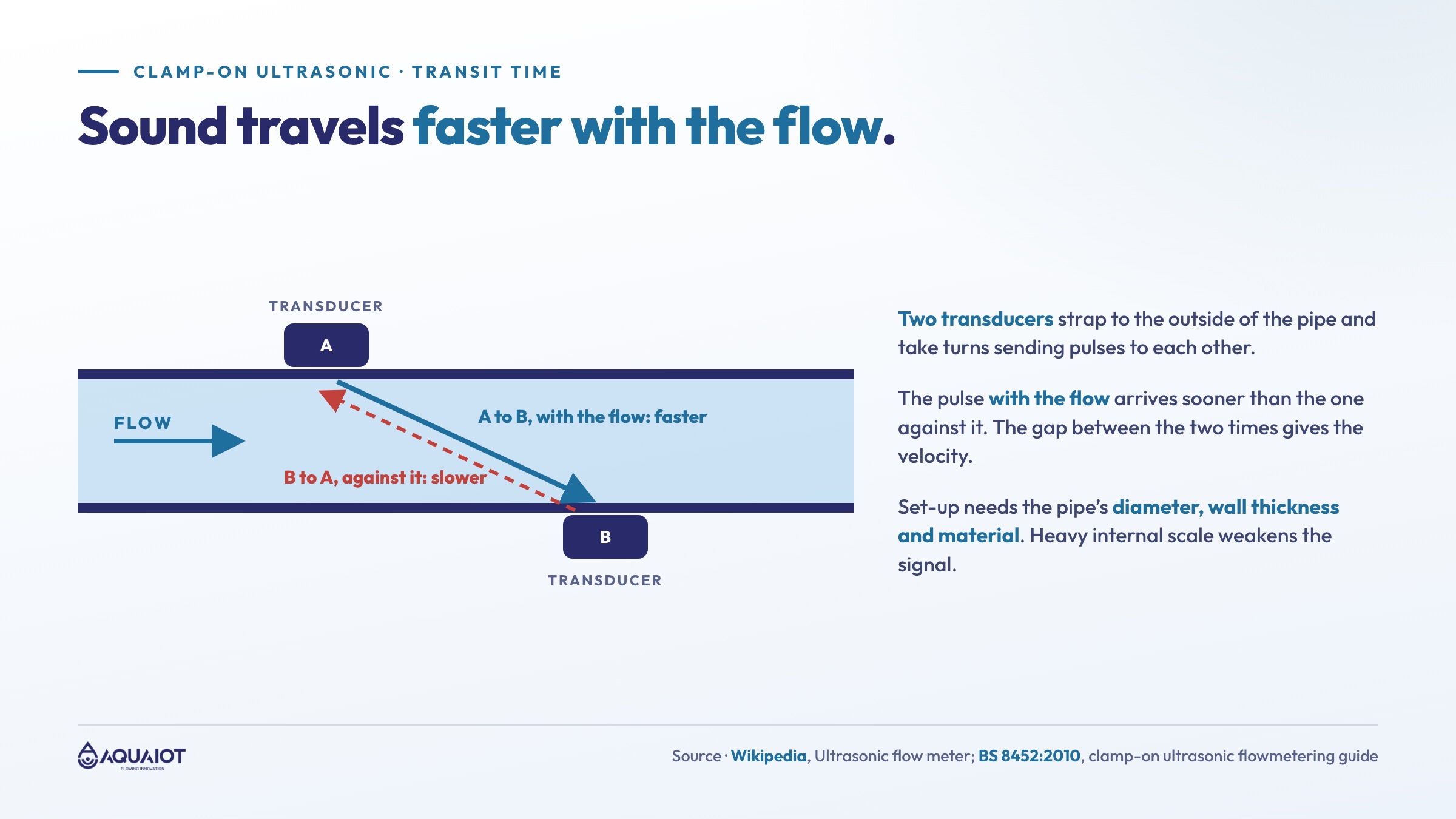
A clamp-on ultrasonic flow meter straps two transducers to the outside of the pipe. They send sound pulses through the pipe wall, with the flow and against it, and the meter works out the velocity from the difference in travel time. Nothing is cut, tapped or opened, so the pipe stays live throughout the installation.
The principle is the same as in wetted ultrasonic meters. Ultrasonic flow meters measure the difference between the transit times of pulses travelling with and against the flow, and come in in-line and clamp-on versions. The clamp-on version has to know the pipe it is looking through: outside diameter, wall thickness and material are entered at set-up, and heavy scale or corrosion inside the pipe can weaken the signal. BS 8452:2010 is the British guide to using clamp-on ultrasonic techniques on closed pipes.
Regulators already rely on it for one specific job. The Environment Agency’s minimum requirements say new permitted flow installations must have enough exposed pipe to install a clamp-on flow meter for verification, with a recommended minimum of the greater of 450 mm or 1.5 pipe diameters. Our guide to the 2026 MCERTS flowmeter changes covers that scheme in detail.
Which flow meter is the most accurate?
A well-installed full-bore electromagnetic meter is usually the most accurate of the three, and the Environment Agency notes that insertion and clamp-on reference methods may carry considerably more uncertainty. In practice, installation errors often outweigh the difference between meters, so the straight pipe run and the valves near the meter matter as much as the meter’s specification.
The same guidance puts numbers on those installation effects for electromagnetic meters. A single or double bend within 5 diameters upstream or 2 downstream adds 1% to 2% of uncertainty. A valve in the same zone adds 2% to 18%, with the worst case a gate valve half open. A pump within 20 diameters upstream also adds 2% to 18%, and sensors should never go on the suction side of a pump.
For permitted effluent discharges, the target is explicit: the total daily volume must be measured to within plus or minus 8% at 95% confidence, for each discharge point. That is the kind of requirement where a certified, full-bore meter earns its cost.
Most monitoring on estates is a different job. Spotting a leak at 3am, comparing a building’s night flow with last month’s, or checking whether a sub-meter agrees with the incomer does not need billing accuracy. It needs a steady reading, on the right pipe, every few minutes, without shutting anything down.
How do you choose a flow meter for an existing pipe?
Choose a flow meter by answering five questions in order: can the supply be isolated, does a permit or contract demand a certified meter, how big is the pipe, does the liquid conduct, and how much straight pipe is there. The first two answers usually decide the type before the specification sheet is opened.
- Can the supply be shut down? If not, a full-bore meter is out and the choice is between insertion and clamp-on.
- Is the reading for a permit or a bill? A permitted discharge needs an MCERTS certified meter; a bill needs an approved meter. Monitoring and leak detection need neither.
- How big is the pipe? Very large pipes favour insertion or clamp-on on cost; small estate pipework suits clamp-on or a small full-bore section.
- Does the liquid conduct? Electromagnetic meters need a conductive liquid. Ultrasonic meters measure oils and chemicals as well as water.
- Where is the straight run? Find the longest straight length, away from valves and pumps, and put the meter there, whatever the type.
Where does continuous flow data pay off?
Continuous flow data pays off wherever a volume changes when nobody is looking: overnight, at weekends, in empty buildings and on supply pipes buried between them. A meter that logs every few minutes shows the baseline, and any rise in that baseline is water going somewhere it should not.
Night flow is the clearest example. When a site is closed, usage stops and leaks do not, so a floor that never drops to zero points to a leak or a running fitting. Our guide to night flow analysis for leak detection walks through reading that trace.
The same data supports water sub-metering and tenant recharging, checks that a bulk meter and the sum of its sub-meters agree, and gives an independent check on a permitted meter from outside the pipe.
The full AQUAIOT flow monitoring capability stack
Each layer below is chosen for pipes that are already in service and cannot easily stop.
Clamp-on metering on estate pipework
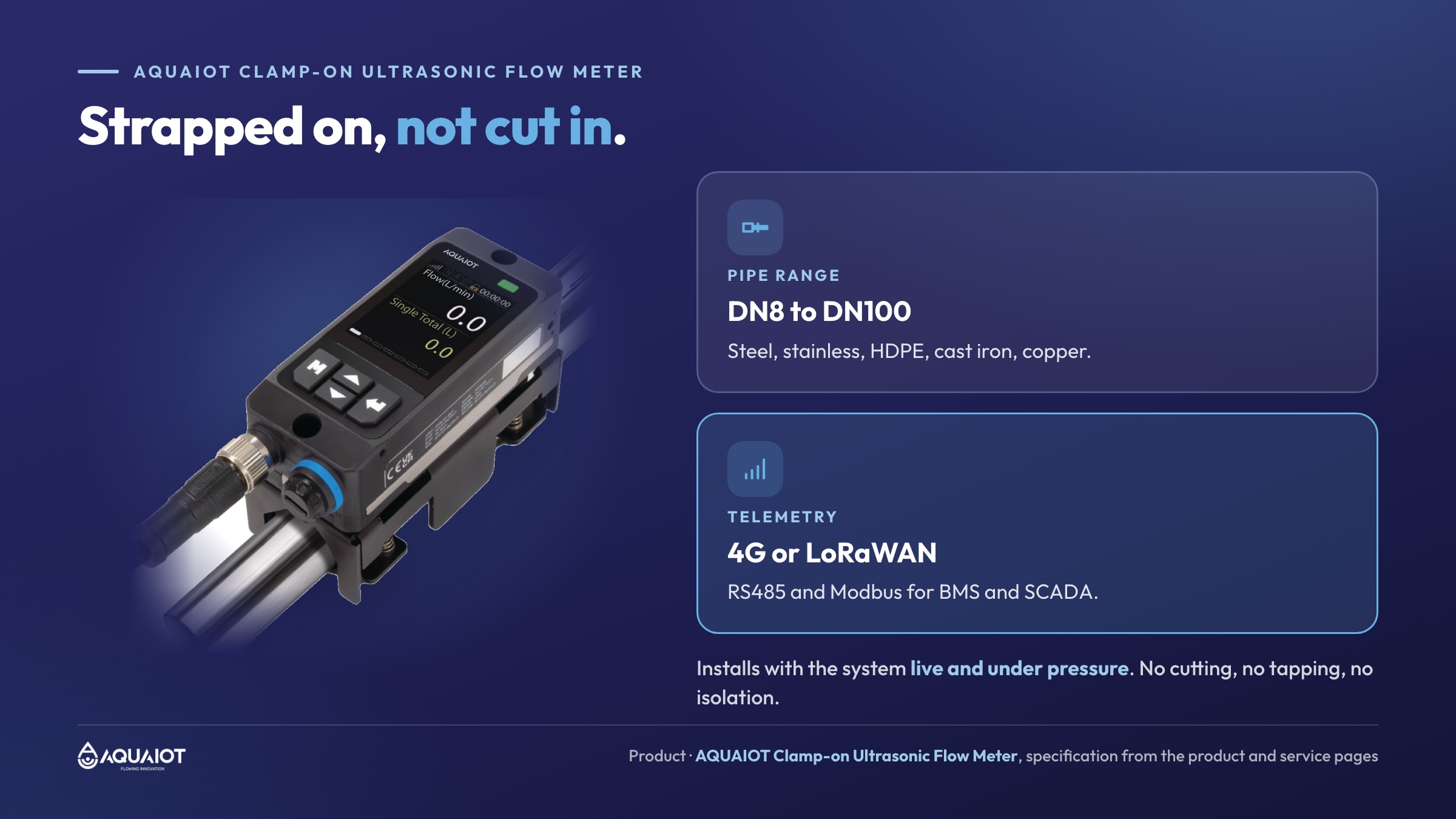
The AQUAIOT Clamp-on Ultrasonic Flow Meter covers pipes from DN8 to DN100 in steel, stainless steel, HDPE, cast iron, copper and other common materials. It uses transit-time measurement and installs with the system live and under pressure. It is built for monitoring, water balance and leak detection rather than custody transfer.
Larger mains and plant loops
The wider range on our clamp-on flow monitoring service runs from DN25 up to DN5000, with accuracy from plus or minus 1% on entry models to plus or minus 0.2% to 0.5% on the high accuracy version used for commissioning checks.
Open channels and chambers
Where flow runs in an open channel rather than a full pipe, it is usually worked out from the water level over a weir or flume. The AQUAIOT Radar measures level without contact: 60 GHz radar, accurate to within 2 mm, and reliable in enclosed chambers.
Telemetry and integration
Meters report over 4G or LoRaWAN to the AQUAIOT Cloud, with RS485 and Modbus for on-site BMS and SCADA connections and open APIs for CAFM and analytics tools.
Alerts that reach the right person
Thresholds on flow, night-time baselines and continuous-flow rules raise alerts by SMS, email or app, routed by role, so a burst on a Sunday reaches someone who can act on it.
Frequently asked questions
Can you fit a flow meter without cutting the pipe?
Yes. A clamp-on ultrasonic flow meter straps two transducers to the outside of the pipe and measures through the wall, so nothing is cut, tapped or opened and the system stays live. An insertion meter needs one tapping. A full-bore electromagnetic meter needs the pipe cut and isolated.
Do electromagnetic flow meters work on all liquids?
No. An electromagnetic flow meter needs a conducting liquid, such as water containing dissolved ions, because it measures the voltage the moving liquid generates in a magnetic field. Mains water, effluent and most process water conduct well enough. Oils and hydrocarbons do not, so ultrasonic meters are used for them instead.
How accurate is a clamp-on flow meter?
A clamp-on ultrasonic meter is accurate enough for monitoring, water balance and leak detection, and the AQUAIOT range runs from plus or minus 1% to plus or minus 0.2% to 0.5% depending on the model. The Environment Agency notes that clamp-on reference methods may carry more uncertainty than a certified full-bore meter, so they are not used for billing.
How much straight pipe does a flow meter need?
Environment Agency guidance asks for at least 5 straight pipe diameters upstream of an electromagnetic sensor and 2 downstream, of the same nominal diameter. Valves and pumps are the worst disturbances: a partly closed gate valve directly upstream can cause an error of up to 18%. Whatever the meter type, fit it on the longest straight run available.
Can a clamp-on meter be used for MCERTS?
For the permitted measurement itself, the Environment Agency expects a flowmeter certified under its MCERTS flowmeter scheme, revised on 24 August 2026 to adopt BS EN 17694:2023. Clamp-on meters have a defined role alongside it: new installations must leave at least 450 mm, or 1.5 pipe diameters, of exposed pipe so a clamp-on meter can be fitted to verify the permanent one.
Where to start
Walk the pipe before you choose the meter. Note the size, the material, the nearest valves and pumps, and the longest straight run, and ask whether the supply can ever be stopped. Those answers narrow the choice to one or two types before anyone talks about accuracy.
If you have a pipe you need to see inside without shutting it down, tell us about the site and a UK engineer will come back within one working day. For the wider picture, see our guide to non-invasive flow monitoring.